
Labradorite Meaning: Spiritual Symbolism, Properties, and Uses
Labradorite meaning is commonly associated with transformation, intuition, protection, and hidden beauty in modern crystal traditions. Scientifically, labradorite is a plagioclase feldspar mineral known for its iridescent flash, called labradorescence. Its blue, green, and golden colors make it popular in jewelry and spiritual practices, while its geological identity explains the optical effect.
If you’ve ever held a gray stone that suddenly reveals brilliant color when you tilt it toward the light, you understand why labradorite feels special. This guide explores its spiritual symbolism, mineral properties, gemstone uses, and responsible interpretations so you can appreciate the stone without confusing tradition with established science.
Labradorite Meaning, Properties and Overview
Labradorite meaning centers on transformation and inner discovery in many contemporary crystal practices. The stone is often associated with intuition, spiritual awareness, personal growth, and protection. These are symbolic or traditional interpretations, not scientifically demonstrated powers of the mineral. Its physical identity is plagioclase feldspar, with an iridescent effect known as labradorescence.
The contrast between a dark base and sudden flashes of color inspires the stone’s symbolism. Many enthusiasts interpret it as a reminder that something valuable can remain hidden until circumstances change. This metaphor can make labradorite meaningful during personal transitions, creative work, meditation, or moments of self-reflection.
Labradorite Meaning in Simple Terms
In simple terms, labradorite represents change, perspective, and hidden potential within modern spiritual symbolism. Its shifting appearance makes it a popular reminder to look beyond first impressions. Although people may use it as a personal focus during reflection, there is no established evidence that the stone itself produces spiritual abilities or physical healing.
What Causes Labradorite Meaning and Labradorescence?
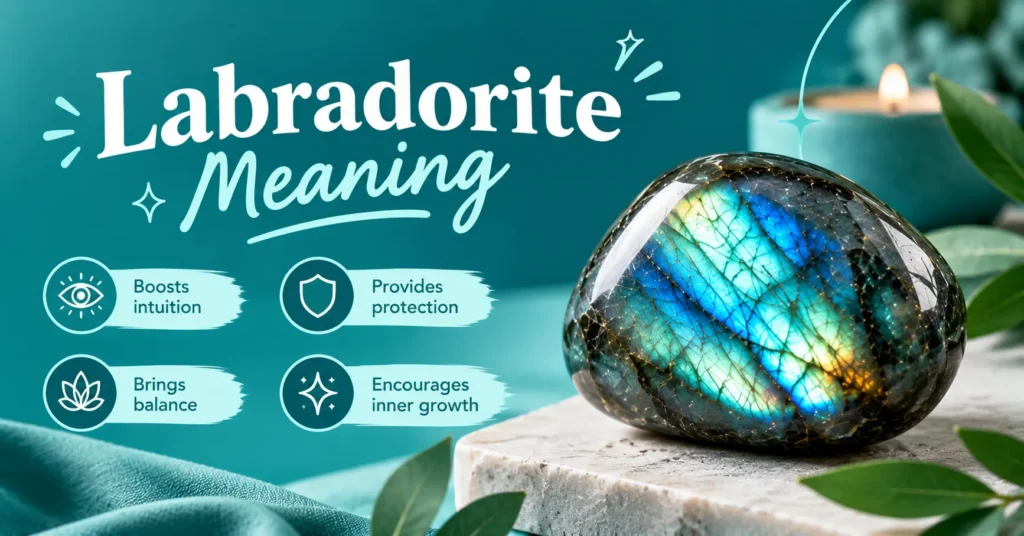
Labradorescence is the optical phenomenon that gives many labradorite specimens their recognizable blue, green, gold, orange, or other color flashes. Light interacts with internal structures within the mineral, creating interference effects that change as the stone or viewing angle changes. The color is not simply a surface coating or ordinary pigment.
Geology.com explains that light interacts with twinning surfaces inside labradorite, while modern mineralogical descriptions discuss fine internal structures and optical interference. This distinction matters because the flash is a geological property, even though crystal traditions give it symbolic meanings such as awakening, mystery, and transformation.
Why Labradorite Flashes Different Colors
The color you see depends on internal structure, lighting, and viewing angle. One piece may display electric blue, while another shows green, gold, or several shades. Not every labradorite specimen displays strong labradorescence, and the intensity of its flash varies between pieces.
Physical Properties of Labradorite Meaning
Labradorite belongs to the plagioclase feldspar series and commonly occurs in igneous rocks, including basalt, gabbro, norite, and anorthosite. Its reported Mohs hardness is approximately 6 to 6.5, and it has characteristic cleavage that affects how it should be cut and handled as a gemstone.
| Property | Labradorite |
| Mineral group | Plagioclase feldspar |
| Crystal system | Triclinic |
| Mohs hardness | Approximately 6–6.5 |
| Specific gravity | Approximately 2.68–2.72 |
| Optical effect | Labradorescence |
| Typical body color | Gray, white, or clear |
| Common flash colors | Blue, green, gold, orange, and red |
The body color and visible flash should not be confused. A gray stone may reveal vivid color under the right lighting, while some labradorite specimens have different optical effects or limited visible labradorescence. Physical identification can require more than a photograph or appearance alone.
Labradorite Meaning and Traditional Healing Properties
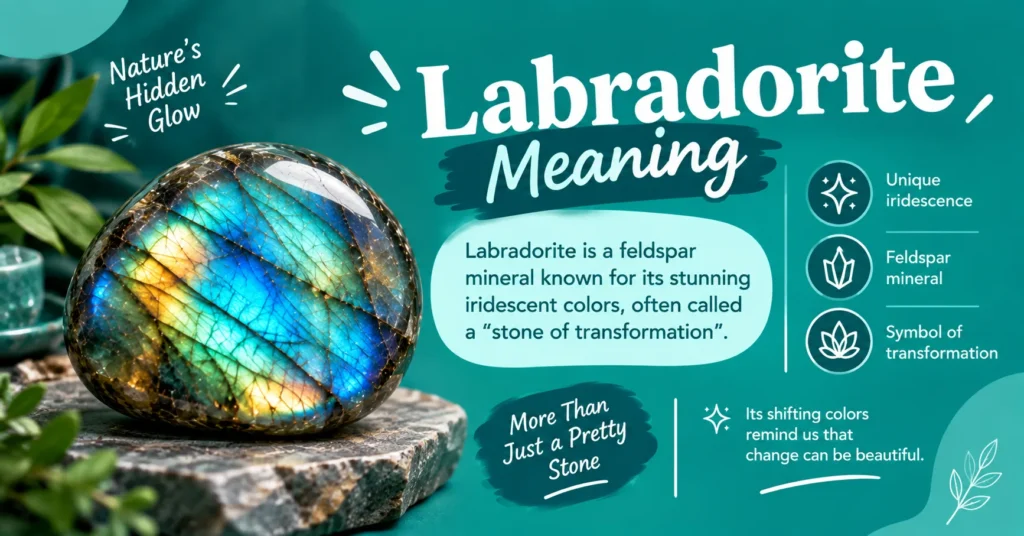
In crystal-healing traditions, labradorite is often associated with emotional balance, intuition, protection, and navigating change. Some practitioners use it during meditation or as a symbolic object when processing difficult experiences. These practices may hold personal or cultural meaning, but they should not be represented as scientifically established medical treatments.
A grounded approach is to distinguish the stone’s symbolic role from health claims. Holding a smooth crystal, focusing on its colors, or incorporating it into a reflective routine may help someone pause and concentrate. That possible benefit does not demonstrate that labradorite treats anxiety, illness, hormonal problems, or other medical conditions.
Emotional and Spiritual Labradorite Meaning
The spiritual symbolism of labradorite often includes self-discovery, inner vision, and protection from negative energy. These ideas come from contemporary metaphysical traditions. There is no established scientific evidence that labradorite creates an aura shield, increases psychic perception, or changes the body’s biological functions.
Labradorite Meaning and Intuition
Some crystal practitioners connect labradorite with intuition and the Third Eye Chakra. A person may use the stone as a reminder to reflect, consider choices, or slow down before making decisions. That personal practice is different from claiming that the mineral directly increases intuitive or psychic abilities.
Critical Terminology Note: Labradorite Meaning and Spectrolite
Spectrolite is a name used in the gemstone trade for exceptional Finnish labradorite material, particularly material associated with vivid, broad-spectrum color. However, trade terminology can vary, and not every colorful labradorite specimen should automatically be identified as Finnish spectrolite. Origin and material identification matter when discussing value or authenticity.
Another important distinction involves the term “black moonstone.” Some sellers use this label for dark labradorite, but trade names do not necessarily establish a mineral’s scientific identity. Buyers should ask for clear information about the stone, its treatment, and its reported origin rather than relying solely on a marketing name.
Labradorite as a Gemstone Meaning
Labradorite is used in jewelry, cabochons, polished specimens, and decorative objects. Its appeal comes from the combination of body color, surface polish, and directional color flash. Gemstone quality varies considerably, and the presence, intensity, and distribution of labradorescence influence how a finished stone looks.
Unlike highly durable gemstones such as sapphire, labradorite requires thoughtful handling because its hardness and cleavage make it vulnerable to scratches and impact. A beautiful specimen can be appropriate for jewelry, but its setting and intended use should take its physical properties into account.
| Use | Practical consideration |
| Pendant | Often suitable when protected from impact |
| Earrings | Can display color effectively |
| Ring | Requires additional care because of exposure to knocks |
| Cabochon | Common cut for directional labradorescence |
| Display specimen | Protect from drops and abrasion |
Cutting Labradorite Meaning
Labradorite is frequently cut into cabochons because its color flash depends on viewing direction and internal structure. A cutter studies the rough material and orients it to maximize the visible effect. The goal is to produce an attractive face-up appearance rather than simply cutting the stone into a standard shape.
This is why two pieces of labradorite of similar size may look very different. One may show a broad blue flash across its surface, while another displays a narrow green or gold area. The cutting process, natural structure, and lighting all contribute to the final appearance.
Geologic Occurrence of Labradorite Meaning
Labradorite occurs primarily in igneous geological settings and is associated with rocks such as basalt, gabbro, norite, and anorthosite. It can also occur in metamorphic rocks derived from labradorite-bearing igneous materials and in sediments formed through weathering and erosion. Its geological context helps explain why specimens from different locations can vary in appearance.
From a mineralogical perspective, labradorite is not defined by its spiritual associations. It is a naturally occurring feldspar mineral whose composition, crystal structure, and optical behavior can be studied through geological and gemological methods. This scientific foundation gives the stone a distinct identity apart from the meanings people may assign to it.
Notable Labradorite Localities and Meaning
Labradorite is named after the Labrador region of Canada, where it was identified from material associated with the Isle of Paul near Nain. Significant material has also been reported from Finland, Madagascar, Russia, India, and other locations. Different deposits can produce variations in color, transparency, optical effects, and suitability for gemstone use.
Finland is particularly associated with spectrolite, while Madagascar is known for gray to dark material with attractive labradorescence. Oregon also produces feldspar materials sold as Oregon Sunstone, some of which are labradorite. Locality information is useful for understanding a specimen, but a visual photograph alone cannot reliably establish geographic origin.
Conclusion
Labradorite meaning combines a fascinating scientific identity with rich symbolic associations in contemporary crystal traditions. As a plagioclase feldspar, it is known for labradorescence, distinctive internal structure, and use as a gemstone. In spiritual settings, people often connect it with transformation, intuition, and self-discovery.
The most useful way to appreciate labradorite is to keep both perspectives clear. You can enjoy its beauty, explore its cultural symbolism, and use it as a personal reflection object without treating unverified healing claims as medical facts. Its changing flashes offer a compelling reminder that appearance, perspective, and interpretation can all influence what we notice.
FAQs
Author

Ethan Carter is an SEO blogger specializing in internet slang, text abbreviations, and social media meanings. He creates clear, accurate, and reader-friendly content backed by thorough research. His goal is to help readers understand modern online language with reliable, easy-to-read guides.





2 Comments