20+SFW Meaning: What SFW Stands For and How It’s Actually Used
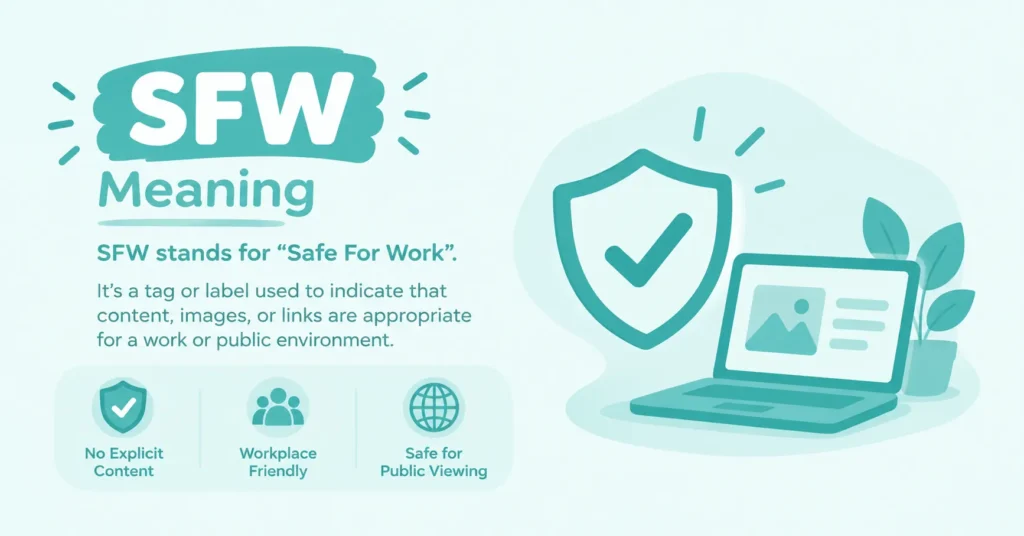
SFW meaning, put simply, is “safe for work” a quick internet label telling you content is fine to open at your desk, in class, or around family. If you’ve ever hesitated before clicking a link a friend sent, wondering whether it’s workplace-appropriate content or something you’d rather not have on-screen during a meeting, you already understand the pain point this abbreviation solves.
I’ve spent years watching internet slang evolve, and few labels have stuck around as reliably as this one. It’s a small piece of digital etiquette with a genuinely useful job: protecting you from an awkward moment. By the end of this guide, you’ll know exactly what SFW means, how it compares to NSFW, and how to use it correctly across social media, texting, and gaming communities.
What Is SFW Meaning?
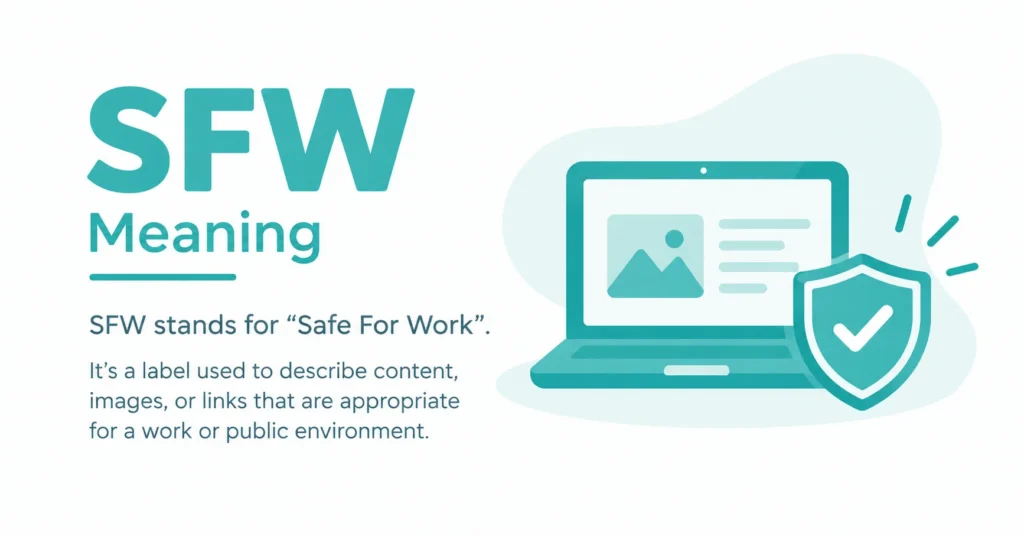
The core sfw meaning is straightforward: SFW = Safe For Work. It describes content a photo, video, meme, or link that’s appropriate content for a professional setting, without graphic violence, explicit material, or anything that could embarrass you at the office. It’s a content warning working in reverse, reassuring rather than cautioning.
Dictionary.com defines it almost identically: content “not containing any graphic violence, sexually explicit images, or any other potentially offensive material.” That consistency across a slang glossary and a formal dictionary entry tells you this isn’t loose internet culture jargon it’s a stable, dictionary-recognized term with one dominant, agreed-upon meaning.
Understanding the SFW Full Form
Breaking down the SFW full form makes the sfw meaning even clearer: “Safe” means harmless or appropriate, “For” signals suitability, and “Work” points to the professional setting where the standard applies. Put together, it simply flags content you can view without discomfort.
This full form matters because it explains why the label exists at all. It’s not about content being boring or low-quality it’s purely a workplace-appropriate content signal, letting you share things confidently across mixed-age groups, office chats, or public settings without a second thought.
SFW vs NSFW: Key Difference Explained
You can’t fully grasp sfw meaning without its opposite. NSFW (Not Safe For Work) marks content nudity, profanity, graphic violence, or other adult content that’s unsuitable for a professional setting. Wikipedia’s entry on the term frames SFW explicitly as the counterpart used “especially where the title might otherwise lead people to think content is NSFW.”
The distinction is genuinely simple once you see it side by side, which is why the comparison shows up in nearly every internet slang glossary:
| Term | Full Form | Meaning | Typical Use |
| SFW | Safe For Work | Appropriate, clean content | Professional/public sharing |
| NSFW | Not Safe For Work | Explicit or sensitive content | Adult material, flagged posts |
| NSFL | Not Safe For Life | Disturbing, graphic content | Extreme warning label |
History and Origin of the SFW Abbreviation
The sfw meaning we use today has real documented history. Language researchers trace NSFW (and by extension SFW) back to early-2000s message boards, possibly evolving from an earlier shorthand, “not for British school kids.” A definition of NSFW appeared on Urban Dictionary as early as 2003.
By 2011, the term was established enough for Oxford Dictionaries Online to add it; Merriam-Webster followed in 2015, and the Oxford English Dictionary in 2016. In 2009, someone even proposed NSFW as a standardized HTML5 content tag a sign of how mainstream this internet slang had already become.
Where Is SFW Meaning Commonly Used?
The sfw meaning shows up wherever people share links or media they didn’t create themselves. Reddit, X (Twitter), Patreon, and DeviantArt all built explicit SFW/NSFW tagging into their platforms, letting users and algorithms separate workplace-appropriate content from adult content automatically.
Beyond social platforms, you’ll see the label in group chats, forums, video descriptions, and gaming communities. Anywhere content quality and context vary wildly from post to post, an SFW tag gives readers a fast, reliable heads-up before they click anything.
SFW Meaning in Social Media Context
On Instagram, X, and TikTok, sfw meaning is used casually to flag clean, shareable content think “SFW meme” or “this video is totally SFW.” It’s a quick trust signal between creator and audience, especially in communities that also post adult content and need clear separation.
Content creators lean on this distinction deliberately: SFW-labeled posts tend to get wider distribution, better brand safety scores, and stronger platform approval, since advertisers and algorithms both favor clearly appropriate content over ambiguous or unlabeled material.
SFW Meaning in Text Messages
In everyday texting, sfw meaning gets used far more casually “Is this SFW?” or “Send me SFW content only” between friends or in group chats. It’s shorthand for “I trust you not to send me something embarrassing right now.”
This casual usage matters in mixed-age or professional group chats specifically. A quick “keep it SFW” sets the tone for an entire thread, letting people share jokes, links, or images without anyone worrying about crossing a line.
SFW Meaning in Gaming Communities
Gamers use sfw meaning constantly to label streams, clips, and server rules “SFW gameplay clip” or “this server is SFW friendly” are common phrasings. It reassures players, especially younger ones, that a community keeps its content appropriate.
Discord servers in particular often split channels explicitly into SFW and NSFW sections. That structural use of the term shows how deeply this internet slang has been absorbed into actual platform architecture, not just casual conversation.
SFW Meaning in Professional Environments
Inside actual workplaces, sfw meaning carries real professional weight. Employees sharing articles, memes, or videos in office Slack channels rely on the SFW standard to avoid offending colleagues or violating workplace content policy intentionally or not.
Getting this wrong has consequences beyond embarrassment; HR guidance frequently references NSFW browsing as a policy violation. Understanding and respecting the SFW/NSFW boundary is, in a small but real way, part of basic professional digital literacy today.
Why People Use SFW Labels
People rely on sfw meaning because it solves a genuine, recurring problem: nobody wants to accidentally open explicit material in front of a boss, a classroom, or a family member. The label does the filtering work before a single click happens.
It also builds trust. When someone consistently labels their content accurately, followers and coworkers learn to rely on that signal which is exactly why platforms increasingly reward creators who label consistently with better reach and fewer moderation flags.
Common Misunderstandings About SFW
A frequent mistake with sfw meaning is assuming SFW automatically means “boring” or purely educational it doesn’t. SFW simply means non-offensive; a funny meme, a movie trailer, and a news article can all be equally SFW despite being completely different in tone.
Another misunderstanding is treating the label as universal across every audience. What counts as workplace-appropriate content can shift slightly by industry, company culture, or country, so SFW is a helpful default not an absolute, context-free guarantee.
Examples of SFW Meaning in Real Life
Seeing sfw meaning in real sentences makes the concept click faster than any definition alone:
- “This video is SFW and family-friendly.”
- “Is this post SFW or NSFW?”
- “Keep it SFW for the school presentation.”
- “Despite what you may have heard, this is SFW.” (a phrasing dictionary sources cite directly from published journalism)
These examples show the same core idea working across completely different settings texting, social captions, and professional disclaimers.
Conclusion
The sfw meaning is small in size but genuinely useful in practice Safe For Work, a simple label that keeps online sharing comfortable, professional, and trustworthy. From Reddit threads to office Slack channels, understanding this one abbreviation helps you navigate digital spaces with a bit more confidence and a lot less risk of an awkward moment.
FAQs
Author

Ethan Carter is an SEO blogger specializing in internet slang, text abbreviations, and social media meanings. He creates clear, accurate, and reader-friendly content backed by thorough research. His goal is to help readers understand modern online language with reliable, easy-to-read guides.