Verbiage Meaning: Definition, Examples & Correct Usage
The verbiage meaning is usually connected with an excess of words or unnecessarily complicated language, but in American English, it can also simply mean the wording or style used to express something. That difference matters when you encounter terms such as wordiness, verbosity, diction, phrasing, language, and wording in a contract, email, article, or conversation.
If you’ve ever heard someone say, “Please change the verbiage,” and wondered whether they meant “change the wording” or “remove unnecessary words,” you’re not alone. As a language writer, I find this is where the word becomes genuinely interesting: its meaning depends heavily on context, tone, and whether the speaker is criticizing the language or simply identifying the words being used.
Explanation
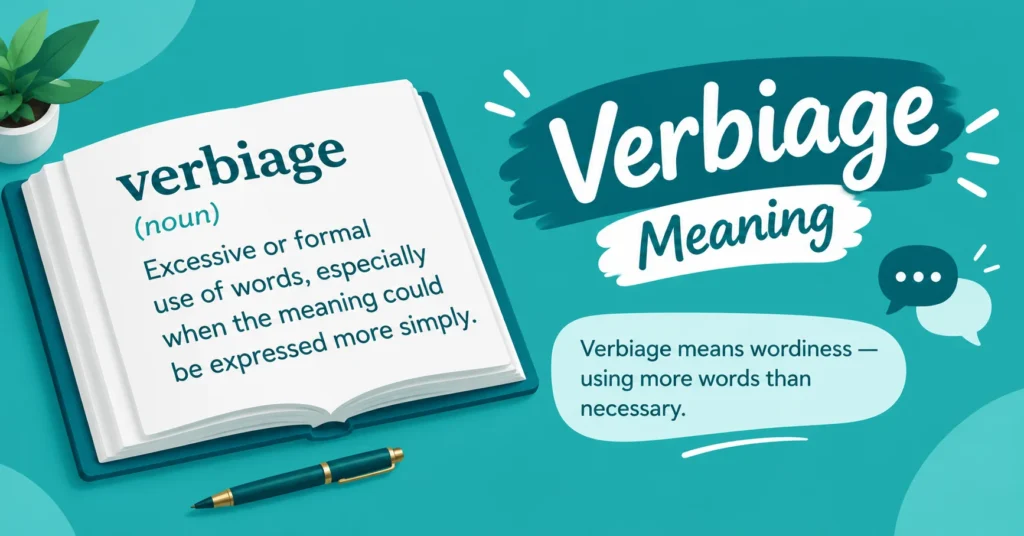
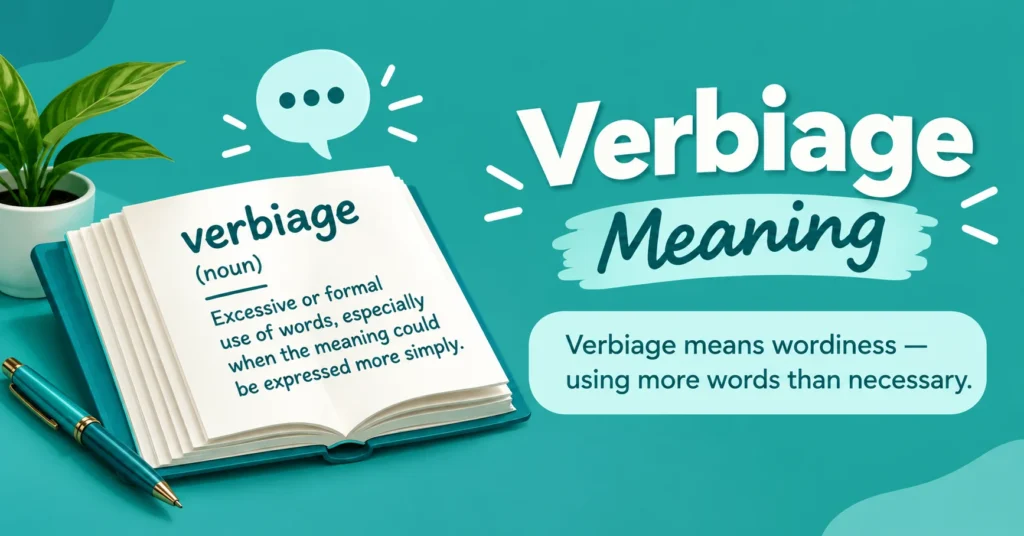
In its traditional and often critical sense, verbiage means an excessive amount of words, especially language that is unnecessary, complicated, or difficult to understand. This connects it with terms such as verbosity, wordiness, redundancy, long-windedness, and circumlocution. Cambridge Dictionary similarly defines it as complicated language containing many unnecessary words.
For example, imagine receiving a five-page workplace notice that could have been explained in three short paragraphs. You might reasonably describe the document as containing excessive verbiage. The problem isn’t simply that it is long; the criticism is that the extra wording makes the actual message harder to find. In that sense, clarity and conciseness are the natural contrasts to verbiage.
There is also a neutral American-English sense. In that usage, verbiage can refer to the particular wording, language, or manner of expression used in a document, announcement, policy, or conversation. Scribbr specifically notes that this neutral usage is more common in U.S. English than U.K. English.
Consider the sentence, “Please review the verbiage in the updated policy.” Here, the speaker may not be criticizing the policy at all. They could simply mean, “Please review the wording.” This explains why you may hear the term frequently in professional, corporate, legal, technical, and administrative settings.
The easiest way to understand the two senses is:
| Context | Meaning of verbiage |
| Critical | Excessive, complicated, or unnecessary language |
| Neutral | The wording or language used |
| Legal | The language used in a contract or document |
| Business | The wording of a message, policy, or announcement |
| Technical | Specialized or complicated language |
So, when someone asks about the verbiage meaning, don’t automatically assume that the word means “bad writing.” Context determines whether it is being used critically or neutrally.
Verbiage vs. verbage
The standard spelling is verbiage, with an i after the “b.” Verbage is encountered in everyday writing, but major language references and the leading ranking pages treat it as a nonstandard form that should generally be avoided in formal or carefully edited English.
The confusion is understandable because verbiage looks as though it might be formed from verb + age, and its pronunciation does not make the middle “i” particularly obvious. That can make verbage feel natural when someone writes the word from memory. Still, if you’re preparing an essay, business document, website, report, or professional email, verbiage is the safer standard spelling.
| Form | Standard choice? | Typical interpretation |
| verbiage | Yes | Wording or excessive wording |
| verbage | Generally nonstandard | Usually intended to mean verbiage |
For example:
Correct: “The contract contains complicated legal verbiage.”
Nonstandard: “The contract contains complicated legal verbage.”
The second version will usually be understood, but it isn’t the spelling you want in polished writing.
Interestingly, current online discussions show that the neutral use of verbiage remains controversial among some professional writers. A 2026 technical-writing Reddit discussion includes people objecting to its use as a simple synonym for “text,” while others point out that dictionaries recognize both the critical and neutral senses.
That disagreement is useful because it highlights an important language principle: a word can have a documented meaning even when some speakers dislike a particular use of it.
Etymology
The history of verbiage helps explain why the word has such a strong connection with words, speech, and excessive language. Dictionary.com dates its first recorded English use to the early 18th century and traces it through French, including Middle French verbier, associated with talking or chattering.
The modern word therefore has a long history in English rather than being a recent corporate expression. Its historical development also helps explain why it became associated with an abundance of language. Over time, its meaning broadened in some varieties of English so that it can refer more neutrally to wording or diction.
That broadening is important for modern American readers. Someone who says, “We need to update the verbiage on the website,” may simply mean “We need to update the wording.” Someone who says, “The report is buried under technical verbiage,” is clearly criticizing the language for being difficult or unnecessarily complicated.
In other words, the word’s history and modern usage have left it with two closely connected meanings rather than one rigid definition.
Origin of verbiage
The word is ultimately connected with French language history, and Dictionary.com identifies the French/Middle French background in its etymology. The English form has been established for centuries, which is why verbiage should not be confused with a newly invented business term.
Its modern relationship to words such as verbal, verbose, wording, diction, and verbosity can make the vocabulary family easier to remember, although these words are not interchangeable. Verbosity, for example, focuses specifically on excessive word use, while verbiage can refer either to excessive language or to wording itself.
That distinction becomes especially useful when editing. If you want to say that a writer uses too many words, verbosity may be the most precise term. If you mean the actual language chosen for a contract or announcement, wording is often clearer. If the context is intentionally critical, verbiage can capture the sense of bloated or complicated language.
Example Sentences
Here are several examples showing how verbiage changes meaning according to context:
| Sentence | Meaning |
| “The contract contains technical verbiage.” | Complicated language |
| “Please review the verbiage before publication.” | Wording |
| “The editor removed unnecessary verbiage.” | Excess words |
| “The policy’s legal verbiage confused readers.” | Complicated legal language |
| “We changed the verbiage of the announcement.” | Wording |
| “The essay was full of unnecessary verbiage.” | Wordiness |
| “Use the exact verbiage provided by the company.” | Exact wording |
| “The instructions contain too much technical verbiage.” | Specialized, difficult language |
These examples show why replacing every instance of verbiage with “wordiness” would be inaccurate. Sometimes the intended meaning is simply wording.
A useful real-world example is a workplace announcement. If a manager says, “Let’s revise the verbiage before sending this to customers,” the likely meaning is that the team should revise the wording. If an editor says, “Let’s remove the unnecessary verbiage,” the instruction is different: shorten or simplify the language.
The surrounding words usually make the intended meaning clear.
What is a synonym of verbiage?
There isn’t one perfect synonym because verbiage has two major senses. When it means excessive language, related words include verbosity, wordiness, long-windedness, redundancy, diffuseness, circumlocution, and windiness. When it means style or manner of expression, related terms include wording, diction, language, syntax, style, and turn of phrase.
| If verbiage means… | Useful alternatives |
| Excessive language | verbosity, wordiness |
| Too many words | long-windedness, diffuseness |
| Repetitive language | redundancy |
| Indirect expression | circumlocution |
| Choice of words | wording, diction |
| Style of expression | language, style |
| Sentence construction | syntax |
| Particular expression | turn of phrase |
There is an important practical difference between these terms. Wording is usually neutral, while verbosity specifically points toward excessive word use. Therefore, “Please change the wording” sounds straightforward, while “The report suffers from verbosity” is a criticism.
If your goal is clear communication, choosing the simpler term can sometimes be better. Saying “change the wording” is immediately understandable to almost everyone. Saying “change the verbiage” is perfectly possible, particularly in American professional English, but it may sound more formal or corporate.
How do I pronounce verbiage?
Verbiage is commonly pronounced approximately “VER-bee-ij.” It has three syllables, with the primary stress on the first syllable. Scribbr and QuillBot both give the pronunciation as ver-bee-ij.
In American English, the pronunciation can be represented approximately as /ˈvɝː.bi.ɪdʒ/. Dictionary.com gives an American pronunciation alongside a separate British pronunciation.
The spelling is one reason people sometimes write verbage. When heard aloud, the middle vowel isn’t especially prominent, so someone unfamiliar with the written word might leave out the “i.”
A simple memory aid is:
verbiage = VER-bee-ij
Remember the i in the middle when writing it.
A quick way to remember the verbiage meaning
Think of verbiage as having two doors.
Behind the first door is too much or unnecessarily complicated language:
“The contract is full of legal verbiage.”
Behind the second is simply the wording used:
“Please review the verbiage before we publish the announcement.”
If the surrounding sentence sounds critical, the first meaning is probably intended. If it sounds like a workplace request to review or change text, the second meaning is often more likely.
The spelling is easier: verbiage, not verbage.
Understanding that small distinction can prevent a surprisingly common misunderstanding. Instead of automatically treating the word as a synonym for “wordiness,” look at the surrounding context. In American English especially, verbiage can refer to either excessive language or ordinary wording, and recognizing that difference makes the word much easier to understand and use accurately.
Conclusion
Understanding the meaning of “verbiage” can make everyday communication easier, especially when discussing writing that feels overly complicated or contains more words than necessary. The word usually refers to the way something is expressed through words, and it can sometimes suggest excessive or unnecessary language depending on the context.
Recognizing this difference helps you choose clearer, more precise wording in conversations, emails, academic work, and professional writing. Good communication is not always about using more words it is about using the right ones. When your message is clear, purposeful, and easy to understand, your ideas have a much better chance of making a lasting impression.
FAQs
Author

Ethan Carter is an SEO blogger specializing in internet slang, text abbreviations, and social media meanings. He creates clear, accurate, and reader-friendly content backed by thorough research. His goal is to help readers understand modern online language with reliable, easy-to-read guides.