CAD Meaning: 5 Surprising Definitions, Uses & Key Facts You Need to Know
If you’re searching for cad meaning, the lowercase word cad usually describes a man who behaves dishonestly, selfishly, or unfairly, while CAD commonly means computer-aided design. The difference matters because the same three letters point to two very different ideas: an old-fashioned insult and a modern design technology.
I’ve seen short dictionary searches create surprising confusion when capitalization and context are ignored. Terms such as cad, caddish, scoundrel, rogue, computer-aided design, CAD software, drafting, and 3D modeling belong to different semantic contexts. This guide separates them clearly, explains their history and usage, and shows how to recognize the intended meaning without guessing.
CAD meaning: Definitions of cad
The word cad is an old-fashioned noun for a man who behaves dishonestly, selfishly, or without proper consideration for others. Dictionaries commonly associate it with someone who is not gentlemanly, particularly when his behavior toward another person is unfair or disrespectful. In modern American English, it often sounds dated rather than like everyday slang.
In practical conversation, calling someone a cad is generally negative. Related terms include scoundrel, rogue, rascal, heel, bounder, and rotter. The word can describe bad manners or questionable conduct without necessarily referring to a specific crime. Its strongest association is character: a cad is someone whose behavior falls noticeably short of expected courtesy or decency.
CAD meaning: The word in context
Imagine someone charming another person, making promises, and then treating that person selfishly or dishonestly. Calling him “a cad” communicates disapproval of his conduct. The expression has a distinctly old-fashioned flavor, so modern speakers may use it seriously, humorously, or deliberately to sound literary.
CAD meaning: Pronunciation
Cad is pronounced /kæd/, with the short vowel sound heard in words such as bad and mad. It is normally pronounced as one syllable. The lowercase word and the uppercase acronym can therefore sound similar even though their meanings are completely different.
That distinction is especially important when the term appears in writing. If someone says “CAD” while discussing architecture, engineering, drafting, or manufacturing, they probably mean computer-aided design. If the sentence describes a dishonest or ungentlemanly man, cad is the intended word. Context does most of the semantic work.
CAD meaning: American and British usage
The word cad is understood in both American and British English, although it is marked as old-fashioned in major learner dictionaries. British usage also preserves historical senses connected with social class and university culture. Today, readers are more likely to encounter the word in literature, commentary, or humorous descriptions than casual everyday conversation.
CAD meaning: Explanation
The easiest way to understand cad meaning is to connect the word with character rather than technology. A cad is a man whose conduct is considered dishonorable, selfish, discourteous, or unfair. The expression is particularly associated with behavior toward women, although the broader idea is someone who behaves badly toward other people.
This explains why words such as bounder, scoundrel, heel, rogue, and rascal frequently appear near cad in dictionaries. They overlap semantically, but they are not perfect substitutes in every sentence. Cad has a distinctive old-fashioned, gentlemanly-social-code flavor that gives it a different tone from a modern insult such as “jerk.”
CAD meaning: Is cad an insult?
Yes. When cad is applied to a person, it normally expresses criticism. However, the strength and tone depend on context. In a historical novel, it may sound natural and serious; in modern conversation, calling someone “a cad” can sound playful, theatrical, or deliberately old-fashioned.
CAD meaning: Etymology
The history of cad is more interesting than its short spelling suggests. Dictionary sources trace the word to late-18th-century usage and connect it with caddie or related forms referring to someone who performed errands or odd jobs. Over time, the social meaning developed into a label for someone regarded as vulgar, inferior, or badly behaved.
The later moral sense became associated with the idea of a man who lacked gentlemanly behavior. That historical development helps explain why cad became especially connected with romantic misconduct and poor treatment of women. The modern word therefore carries both a social-history background and a moral judgment.
CAD meaning: Origin of cad
Dictionary.com dates the word’s first recording to the 1780s and identifies an origin connected with caddie. Vocabulary.com likewise explains the historical connection with cadet and the use of the term around British universities. The exact historical development has been described somewhat differently across sources, but its association with social status and undesirable behavior is well established.
CAD meaning: Example Sentences
Seeing cad in a real sentence makes its meaning much easier to recognize. For example: “He promised to call, disappeared for weeks, and then acted as though nothing had happened—a real cad.” Here, the word criticizes his selfish and inconsiderate behavior rather than identifying a profession or technical concept.
Another example is: “The novel’s charming hero turns out to be a cad.” This sentence shows the word’s frequent literary use. A character can appear attractive or charismatic while behaving dishonestly underneath. That contrast is one reason cad remains useful in fiction, reviews, and humorous commentary.
| Example | Meaning of “cad” |
| “He behaved like a cad.” | He behaved dishonorably. |
| “What a cad!” | What a dishonorable or inconsiderate man! |
| “The charming character is actually a cad.” | His outward charm hides bad behavior. |
| “Only a cad would treat her that way.” | His behavior toward her is unfair or disrespectful. |
CAD meaning: Example in everyday conversation
Because the word sounds old-fashioned, a modern speaker might use it for comic effect: “He ate the last slice and didn’t even ask anyone what a cad!” The underlying meaning remains negative, but the exaggerated vocabulary makes the criticism feel lighter and more humorous.
CAD meaning: Other Word Forms
The related adjective caddish describes behavior that resembles that of a cad. You might encounter expressions such as “caddish behavior” or “a caddish remark.” The related adverb caddishly describes something done in a caddish manner. These forms preserve the central semantic idea of dishonorable or ungentlemanly conduct.
The plural form is cads. For example, “The novel is filled with charming cads” refers to multiple men whose behavior is selfish or dishonorable. Recognizing these forms helps readers understand why a dictionary page may show more than one grammatical variation when researching the word.
CAD meaning: Caddish and caddishly
Caddish is the most useful related form in ordinary writing. If cad identifies the person, caddish describes the conduct: “His caddish behavior ruined the evening.” This distinction is useful for understanding sentences where the word does not directly label someone as a cad.
CAD meaning: What is CAD?
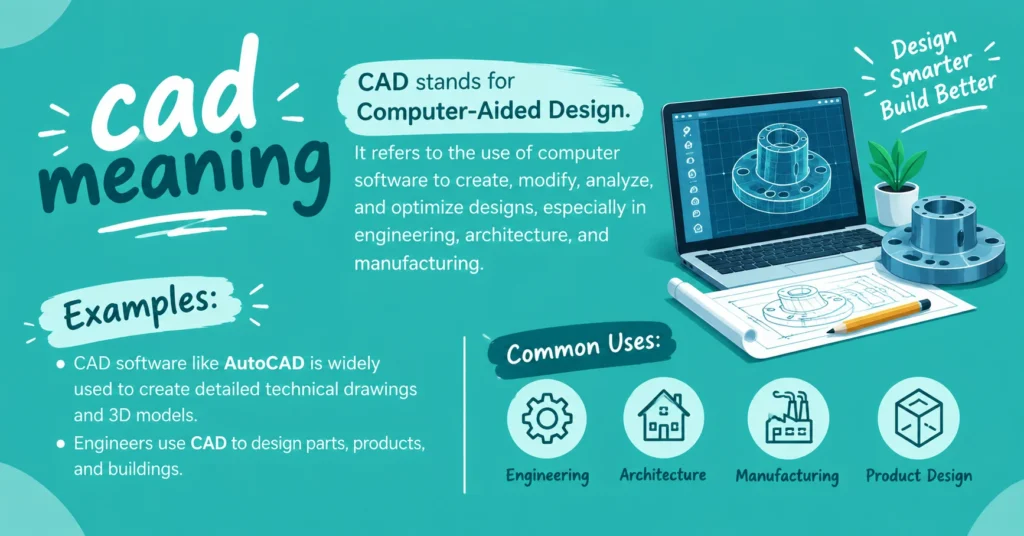
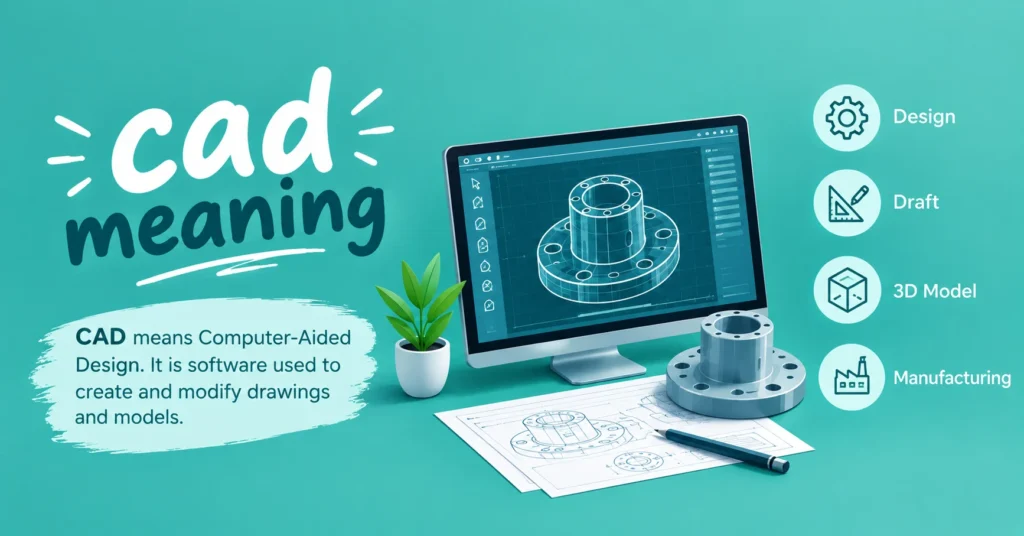
When written in uppercase, CAD most commonly refers to computer-aided design. It is the use of computer technology and specialized software to create, modify, analyze, document, and visualize designs. CAD can produce precise 2D technical drawings as well as detailed 3D models for many professional applications.
Autodesk’s current explanation places CAD across architecture, engineering, product development, manufacturing, and other design fields. Modern CAD systems can include modeling, rendering, simulation, documentation, cloud collaboration, and AI-assisted workflows. In this context, CAD has nothing to do with the old-fashioned noun cad; capitalization and surrounding vocabulary reveal the intended meaning.
CAD meaning: Types of CAD Software
Modern CAD software can support 2D design, 3D modeling, or both. Two-dimensional CAD is commonly used for technical drawings, floor plans, schematics, layouts, annotations, and documentation. Three-dimensional CAD can create volumetric models and support more advanced workflows such as assemblies, simulation, rendering, and visualization.
Autodesk describes several 3D modeling approaches, including parametric, direct, assembly, solid, and surface modeling. The right approach depends on the project. A mechanical engineer may need precise parametric relationships, while a product designer working with complex curves may rely more heavily on surface or direct modeling.
| CAD context | Typical output |
| 2D CAD | Technical drawings, layouts, floor plans |
| 3D CAD | Digital models and assemblies |
| Parametric modeling | Dimension-driven designs |
| Surface modeling | Complex curved forms |
| Solid modeling | Detailed volumetric components |
| Assembly modeling | Connected product components |
CAD meaning: Benefits of Using CAD
The main practical advantages of CAD include greater precision, efficiency, collaboration, visualization, and reduced rework. Digital models can be edited without redrawing an entire project from scratch, while dimensions, constraints, templates, and reusable components help maintain consistency across revisions.
CAD can also make communication easier. Instead of describing a proposed product or building entirely through words, teams can review drawings, models, annotations, simulations, and rendered views. Autodesk notes that modern cloud-connected CAD platforms can also support collaboration across devices and locations, which is particularly useful for distributed design teams.
CAD meaning: Increased drafting precision and accuracy
CAD reduces many errors associated with manual drafting by allowing designers to work with precise dimensions, constraints, geometric tools, and reusable standards. In complex projects, that precision can make revisions easier to manage and help maintain consistency between drawings, models, and manufacturing documentation.
CAD meaning: CAD applications across industries
CAD is used across architecture, engineering, construction, manufacturing, product design, electronics, interior design, and other technical disciplines. In architecture and construction, CAD can support floor plans, elevations, structural documentation, MEP layouts, and infrastructure projects. In manufacturing, it can support components, assemblies, tooling, prototypes, and production documentation.
The technology also connects with neighboring systems. CAD models can feed manufacturing workflows involving CAM and CNC, while architectural models may participate in BIM processes. In product development, CAD can support simulation, rendering, prototyping, and increasingly digital-twin workflows. That broad ecosystem explains why the acronym appears frequently in technical and professional contexts.
CAD meaning: Architecture, engineering, and construction
AEC professionals use CAD for drawings, building layouts, infrastructure documentation, mechanical and electrical systems, and detailed construction information. Modern workflows may connect CAD models with BIM platforms and digital twins, allowing design information to remain useful beyond the initial drafting stage.
CAD meaning: Manufacturing
Manufacturers use CAD to develop components, assemblies, tooling, molds, and other production assets. Detailed digital models can be reviewed and modified before physical fabrication. When connected with CAM and CNC workflows, CAD can become part of a larger digital path from design to manufacturing.
CAD meaning: Product design
Product designers use CAD to explore form, dimensions, ergonomics, materials, assemblies, and manufacturability. A digital model can be repeatedly refined before a physical prototype is produced. Rendering also allows teams and clients to visualize how a proposed product could look before production begins.
CAD meaning: The context decides
The simplest rule is this: lowercase “cad” usually refers to a dishonorable or ungentlemanly man, while uppercase “CAD” commonly refers to computer-aided design. If the surrounding words mention relationships, manners, dishonesty, or gentlemanly behavior, the dictionary meaning is likely intended.
If the surrounding language includes software, drawings, engineering, architecture, modeling, manufacturing, or AutoCAD, the technical acronym is probably intended. The same pronunciation can therefore hide two unrelated meanings. Reading the words around the term is usually enough to resolve the ambiguity.
For example, “He was a cad” is clearly a judgment about someone’s behavior. “The engineer created the component in CAD” clearly refers to design software. “CAD software” and “CAD model” almost always signal the technology meaning, while “a cad” and “what a cad” signal the vocabulary meaning.
In short, cad meaning depends on context: cad is an old-fashioned term for a dishonorable or inconsiderate man, while CAD commonly means computer-aided design. Knowing the capitalization, surrounding words, and subject area makes the distinction straightforward.
Conclusion
CAD can have different meanings depending on where you see it. In everyday conversations, it may refer to Canadian dollars, while in design and engineering, CAD commonly means computer-aided design. It can also appear in finance, payments, healthcare, technology, and online conversations with completely different meanings.
Understanding the surrounding context is the easiest way to know which definition applies. Whether you encountered CAD in a message, payment, technical document, or casual conversation, the words around it usually provide the clue you need. Taking a moment to check the context can help you avoid confusion and understand exactly what someone means when they use “CAD.”
FAQs
Author

Ethan Carter is an SEO blogger specializing in internet slang, text abbreviations, and social media meanings. He creates clear, accurate, and reader-friendly content backed by thorough research. His goal is to help readers understand modern online language with reliable, easy-to-read guides.