What Does FRFR Mean in Text: 20+ Essential & Surprising Ways to Understand This Popular Slang
When someone texts you FRFR, it usually means “for real, for real,” an informal expression that emphasizes honesty, sincerity, or strong agreement. This texting abbreviation appears in digital conversations, social media comments, group chats, and everyday messages, especially among people familiar with internet slang and Gen Z expressions.
Understanding modern texting language can sometimes feel confusing when familiar words suddenly appear in shortened forms. Having researched online slang, dictionary definitions, and documented internet culture, this guide explains the FRFR meaning, its connection to FR, practical examples, and how to interpret the expression naturally without misunderstanding someone’s message.
What does FRFR mean in texting?
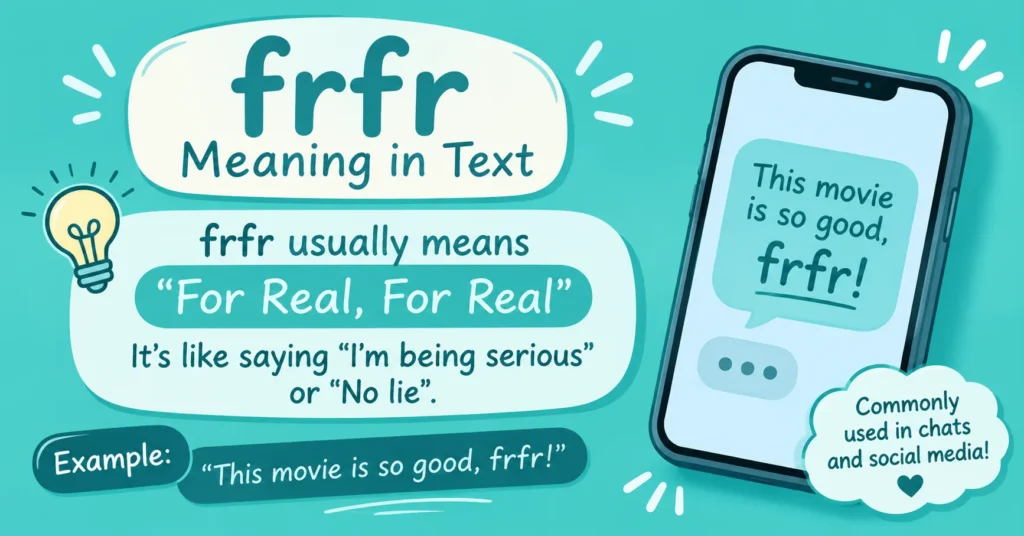
FRFR stands for “for real, for real.” It is an informal internet abbreviation people use when they want to emphasize that something is genuinely true, express sincere feelings, or strongly agree with another person’s statement. It adds extra emphasis compared with simply writing FR.
For example, imagine your friend messages you, “That concert was amazing.” You might reply, “FRFR!” This communicates that you completely agree. Similarly, writing “I’m serious FRFR” emphasizes that you genuinely mean what you are saying rather than joking or exaggerating.
The phrase can express several closely related ideas:
- Honesty: I genuinely mean what I said.
- Agreement: I completely agree with you.
- Seriousness: I’m not joking.
- Sincerity: My feelings or opinion are genuine.
- Emphasis: I strongly believe what I’m saying.
The exact interpretation depends on the surrounding conversation. Cambridge Dictionary defines the underlying phrase “for real” as informal language referring to something actual or genuine.

Why do people say FRFR instead of FR?
People use FRFR instead of FR because repeating the expression adds emphasis. While FR generally communicates agreement or sincerity, FRFR makes that message sound stronger. It is similar to saying “I’m really serious” instead of simply “I’m serious.”
The repetition also creates a conversational tone. In short messages, people often prefer expressions that communicate emotion quickly without requiring a lengthy explanation. FRFR achieves that purpose while maintaining the casual style of texting and social media communication.
Consider these differences:
| Expression | Meaning | Example |
| FR | For real | That movie was good FR. |
| FRFR | For real, for real | That movie was amazing FRFR. |
| Seriously | Genuine emphasis | Seriously, I loved it. |
| No cap | No lie or exaggeration | That was incredible, no cap. |
Although these expressions overlap, they are not always interchangeable. FRFR emphasizes sincerity through repetition, while other slang expressions can communicate slightly different tones.
How do you use FRFR?
FRFR is commonly used in informal messages when someone wants to express genuine agreement, reinforce an opinion, or make a statement sound more convincing. You can place it at the beginning or end of a sentence, or use it independently as a response.
The best way to understand it is to look at the context. A friend might use FRFR after sharing an opinion, while someone else might add it to a promise to communicate that they genuinely intend to follow through.
Here are some original examples:
| Situation | Example message | Intended meaning |
| Agreement | “That was hilarious FRFR.” | I completely agree. |
| Honesty | “I’m telling you FRFR.” | I’m being honest. |
| Compliment | “You did a great job FRFR.” | I genuinely mean it. |
| Opinion | “This is my favorite song FRFR.” | I truly believe this. |
| Promise | “I’ll call you tomorrow FRFR.” | I’m being serious. |
| Excitement | “That game was incredible FRFR.” | I’m genuinely impressed. |
Beginning of a sentence
You can put FRFR at the beginning when emphasizing an opinion or responding strongly to something another person has said.
Example:
“FRFR, everyone should watch that movie.”
The sender is emphasizing their recommendation rather than simply mentioning a movie.
End of a sentence
Adding FRFR at the end makes the entire statement sound more sincere or emphatic.
Example:
“I really appreciate your help FRFR.”
Here, the expression reinforces the speaker’s gratitude.
As a standalone response
FRFR can also work independently when responding to someone else’s message.
Example:
Person A: “We really needed that vacation.”
Person B: “FRFR!”
Person B is expressing strong agreement.
Where “FRFR” came from and how it spread
The expression FRFR developed from the spoken phrase “for real, for real.” The underlying expression existed before modern social media, while its abbreviated form became part of digital communication through internet slang, online conversations, and short-form posts.
Know Your Meme documents the expression’s history, including early online uses of FR in 2003 and FR FR appearing in tweets around 2010, followed by increased visibility through Twitter and Vine during the 2010s. Its popularity continued growing as internet slang became more widely recognized in Gen Z culture.
The history is worth understanding because FRFR did not originate as a separate technical acronym in ordinary texting. It is essentially a repeated version of FR, using the same underlying phrase to communicate stronger sincerity.
Today, the expression is familiar in digital conversations, including comments, messages, and online communities. Its meaning remains relatively consistent, although the tone can vary depending on who is communicating and what they are discussing.
Is FRFR the same as ‘for real’?
FRFR and “for real” have essentially the same underlying meaning, but FRFR places additional emphasis on the expression. The abbreviation represents the repeated phrase “for real, for real,” while writing “for real” once generally communicates a straightforward statement of sincerity.
For example, consider the following:
- “I like this song for real.”
- “I like this song FRFR.”
Both communicate genuine appreciation, but the second can sound more emphatic and conversational.
The difference is not a completely separate definition. Instead, it is a difference in emphasis and writing style. Someone who uses FRFR generally wants their message to sound particularly sincere, enthusiastic, or convincing.
FR vs. FRFR
FR and FRFR are closely related texting abbreviations, but they differ in emphasis. FR stands for “for real,” whereas FRFR means “for real, for real.” Both are commonly associated with agreement, sincerity, and informal digital communication.
| Feature | FR | FRFR |
| Full form | For real | For real, for real |
| Length | Two letters | Four letters |
| Emphasis | Normal | Stronger |
| Agreement | Yes | Strong agreement |
| Sincerity | Yes | Strongly emphasized |
| Usage | Texting and comments | Texting and comments |
For instance:
FR: “That assignment was difficult.”
FRFR: “That assignment was seriously difficult.”
Both statements express a similar opinion, but FRFR gives the message additional emphasis.
Other expressions you might encounter include:
- TBH: To be honest.
- NGL: Not gonna lie.
- IMO: In my opinion.
- ONG: On God.
- No cap: No lie or exaggeration.
- BFFR: Be for real, a more forceful expression.
These abbreviations belong to informal internet communication, but their meanings and tones differ.
What does FRFR mean on social media?
On social media, FRFR generally communicates strong agreement, sincerity, or a genuine reaction. It appears in comments, captions, direct messages, and replies when someone wants to emphasize an opinion without writing a long explanation.
The meaning does not fundamentally change between platforms. However, the surrounding content can influence how the expression feels.
| Platform | Typical usage | Example |
| Snapchat | Personal messages | “I miss those days FRFR.” |
| TikTok | Agreeing with videos | “This is so relatable FRFR.” |
| Comments and DMs | “Your artwork is amazing FRFR.” | |
| Everyday conversations | “I’m serious FRFR.” | |
| Discord | Group discussions | “That match was incredible FRFR.” |
| X | Short posts and replies | “We need another season FRFR.” |
For example, someone commenting “This is exactly what happened to me FRFR” under a relatable TikTok video is communicating genuine agreement.
On Instagram, a person might write “Your photography is beautiful FRFR” to make a compliment sound more sincere.
On Snapchat, friends might use it to emphasize a personal message. The abbreviation makes the conversation shorter while preserving its intended meaning.
These are illustrative examples rather than measured platform-frequency statistics.
Common Mistakes to Avoid When Using FRFR
Although FRFR is easy to understand, using it incorrectly can sometimes create confusion. The most important thing is to recognize that it is informal slang, not a replacement for every expression involving honesty or seriousness.
Here are some common mistakes:
- Using it in formal writing: FRFR generally belongs in casual messages rather than academic assignments or professional reports.
- Assuming it always means agreement: It can also emphasize an individual statement or feeling.
- Overusing the abbreviation: Adding it to every sentence can make communication repetitive.
- Ignoring context: The surrounding words help determine whether someone is expressing excitement, sincerity, or agreement.
- Confusing FR and FRFR: Both have related meanings, but the repeated version usually adds emphasis.
For example, “I’m exhausted FRFR” emphasizes a personal feeling. It does not necessarily mean the sender is agreeing with someone else.
Similarly, “FRFR, that was unexpected” communicates a genuine reaction rather than asking another person for confirmation.
Using the abbreviation naturally is more important than trying to include it in every conversation.
Is FRFR a bad word?
No, FRFR is not generally considered a bad word or profanity. It is an informal abbreviation for “for real, for real,” commonly used to express sincerity, agreement, and emphasis in everyday digital conversations.
However, its casual tone makes it more suitable for messages with friends, social media comments, and informal discussions than formal communication.
If you’re messaging someone who is unfamiliar with internet slang, writing “seriously” or “I genuinely mean it” may communicate your intention more clearly.
There is also a separate technical meaning worth knowing: in audio equipment, FRFR can stand for “Full-Range, Flat-Response,” describing speakers designed to reproduce sound across a broad frequency range with a relatively neutral response.
This technical meaning is different from the texting abbreviation. The surrounding topic tells you which interpretation is intended.
How do you respond to FRFR?
Your response to FRFR depends on the original message. If someone uses it to agree with your opinion, you can respond naturally with “exactly,” “same,” or “facts.” If someone uses it to emphasize a promise or compliment, acknowledging their message is usually enough.
Here are some possible responses:
| If someone says | You can respond |
| “That movie was amazing FRFR.” | “Absolutely!” |
| “I’m really tired FRFR.” | “Same here.” |
| “You did a great job FRFR.” | “Thank you, I appreciate it!” |
| “This song is incredible FRFR.” | “Facts!” |
| “I’m telling the truth FRFR.” | “I believe you.” |
| “That was the best day ever FRFR.” | “I agree!” |
You do not need to repeat FRFR in every response. A natural reply that matches the conversation is usually better than forcing additional slang into your message.
For example, if someone says, “I genuinely appreciate your friendship FRFR,” a simple “That means a lot to me” is a perfectly appropriate response.
The important thing is to understand the intended emotion before replying.
Conclusion
Understanding what does FRFR mean makes it easier to follow everyday online conversations and recognize the tone behind a message. Short for “for real, for real,” FRFR is a popular slang expression used to show honesty, agreement, or strong emphasis. Whether someone uses it on Snapchat, TikTok, or in a regular text conversation, its meaning usually depends on the context.
It can make a statement sound more genuine or show that someone completely agrees with you. The next time you see FRFR in a message, you will know what the person means. Just remember, context always matters in texting.
FAQs
Author

Ethan Carter is an SEO blogger specializing in internet slang, text abbreviations, and social media meanings. He creates clear, accurate, and reader-friendly content backed by thorough research. His goal is to help readers understand modern online language with reliable, easy-to-read guides.

One Comment