Starling Meaning: 7 Powerful Symbolic Insights & Fascinating Facts
Starling meaning most commonly refers to a dark, often glossy songbird in the family Sturnidae, especially the European starling. If you’ve encountered the word in a dictionary, nature article, poem, username, or conversation, its meaning can shift slightly with context. The key terms are songbird, European starling, flock, Sturnidae, and bird species.
After researching dictionary definitions, modern usage, and the word’s history, one thing becomes clear: starling is much older than internet slang. It connects Old English, birdwatching, wildlife, murmuration, symbolism, and literature. In this guide, we’ll separate the literal definition from symbolic interpretations so you can understand exactly what the word means wherever you encounter it.
Starling Meaning: Definition & Meaning
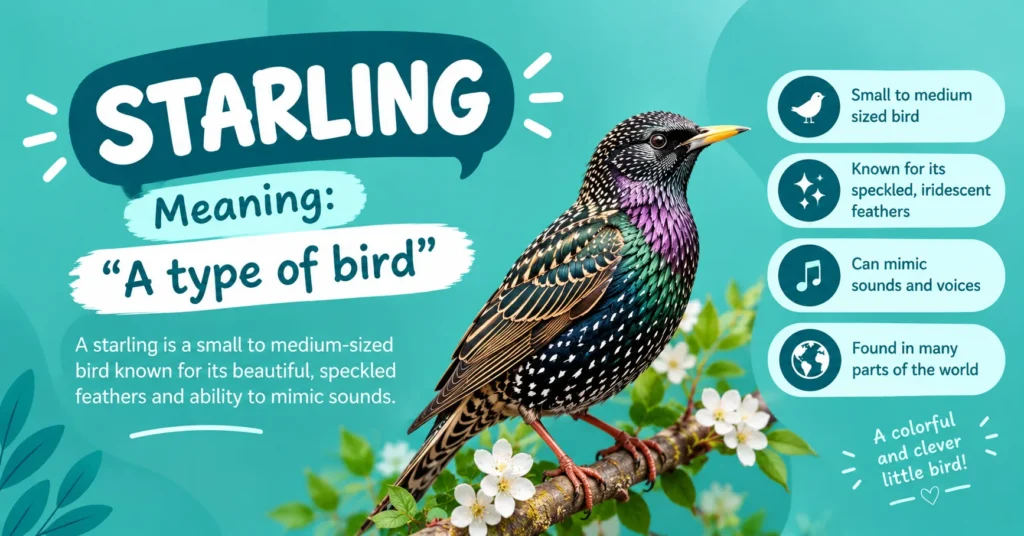
In ordinary English, a starling is a common bird with dark or glossy feathers that often lives and travels in groups. Oxford describes it as a common bird with dark, shiny feathers and a noisy call, while Cambridge similarly defines it as a common dark-feathered bird that lives in large groups. The most familiar U.S. example is the European starling, Sturnus vulgaris.
The word is a noun, and its plural is starlings. A flock of these birds can produce an extraordinary aerial display known as a murmuration. Their appearance can look almost black from a distance, while closer views may reveal glossy or iridescent tones. This combination of songbird, flock, feathers, vocalization, and movement explains many of the associations surrounding the word.
How the Meaning Developed
The word has an old linguistic history. Oxford traces starling to Old English stærlinc, from stær, meaning the bird, with a Germanic origin. Dictionary.com likewise gives an Old English and Germanic etymology. So despite the modern-looking beginning “star,” the word is not derived from the modern English noun star.
1. Everyday Conversation
In everyday speech, starling meaning is usually straightforward: someone is talking about the bird. If a person says, “There was a starling in my backyard,” they are identifying an actual bird. In this context, there is no hidden slang or symbolic message. The surrounding words garden, feathers, flock, tree, or bird usually make the meaning obvious.
2. Birdwatching
Birdwatchers use starling as a biological identification term. In the United States, the European starling is especially familiar because it became established after being introduced in North America in the late nineteenth century. A birder may therefore use the word while discussing species identification, behavior, habitat, feathers, or flocking.
3. Nature Writing
In nature writing, a starling can be more than a species label. Writers may use the bird to create an image of a changing sky, noisy trees, winter flocks, or coordinated movement. Terms such as wildlife, murmuration, flock, feathers, and bird call naturally surround this usage, giving the word a vivid environmental context.
4. Literature
Literary use can be literal or symbolic. A writer may mention a starling simply because one appears in a scene, or the bird may represent movement, freedom, loneliness, or community. There is no universal literary code that assigns one fixed meaning to every starling reference; interpretation depends on the work and surrounding imagery.
5. Social Media
On Instagram, X, Reddit, or another social platform, someone posting a photograph of a starling is normally referring to the bird. However, Starling can also appear as a username or profile name. In that situation, the word may reflect someone’s interest in nature, a personal nickname, a fictional character, or simply a preferred name.
6. Texting
If someone texts, “Look at this starling,” the ordinary meaning is the bird. If the message says, “Starling is such a beautiful name,” the speaker is discussing the word as a name. Context is therefore more useful than assuming that every occurrence has the same meaning.
7. Gaming
In gaming, Starling could be a character, creature, location, organization, item, or username. The capitalization may provide a clue, but the surrounding game universe matters more. A player saying “Starling is my favorite character” isn’t necessarily talking about an actual bird.
8. Professional Writing
Scientific and educational writing normally uses starling in its literal biological sense. A sentence such as “Researchers observed European starlings near the wetland” identifies birds. In professional communication, the surrounding scientific terms make the intended meaning particularly clear.
Starling Meaning: Background & History
The history behind starling meaning is surprisingly old. Dictionary.com traces the bird sense to Old English and related Germanic forms, while Oxford gives the Old English form stærlinc. These sources establish that the word belongs to a much older layer of English vocabulary rather than being a recent creation of social media or modern slang.
The modern word is also connected with the scientific classification of the birds. Starlings belong to the family Sturnidae, with the European starling classified as Sturnus vulgaris. That relationship matters because “starling” can describe the familiar European species specifically or, more broadly, members of the starling family depending on context.
Bird
The simplest semantic relationship is:
Starling → bird → songbird → Sturnidae
That hierarchy explains why dictionaries place starling alongside other wild-bird vocabulary. Cambridge specifically groups it with terms such as blackbird, finch, mynah, sparrow, and song thrush.
Songbird
A starling is commonly described as a songbird because of its varied vocal behavior. Its sounds can include whistles, calls, and imitations. This makes songbird, vocalization, communication, call, and mimicry important contextual terms when explaining the word rather than treating starling as an isolated dictionary entry.
Blackbird
The words starling and blackbird can cause confusion because some starlings have dark plumage. However, they are not interchangeable species names. Oxford notes that “blackbird” itself can refer to different birds depending on the regional context, while a starling belongs to the Sturnidae family.
Myna
Mynas are particularly relevant because they belong to the same broader family, Sturnidae. This means myna and starling are related, but one should not automatically substitute one term for the other. Species and regional context determine the precise identification.
Sparrow
A sparrow is another small bird that people may confuse with a starling, especially at a distance. They are not the same. Punzelo specifically addresses the distinction, while Cambridge also lists sparrow separately within its related-bird vocabulary.
Starling Meaning: Usage in Various Contexts
Context is one of the most important parts of understanding starling meaning. The same spelling can refer to a bird, a person’s name, a fictional character, or a symbolic image. In ordinary American English, the bird remains the dominant meaning, but context tells you whether the speaker intends the literal species or something more personal.
This is especially useful online. A nature photographer, novelist, gamer, and parent choosing a baby name could all use the word Starling differently. Rather than assuming an unusual hidden meaning, identify the surrounding subject first: birdwatching, literature, social media, names, gaming, wildlife, or conversation.
If Someone Talks About the Bird
If someone says, “I saw a starling,” the natural interpretation is a bird sighting. You can ask what it looked like, where it was, or whether it was part of a flock. There is normally no need to search for slang unless other context suggests that the word has been used unusually.
If Someone Says It Is Their Favorite Bird
Here, the literal meaning is again the bird. The statement may reflect appreciation for its appearance, vocal abilities, adaptability, or spectacular flocking behavior. A natural follow-up is simply asking what they like about starlings.
If Someone Says Starling Is a Name
In a naming discussion, Starling can function as a personal or fictional name. Punzelo notes that it may be used as a surname, given name, or character name. The symbolic qualities people attach to the name such as nature, movement, or individuality are associations rather than dictionary definitions.
If Someone Uses Starling as a Username
A username such as “StarlingWrites” does not automatically have a secret meaning. It might reflect a love of birds, literature, a family name, a favorite fictional character, or simply the sound of the word. The safest interpretation is the one supported by the user’s own context.
Funny Response
When the term clearly refers to a bird, a playful response can stay simple: “That little starling looks like it owns the neighborhood.” Humor works best when it builds on the literal meaning rather than inventing an unsupported slang definition.
Professional Response
In academic or professional conversation, clarity is more useful than guessing. If someone mentions a starling in a research setting, asking whether they mean the European starling can eliminate ambiguity. This is particularly helpful when discussing species, habitat, behavior, conservation, or environmental research.
Starling Meaning: Common Misconceptions & Clarifications
One common misconception is that starling meaning must be connected to the English word “star” because the spelling begins with star. That isn’t the historical explanation. Dictionary sources trace the word through Old English and Germanic forms associated with the bird itself.
Another misconception is that every symbolic interpretation is an official definition. It isn’t. Ideas such as freedom, community, transformation, and adaptability can arise from the bird’s behavior or from literary use, but they should be described as symbolism, not as the literal dictionary meaning.
Is a Starling the Same as a Sparrow?
No. A starling and a sparrow are different birds. Although they can share environments and may both be seen around gardens or urban spaces, they belong to different biological groups. The distinction becomes especially important when identifying a bird accurately.
Is Starling a Type of Crow?
No. Starlings and crows are different birds and belong to different families. A dark-colored starling may visually remind someone of another dark bird, but appearance alone does not make the species the same.
Is Starling a Bad Word?
No. The ordinary word starling is not generally offensive. It is primarily a bird name. If somebody uses it sarcastically as a nickname or private joke, the meaning would come from that particular context rather than from the standard English word.
Can Starling Be a Name?
Yes. Starling can appear as a surname, given name, fictional name, or username. When used this way, the intended meaning depends on the person or character. It should not automatically be interpreted as a statement about birds.
Does Starling Mean Freedom?
Not literally. Freedom is one possible symbolic association, particularly because birds and flight are frequently used as literary imagery. Punzelo specifically treats freedom and movement as symbolic associations rather than fixed dictionary meanings.
Is Starling Slang?
No. The ordinary English word starling is not generally recognized as internet slang. It can appear creatively online, but its standard meaning remains the bird.
Starling Meaning: Comparison with Similar Terms
Understanding related birds helps sharpen the definition. Starling refers to birds in or associated with the family Sturnidae, while terms such as sparrow, crow, and blackbird refer to different groups or have regional meanings. This distinction prevents a broad description like “small dark bird” from becoming an inaccurate identification.
| Term | Main meaning | Relationship to starling |
| Starling | Bird in the Sturnidae family | Primary term |
| European starling | Sturnus vulgaris | Well-known species |
| Myna | Sturnidae bird | Closely related |
| Sparrow | Different group of small birds | Not the same |
| Blackbird | Several region-dependent bird names | Not interchangeable |
| Crow | Corvid bird | Different family |
| Songbird | Broad descriptive category | Related category |
Starling vs Sparrow
A sparrow is not a starling. Both can be familiar backyard birds, but their classification, appearance, and behavior differ. If you’re identifying a bird, looking at size, bill shape, plumage, behavior, and habitat is more reliable than assuming every small flocking bird is a starling.
Starling vs Myna
Mynas are much more closely connected to starlings because both belong to Sturnidae. This is a useful relationship for understanding the starling family, but it still doesn’t mean every myna is simply another name for a European starling.
Starling vs Blackbird
Blackbird is particularly tricky because its meaning changes by region. Oxford’s American dictionary describes North American blackbirds differently from the European blackbird, which illustrates why bird terminology needs geographic context.
Starling vs Crow
Crows are considerably different birds and belong to the crow family, Corvidae. If someone describes a large dark bird with a strong bill as a crow, that doesn’t make it a starling. Size, behavior, vocalizations, and anatomy help distinguish them.
Starling Meaning as a Name
As a personal name, Starling has a nature-inspired quality because the underlying word identifies a bird. Punzelo notes that it may be used as a surname, given name, or fictional character name. People may associate the name with nature, movement, curiosity, individuality, or freedom, but these are interpretive associations rather than official name definitions.
This distinction matters when researching names. A dictionary definition tells you what the noun means; it does not necessarily establish a personality trait for every person who carries the name. If Starling appears as a character’s name, the author’s intended symbolism should be determined from the story rather than assumed from the word alone.
Example
Consider the sentence:
“Starling stood quietly beneath the old tree.”
Here, Starling could be a person’s or character’s name.
Compare it with:
“A starling landed on the branch.”
Here, starling clearly identifies a bird.
Capitalization and context therefore work together to reveal the intended meaning.
Starling Meaning in Literature and Symbolism
In literature, starling meaning can become richer than the literal bird definition. A writer may use a starling to suggest freedom, movement, community, isolation, communication, or change. These interpretations often arise from observable characteristics such as flocking behavior and flight rather than from a fixed dictionary definition.
A lone starling in a story might represent separation, while a huge flock could evoke unity or collective movement. Neither interpretation is automatically correct. The surrounding narrative, imagery, character development, and authorial context determine what the bird represents.
Cultural Symbolism
Modern symbolic discussions frequently connect starlings with community, adaptability, communication, movement, and transformation because of their social behavior and coordinated flocking. These ideas are cultural or literary interpretations, not scientific definitions of the word.
Starling in Literature and Symbolism: A Simple Example
Imagine a character watching thousands of birds move across an evening sky. The writer could use that scene to emphasize belonging, change, or the tension between individuality and community. Another author might use one isolated bird to create an entirely different emotional effect. Context always wins.
Why Starlings Are Interesting
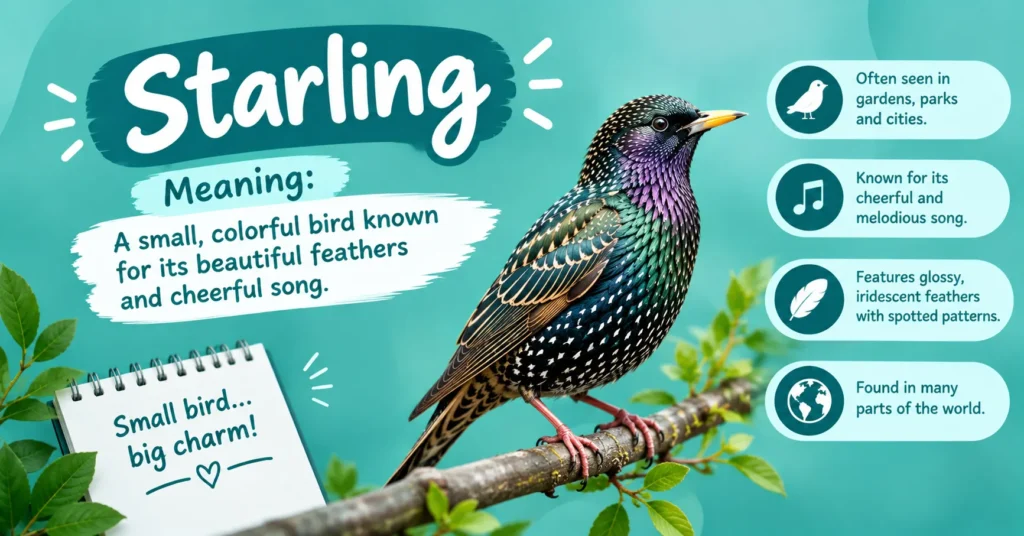
The bird behind the word is genuinely remarkable. European starlings can have glossy, iridescent plumage and are known for varied vocal behavior. Large groups can also produce coordinated aerial displays called murmurations, making them a frequent subject of nature writing, photography, and birdwatching.
Their ability to imitate sounds adds another layer to their reputation. Dictionary.com notes that starlings can imitate bird calls and human-made sounds, while Cambridge’s examples also highlight their dramatic flocking behavior. These biological traits help explain why the word has acquired such vivid cultural associations.
Starling Meaning in Simple English
If you need the shortest explanation, remember this:
Starling = a type of bird, especially the European starling in common U.S. usage.
Starlings = more than one starling.
Sturnidae = the bird family associated with starlings.
Murmuration = a coordinated flock display.
Starling as a name = a surname, given name, character name, or username depending on context.
Starling symbolism = possible associations such as freedom, community, movement, adaptability, or change not fixed dictionary meanings.
The word is also pronounced differently in some English varieties, with Cambridge providing both U.S. and U.K. pronunciations. Oxford’s American entry gives the U.S. pronunciation as /ˈstɑr.lɪŋ/.
Common Examples of “Starling”
- “A starling landed on my balcony.” The bird.
- “We watched a flock of starlings.” Multiple birds.
- “The starling has glossy feathers.” A description of the bird.
- “Starling is an unusual surname.” A family name.
- “She named her character Starling.” A fictional name.
- “Thousands of starlings crossed the evening sky.” A flock or murmuration.
These examples demonstrate why surrounding context is essential when interpreting the word.
Professional Example
In a scientific sentence, you might see:
“Researchers observed European starlings near the wetland.”
Here, starlings has a precise biological meaning. In professional writing, identifying the species or scientific context can be more useful than relying on symbolic interpretations.
When to Explain the Word
If your audience isn’t familiar with the term, define it once and then use it naturally:
A starling is a dark, often glossy songbird commonly seen in groups.
After that, additional details can focus on species, habitat, behavior, pronunciation, or cultural context.
Conclusion
The simplest starling meaning is a bird, particularly the European starling in common American usage. It belongs to the family Sturnidae and is known for dark, glossy plumage, varied vocalizations, social behavior, and spectacular flocking displays.
But the word can travel beyond the dictionary. Starling may appear as a surname, personal name, fictional character, username, or literary symbol. Ideas such as freedom, community, movement, and transformation can be associated with the bird, but those are contextual interpretations rather than literal definitions.
So when you encounter the word, start with the simplest question: Is the speaker talking about a bird? If not, look at the surrounding context. That small distinction is usually enough to uncover the intended meaning.
FAQs
Author

Ethan Carter is an SEO blogger specializing in internet slang, text abbreviations, and social media meanings. He creates clear, accurate, and reader-friendly content backed by thorough research. His goal is to help readers understand modern online language with reliable, easy-to-read guides.