SM Meaning: 7 Powerful Ways to Understand It in Text
SM meaning usually refers to “so much” in casual texting, but it can also mean “social media,” “send me,” or other context-specific phrases. After researching how modern texting abbreviations are actually explained and used, one thing becomes clear: those two letters cannot always be decoded in isolation.
If you’ve ever received “I miss you sm” and wondered whether it meant something else, you’re not alone. The surrounding words, relationship, platform, and tone usually provide the answer. This guide breaks down the common meanings, real conversational examples, emotional nuances, and situations where writing the full phrase is clearer.
SM Meaning in Text Quick Meaning
In everyday texting, SM meaning is most commonly “so much.” It works as informal shorthand that adds intensity to an emotion, opinion, or reaction. You may see it after expressions such as “miss you,” “love this,” “thank you,” or “I appreciate it.”
The same abbreviation can have another meaning when the conversation changes. In business or marketing, SM may refer to “social media,” while some casual messages use it for “send me” or, less commonly, “someone/something.” Context not capitalization alone is what usually reveals the intended meaning.
SM Most Common Meanings at a Glance
| SM meaning | Typical context | Example |
| So Much | Casual texting | “I miss you sm.” |
| Social Media | Business/marketing | “Our SM strategy needs work.” |
| Send Me | Sharing requests | “SM the photo.” |
| Someone/Something | Fast casual texting | “I need sm to help.” |
The dominant interpretation in personal texting is so much, especially when SM follows an emotion or expression of appreciation.
Primary meanings
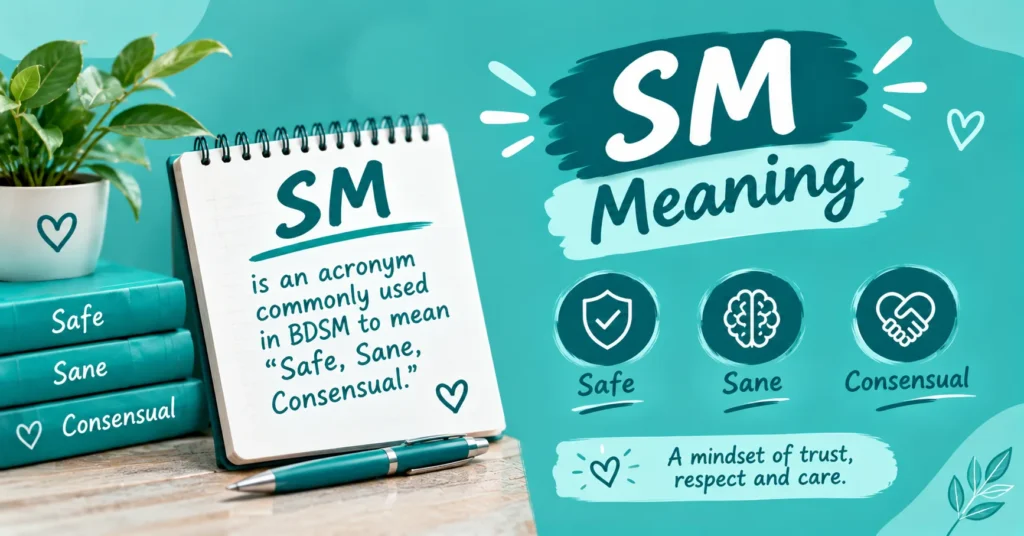
The leading interpretations are not equally common. “So much” is the clearest everyday texting meaning, while “social media” becomes more natural in professional or platform-related conversations. “Send me” and “someone/something” are more dependent on sentence structure.
A useful test is to replace SM with each possible phrase. If “I love this so much” sounds natural, you probably have the intended answer. If “Our social media campaign” fits instead, the context has changed.
SM Meaning “So Much”
The most common SM meaning in casual messages is “so much.” It acts as an intensifier, strengthening a feeling or reaction without requiring the sender to type the complete phrase. “I love this sm” therefore carries roughly the same basic meaning as “I love this so much.”
This shorthand can communicate affection, gratitude, excitement, frustration, or emotional intensity. The abbreviation itself is not automatically positive or negative; the words around it determine the feeling. “Thank you sm” sounds appreciative, while “I hate this sm” communicates strong dislike.
Emotional Meaning
When SM meaning is “so much,” the abbreviation often makes a message feel more immediate and conversational. It can intensify affection in “miss you sm,” gratitude in “thanks sm,” or enthusiasm in “I want this sm.”
The emotional effect comes from the phrase being shortened rather than from SM having a separate emotional definition. That distinction matters: the sender is still saying “so much,” but the abbreviated form fits the fast, informal rhythm of digital conversation.
What it expresses
SM can express strong feelings such as love, appreciation, excitement, longing, or even frustration. For example, “I appreciate you sm” communicates stronger gratitude than a bare “thanks,” while “that hurt sm” emphasizes emotional pain.
The abbreviation is therefore flexible rather than inherently romantic. Whether the message feels friendly, affectionate, enthusiastic, or negative depends on the complete sentence, punctuation, emojis, and relationship between the people communicating.
SM Meaning “Social Media”
Another important SM meaning is “social media.” This interpretation is especially common in marketing, business, creator, and workplace conversations. A sentence such as “We need to improve our SM strategy” is much more likely to refer to social media than “so much.”
Context makes this distinction relatively easy. If the surrounding discussion involves Instagram, TikTok, campaigns, posts, analytics, content calendars, or digital marketing, SM can function as shorthand for social media. In an emotional text, however, “so much” is usually the more natural reading.
Social Media Usage
On platforms such as Instagram, TikTok, and Snapchat, both meanings can appear because people use the same platforms for personal conversations and professional discussions. “I love this sm” uses the emotional meaning, while “SM marketing is changing” points toward social media.
This overlap explains why platform names alone cannot determine the meaning. Instagram does not make every SM reference mean social media. You still need to read the words surrounding the abbreviation.
Workplace Context
In professional communication, SM can appear in phrases related to social media, management, campaigns, or online marketing. However, workplace abbreviations can be organization-specific, so spelling out the term is safer when the audience might misunderstand it.
For example, “Please review the SM campaign” may be perfectly understandable inside a marketing team. In an external email, “social media campaign” is clearer and more professional because it removes unnecessary ambiguity.
SM Meaning “Send Me”
A less common SM meaning is “send me.” Here, the abbreviation functions as a short request for someone to share a photo, link, file, address, playlist, or another piece of information. GrammarThat gives examples such as asking someone to send a playlist or notes.
The sentence structure provides the strongest clue. If SM is followed by something that can be shared such as “the photo,” “the link,” or “the notes”“send me” may make more sense than “so much.” Because this usage is less widespread, it should not automatically be assumed.
For example:
“SM the pictures when you get home.”
Here, SM = send me.
But:
“I love the pictures sm.”
Here, SM = so much.
The surrounding words completely change the interpretation.
SM Meaning “Someone / Something”
Another less common SM meaning is shorthand for “someone” or “something.” This usage appears mainly in highly abbreviated, fast-paced conversations where the missing letters can be understood from context.
Because this interpretation is much less universal, readers should be cautious about assuming it. If a sentence sounds unnatural after replacing SM with “someone” or “something,” another meaning is probably intended.
For example, “I need sm to help me move” could potentially mean “I need someone to help me move.” But “I miss you sm” clearly does not fit that interpretation. Context provides the semantic clue.
SM Meaning in Love and Relationships
In romantic or close-friend conversations, SM meaning is commonly “so much,” especially when it follows emotional verbs such as love, miss, appreciate, or like. “I miss you sm” means “I miss you so much,” while “I love you sm” means “I love you so much.”
The abbreviation can make affection sound casual and spontaneous rather than formal. Still, SM itself does not prove romantic intent. A friend can write “I appreciate you sm” without the message being romantic, so the relationship and broader conversation matter.
What is the meaning of SM in love?
In love-related texting, SM generally means “so much.” For example, “I love you SM” means “I love you so much.” It strengthens the emotional statement rather than introducing a separate romantic abbreviation.
If someone sends “miss you sm,” the natural interpretation is that they are emphasizing how strongly they miss you. Whether the message is romantic or friendly depends on the existing relationship and tone.
What does SM stand for in dating?
In dating conversations, SM usually continues to mean “so much.” A message such as “I like you sm” expresses strong affection or attraction. However, context remains important because abbreviations can have different meanings in different communities.
Don’t assume that SM automatically signals romantic interest. The surrounding conversation, relationship, and other words provide much stronger evidence of the sender’s intent.
SM Meaning in Different Contexts
The most reliable way to understand SM meaning is to examine the context around it. Competitor research repeatedly identifies texting, social media, relationships, and professional communication as environments where the abbreviation can shift meaning.
Think of SM as a context-dependent shortcut. In an emotional message, “so much” usually works. In a marketing discussion, “social media” may be obvious. In a file-sharing request, “send me” can make sense. The surrounding words provide the missing information.
Chat Meaning
In ordinary chat, SM usually means “so much.” Messages such as “Thanks sm,” “I miss you sm,” and “I love this sm” use it to add emotional emphasis while keeping the message short.
The lowercase form sm is especially natural in casual texting, although users may write SM in uppercase as well. Capitalization alone should not be treated as a reliable way to determine the meaning.
Friends & Relationships
Friends often use SM to express appreciation, affection, excitement, or strong reactions. A message like “You helped me sm today” is simply an informal way of saying “You helped me so much today.”
In close relationships, the abbreviation can feel warm because it mirrors the relaxed style of everyday texting. Still, the emotional meaning comes from the full sentence, not from the letters SM by themselves.
Work / Professional Settings
Professional conversations require more caution because SM may refer to social media, Sales Manager, Service Manager, Store Manager, or another organization-specific term.
If the meaning isn’t obvious, checking the job description, company terminology, or surrounding sentence is better than guessing. In formal external communication, writing the complete term usually improves clarity.
SM Meaning When to Use It and When NOT to Use It
The most natural SM meaning usage is informal. It works well in personal texts, casual DMs, social comments, and conversations where the other person already understands internet shorthand. Competitors consistently recommend greater caution in formal communication.
A simple rule is to match the communication style of your audience. If you’re texting a friend, “Thanks sm!” sounds normal. If you’re writing to a professor, client, employer, or official organization, “Thank you so much” is clearer and more appropriate.
Use SM When
Use sm when you’re having a casual conversation and the meaning is obvious from context. Good examples include “I miss you sm,” “Thanks sm,” “I love this sm,” or “That helped me sm.”
You can also encounter uppercase SM when discussing social media in professional or creator contexts. In that case, the abbreviation is not necessarily slang; it is simply shorthand for a longer industry phrase.
Never Use SM In
Avoid casual SM shorthand when you’re writing formal emails, academic papers, official documents, professional reports, or messages where ambiguity could cause a problem. Competitor guidance consistently recommends spelling out the intended phrase in these settings.
For example, instead of writing “Thanks sm for your assistance” to a client, use “Thank you so much for your assistance.” The full phrase takes only a few extra characters but removes uncertainty and sounds more polished.
Conclusion
Understanding SM meaning depends heavily on the context where you see it. In chats, social media, relationships, and everyday texting, these two letters can have different meanings, so looking at the surrounding conversation is often the easiest way to understand them correctly. Whether someone uses “SM” as an abbreviation, slang term, or shorthand, the intended meaning usually becomes clear from the situation and tone.
When you come across unfamiliar slang, don’t rely on one definition alone consider who used it, where it appeared, and what was being discussed. A little context can make confusing online language much easier to understand and help you communicate more clearly.
FAQs
Author

Ethan Carter is an SEO blogger specializing in internet slang, text abbreviations, and social media meanings. He creates clear, accurate, and reader-friendly content backed by thorough research. His goal is to help readers understand modern online language with reliable, easy-to-read guides.