
Hakuna Matata Meaning: What It Really Means Today
Hakuna matata means “no worries,” “no problem,” or, more literally, “there are no troubles” in Swahili. The phrase became globally recognizable through Disney’s The Lion King, but its linguistic roots are much older. For anyone searching for the hakuna matata meaning, the key is separating the original Swahili expression from the carefree philosophy popular culture attached to it.
In everyday English, hakuna matata meaning can communicate reassurance, calm, relaxation, or a playful “don’t worry” attitude. Its related ideas include no trouble, peace of mind, taking it easy, positive thinking, and letting go of unnecessary stress. Understanding the Swahili language, East African context, Disney connection, and modern usage makes the phrase much more meaningful than a catchy movie lyric.
Hakuna Matata Meaning
What Does “Hakuna Matata” Mean?
The hakuna matata meaning is “no worries,” “no problem,” or “there are no troubles.” The most literal sense describes the absence of problems or difficulties, while “no worries” is the natural English equivalent people commonly use. Depending on context, it can reassure someone, dismiss a minor concern, or create a relaxed conversational tone.
The phrase is made from two Swahili elements: hakuna, expressing that something is not present, and matata, referring to troubles or problems. Together, they create the idea that there are no problems. That is different from saying that life is permanently perfect; it is usually a practical expression of reassurance.
Swahili Roots
Hakuna matata comes from Swahili, or Kiswahili, a major language of East Africa. The expression existed before Disney used it in The Lion King, so it is not a phrase invented for an animated movie. Its international popularity, however, grew dramatically after the 1994 Disney film introduced it to a huge English-speaking audience.
There is also an important cultural distinction. English-speaking audiences often associate hakuna matata with a broad carefree lifestyle, while the expression itself can function more simply as reassurance that something is not a problem. Treating the phrase as a complete description of East African culture would oversimplify both the language and the people who speak it.
What Does Hakuna Matata Mean
In plain English, hakuna matata means “no worries” or “no problem.” Imagine a friend apologizing because they arrived five minutes late. Saying “Hakuna matata!” can communicate that the delay is not important and that there is no reason to feel bad. In that setting, “no worries” sounds like the closest natural English equivalent.
The phrase can also carry a relaxed, cheerful feeling because of its association with The Lion King. That pop-culture meaning adds emotional color without replacing the original translation. It does not literally mean “happiness,” “fun,” or “perfect life.” Instead, those ideas developed around the expression because of the way it has been presented in popular culture.
A useful distinction is literal meaning versus cultural association. Literally, the phrase concerns the absence of trouble. In modern American usage, someone may use it as a playful reminder to relax and avoid stressing over something minor. Both interpretations can exist at the same time without being identical.
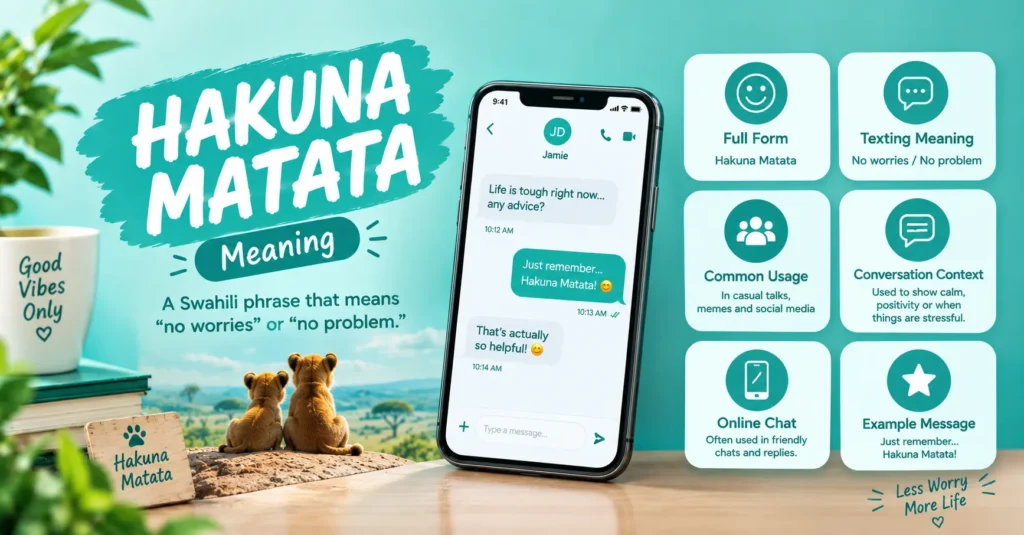
How to Pronounce “Hakuna Matata”
Hakuna matata is commonly approximated in English as “hah-KOO-nah mah-TAH-tah.” The phrase contains clear vowel sounds, and the stress pattern is often represented as ha-KU-na ma-TA-ta. English speakers may pronounce it slightly differently from a Swahili speaker, particularly because the famous Lion King song uses an English-influenced performance style.
If you are saying it in an everyday conversation, clarity matters more than trying to imitate a movie performance. Say each syllable naturally: ha-ku-na ma-ta-ta. Hearing the phrase in The Lion King may make it feel familiar, but the movie’s pronunciation should not automatically be treated as the only authentic pronunciation.
For someone learning the expression for travel, conversation, or cultural interest, listening to native Swahili pronunciation is preferable to relying exclusively on an English-language movie recording. That approach also reinforces the idea that hakuna matata belongs to a real language rather than existing only as a Disney catchphrase.
Hakuna Matata Meaning In The Lion King
The Lion King
The hakuna matata meaning in The Lion King builds on the phrase’s “no worries” sense and turns it into a memorable philosophy of carefree living. Timon and Pumbaa introduce Simba to the expression after he leaves his home, encouraging him to stop dwelling on painful experiences and enjoy life in the present.
Disney’s own material identifies “Hakuna Matata” with Timon and Pumbaa in The Lion King. The 1994 animated film gave the expression enormous international visibility, helping many Americans encounter the Swahili phrase for the first time. The song became one of the movie’s best-known musical moments.
Yet the movie eventually adds an important layer of meaning. Simba cannot simply avoid every responsibility forever. His story demonstrates that letting go of unnecessary worry is different from ignoring genuine responsibilities. That distinction makes the phrase more nuanced than the simplified idea of “never worry about anything.”
Music and Popular Culture
The phrase was present in popular culture before The Lion King. The Kenyan group Them Mushrooms included “hakuna matata” in the 1982 song “Jambo Bwana,” and Boney M. later released an English-language adaptation titled “Jambo Hakuna Matata (No Problems)” in 1983. These earlier uses demonstrate that Disney popularized an existing expression rather than creating the words.
After the Disney film, hakuna matata became strongly connected with animated movies, music, travel culture, merchandise, social media, tattoos, jokes, and motivational language. That history explains why many Americans immediately think of Timon, Pumbaa, and Simba when they hear the phrase, even though its linguistic origin is Swahili.
Hakuna Matata Meaning In Text
The hakuna matata meaning in text is generally the same as in casual conversation: “no worries,” “no problem,” or “don’t worry about it.” Someone might type “Hakuna matata 😂” after a friend apologizes for forgetting to reply. The phrase can make the response feel playful rather than formal.
For example:
Person A: “Sorry, I completely forgot to call yesterday.”
Person B: “Hakuna matata 😂”
Here, the speaker is not making a serious philosophical statement. They are simply communicating that the forgotten call is not a big deal. On Instagram, TikTok, WhatsApp, Snapchat, or casual text messages, the phrase may also be used as a humorous reference to The Lion King.
The exact tone depends on context. A message such as “Vacation starts tomorrow hakuna matata!” expresses excitement and carefree energy. Meanwhile, “Hakuna matata, we can fix it tomorrow” functions more like reassurance. Emojis, punctuation, and surrounding words can make the expression feel more playful, nostalgic, or encouraging.
How to Use “Hakuna Matata”
In English conversation, hakuna matata is best suited to informal, lighthearted situations where the speaker genuinely means that something is manageable or not worth worrying about. It can work after a minor mistake, a small delay, an uncomplicated change of plans, or an everyday inconvenience.
It can also be used deliberately as a pop-culture reference. Someone wearing a Lion King shirt might say “Hakuna matata” jokingly, while friends planning a relaxed vacation might use it as a playful motto. The important factor is context: the phrase works best when the situation is genuinely minor or the tone clearly signals humor.
Common Situations
One common situation is responding to an apology. If someone says, “Sorry I spilled a little water,” answering “Hakuna matata” can mean that the accident is not important. Another situation is a small change of plans: “The restaurant is closed? Hakuna matata. Let’s try the place next door.”
It can also encourage someone to relax before a manageable event. For example, a nervous student might hear, “You prepared all week. Hakuna matata!” Here, the phrase means something close to “Don’t stress; you’ve got this.” It is supportive when the situation does not require serious intervention.
Examples in Conversations
Friend: “Sorry I’m running ten minutes late.”
You: “Hakuna matata. Take your time.”
Friend: “The movie we wanted is sold out.”
You: “Hakuna matata. Let’s pick another one.”
Coworker: “I made a tiny mistake in the spreadsheet.”
You: “Hakuna matata. We can correct it.”
Friend: “I’m nervous about our trip.”
You: “Hakuna matata we’ve planned everything.”
These examples show why the phrase can feel warm and reassuring. It is not necessarily about pretending problems do not exist. In everyday use, it often means that a particular problem is small enough to handle without unnecessary worry.
Similar Expressions
Several English phrases overlap with the hakuna matata meaning, but they are not perfectly interchangeable.
| Expression | Typical meaning | Tone |
| Hakuna matata | No worries / no problem | Playful, culturally associated |
| No worries | Don’t be concerned | Casual |
| No problem | It is not an issue | Casual and direct |
| It’s all good | Everything is okay | Informal |
| Take it easy | Relax / don’t stress | Friendly |
| No big deal | The issue is minor | Casual |
For an American English speaker, “no worries” is often the closest natural substitute. “No problem” can be especially appropriate when responding to a request or apology. Hakuna matata adds a distinctive Swahili and Lion King association that the ordinary English expressions do not have.
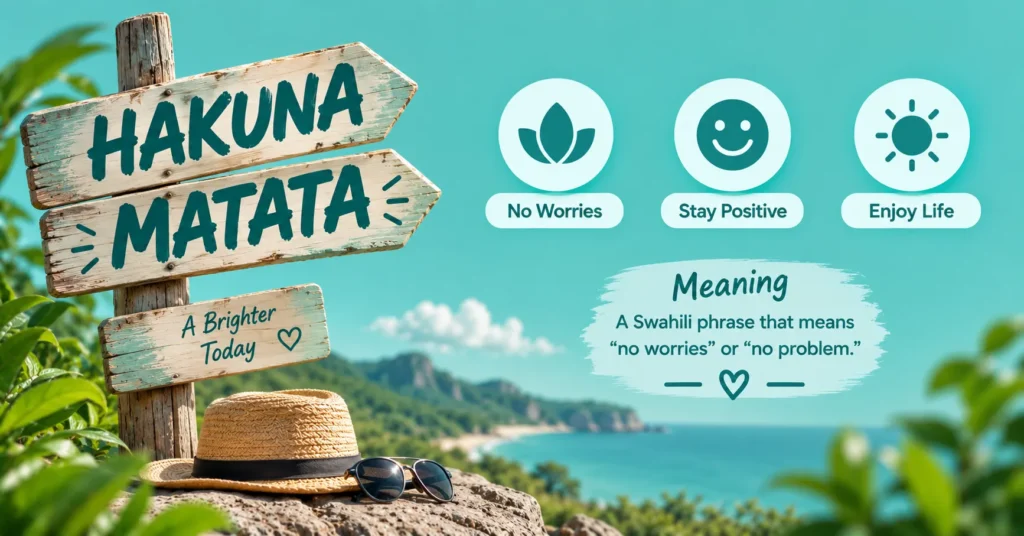
Hakuna Matata Vs No Problem
Hakuna matata and “no problem” overlap strongly in everyday meaning, but they are not identical expressions. Hakuna matata comes from Swahili, while “no problem” is ordinary English. Both can reassure someone that a minor difficulty, request, mistake, or inconvenience is not worth worrying about.
For example, if someone says, “Thanks for helping me,” “No problem!” is a completely ordinary American English response. “Hakuna matata!” could also communicate a similar idea, but it sounds more playful and may immediately remind the listener of The Lion King.
The distinction becomes clearer in serious situations. Neither phrase should automatically be used to dismiss someone who is dealing with grief, a major loss, a serious financial crisis, or another significant difficulty. Reassurance should match the emotional weight of the situation.
Examples Of Hakuna Matata
Here are natural examples showing different shades of the hakuna matata meaning:
After a small delay:
“Sorry I’m late.”
“Hakuna matata we just got here.”
After a minor mistake:
“I sent the wrong attachment.”
“Hakuna matata. Send the right one when you can.”
During vacation:
“Work can wait until Monday. Hakuna matata!”
About changing plans:
“The weather ruined our picnic.”
“Hakuna matata. Let’s have lunch indoors.”
As a playful caption:
“Sunshine, good food, and hakuna matata.”
As a movie reference:
“Timon and Pumbaa had the right phrase: hakuna matata.”
Common Mistakes When Using “Hakuna Matata”
One common mistake is assuming Disney invented the phrase. The expression existed in Swahili before The Lion King. Disney’s major contribution was bringing it to a huge international audience and giving it a memorable pop-culture identity.
Another mistake is treating “Hakuna Matata” as a literal promise that life has no problems. The phrase is better understood as reassurance that there is no need to worry about a particular situation. Its Disney-associated carefree philosophy is broader than its basic linguistic meaning.
It is also misleading to automatically call hakuna matata English slang. The phrase comes from Swahili. When Americans use it in English conversation, they are borrowing a foreign-language expression that may carry a Lion King association.
Finally, context matters. Saying “Hakuna matata” after a small delay can sound friendly. Saying it immediately after someone reveals a serious personal crisis could sound dismissive. The most natural use respects the difference between an everyday inconvenience and a genuinely painful situation.
The simplest takeaway is this: hakuna matata means “no worries” or “no problem,” with a literal sense close to “there are no troubles.” Its Swahili roots came long before Disney, while The Lion King transformed the expression into a globally recognized symbol of carefree optimism. Used thoughtfully, the phrase can still carry that familiar feeling of taking a breath, letting go of a small worry, and moving forward.
Conclusion
The phrase Hakuna Matata meaning is rooted in Swahili and is commonly understood as “no worries” or “there are no problems.” It expresses a relaxed, positive attitude toward life and encourages people not to become overwhelmed by everyday troubles. While the phrase became widely known around the world through The Lion King, its roots come from the Swahili language and East African culture.
Today, people often use Hakuna Matata casually to describe a carefree mindset or reassure someone that everything will be okay. Whether you hear it in conversation, music, or popular culture, its simple message remains easy to appreciate: sometimes, letting go of unnecessary worry can make life feel a little lighter.
FAQs
Author

Ethan Carter is an SEO blogger specializing in internet slang, text abbreviations, and social media meanings. He creates clear, accurate, and reader-friendly content backed by thorough research. His goal is to help readers understand modern online language with reliable, easy-to-read guides.
One Comment