TF Meaning in Text: 15+ Powerful & Surprising Meanings You Should Know
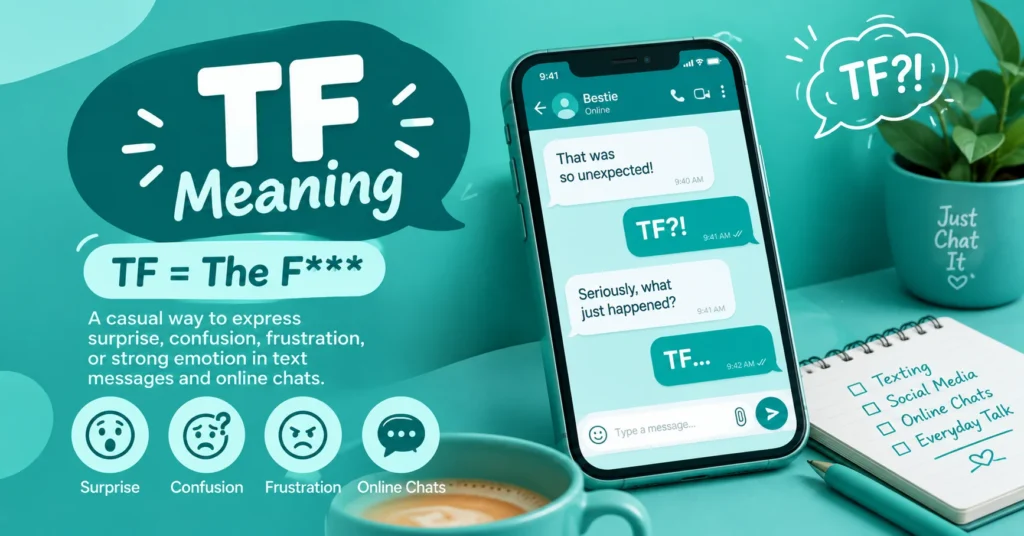
TF usually means “the fuck” in texting and online conversations. It is an informal internet slang abbreviation used to add emphasis or express surprise, confusion, disbelief, frustration, shock, or humor. You may see it in text messages, social media comments, gaming chats, and casual conversations. The exact tone depends on context, audience, punctuation, and the surrounding words.
If you searched for tf meaning because someone suddenly wrote “What TF?” or “How tf did that happen?”, the confusion is understandable. tf meaning is short but emotionally strong. This guide explains the abbreviation, texting slang, internet culture, profanity level, common phrases, alternate meanings, real examples, and situations where a more neutral expression makes more sense.
What Does TF Meaning in Text?
In most texting and social-media contexts, TF is short for “the fuck.” It works as an intensifier, meaning it adds emotional force without fundamentally changing the underlying question or statement. “What happened?” sounds neutral, while “What TF happened?” communicates much stronger surprise, confusion, disbelief, or irritation.
The abbreviation is common in casual digital communication because two letters can convey a strong reaction quickly. You might see “who TF,” “why TF,” “how TF,” or “where TF.” A standalone “TF?” can also work as a blunt reaction to something unexpected, although its precise meaning depends heavily on the conversation.
| Term | Meaning | Typical use | Tone |
| TF | The fuck | Emphasis or reaction | Informal |
| WTF | What the fuck | Strong reaction | Informal |
| AF | As fuck | Intensifying an adjective | Informal |
| TBH | To be honest | Introducing an opinion | Casual |
| NGL | Not gonna lie | Introducing an honest thought | Casual |
The important point is that TF is not automatically angry. A friend might write “How TF did you do that?” after seeing an impressive achievement. In another conversation, “Why TF did you do that?” could sound genuinely annoyed. The words around TF create much of the emotional meaning.

Why Do People Use TF Instead of Writing the Full Phrase?
One reason is speed. Texting culture has always encouraged short expressions, abbreviations, and internet slang. Writing “TF” takes less effort than spelling out the underlying phrase, while still allowing the sender to communicate a strong emotional reaction. The abbreviation also fits naturally into fast-moving chats, comments, gaming conversations, and direct messages.
Another reason is appearance. Although most readers understand what TF represents, abbreviating the profanity makes the expression look less explicit than writing the complete phrase. It can therefore function as a compact emotional marker. In casual online communication, that combination of speed, emphasis, humor, and familiarity explains why TF remains recognizable.
Consider the difference:
- “Where are you?” neutral question.
- “Where TF are you?” stronger urgency or frustration.
- “How did you do that?” ordinary curiosity.
- “How TF did you do that?” amazement, disbelief, or admiration.
The abbreviation therefore changes the tone, rather than simply adding another piece of factual information.
How Is TF Used in Texting?
TF commonly appears after question words such as what, who, why, how, where, and sometimes when. It can also appear inside commands or statements. Examples include “What TF happened?”, “Who TF called you?”, “Why TF is this taking so long?” and “How TF did you finish that so quickly?”
The emotional reading varies with context. A message such as “How TF did you get tickets?” could express excited disbelief. “Why TF did you delete it?” is more likely to communicate frustration. On social media, punctuation and emojis can soften or intensify the reaction, while a period can make the same words feel colder or more serious.
Common situations
Surprise: “TF? You actually won?”
Confusion: “What TF is happening?”
Frustration: “Why TF is my phone doing this?”
Disbelief: “How TF did that even happen?”
Playful amazement: “How TF are you this good?”
Humor: “TF 😂 I wasn’t ready for that.”
These examples show why understanding tf meaning requires more than memorizing the full form. The abbreviation acts as an emotional amplifier, and the surrounding conversation tells you which emotion is most likely.
Is TF Rude or Offensive?
TF can be considered rude or offensive because it abbreviates a profanity. That does not mean every use is intended as an insult. Among close friends, the expression may be playful, humorous, surprised, or admiring. Between strangers, coworkers, customers, teachers, or professional contacts, the same abbreviation can sound unnecessarily aggressive or disrespectful.
Audience matters just as much as the literal phrase. A private group chat may have an informal communication style where TF feels completely ordinary. A business email, school assignment, job application, or customer-service conversation has a different standard. In those settings, neutral alternatives such as “What happened?”, “How did that happen?”, or “What do you mean?” are safer choices.
A useful rule is simple: if you would hesitate to say the full phrase aloud to that person, do not assume abbreviating it makes it appropriate. The letters may be shorter, but the underlying profanity remains recognizable.
When TF feels playful
“Bro, how TF did you win that?”
This can communicate admiration rather than anger, especially between friends.
When TF feels aggressive
“Who TF do you think you are?”
Here the expression directly targets another person and can sound confrontational.
The distinction comes from relationship, sentence structure, situation, and tone, not from the abbreviation alone.
Other Meanings of TF
Although “the fuck” is the dominant meaning when TF appears in casual texting, the abbreviation has many unrelated meanings. Context is therefore essential. In a gaming conversation, TF may refer to Team Fortress. In programming, lowercase tf commonly refers to TensorFlow, while technical documents may use TF for terms such as timeframe, task force, transfer function, or transcription factor.
| Context | Possible TF meaning |
| Texting / internet slang | The fuck |
| Gaming | Team Fortress |
| Programming / AI | TensorFlow |
| Trading | Timeframe |
| Military / government | Task force |
| Engineering | Transfer function |
| Biology | Transcription factor |
| Fan communities | Transformation |
| Entertainment | Transformers |
This is why you should not automatically interpret every occurrence as profanity. If someone writes import tensorflow as tf, for example, the context clearly points to the programming library rather than texting slang. Wikipedia likewise lists many technical, entertainment, geographic, and organizational meanings for TF.
The surrounding words usually solve the ambiguity. “What TF happened?” is clearly slang, while “TF2 server” points toward Team Fortress 2 and “tensorflow as tf” points toward programming.
TF vs Similar Text Abbreviations
TF belongs to a large family of informal internet expressions, but these abbreviations are not interchangeable. WTF means “what the fuck” and commonly functions as a complete reaction. TF is more flexible and often appears inside a sentence: “What TF is this?” or “How TF did that happen?”
AF, meaning “as fuck,” usually intensifies an adjective, as in “tired AF” or “funny AF.” TBH, meaning “to be honest,” introduces an opinion, while NGL, meaning “not gonna lie,” signals an honest or sometimes surprising statement.
| Abbreviation | Full form | Typical function |
| TF | The fuck | Adds emotional emphasis |
| WTF | What the fuck | Strong reaction |
| AF | As fuck | Intensifies an adjective |
| TBH | To be honest | Introduces an opinion |
| NGL | Not gonna lie | Signals honesty |
| IDK | I don’t know | Expresses uncertainty |
| FR | For real | Shows agreement or sincerity |
The biggest distinction between TF and WTF is grammatical. “WTF?” can stand alone as a reaction. TF more often attaches to another phrase, such as “why TF,” “how TF,” or “who TF.” Knowing that difference makes online conversations easier to interpret.
Origin and History of TF
TF developed within the broader history of internet and texting shorthand. Expressions such as WTF, LOL, OMG, and BRB became widespread as online communication and mobile messaging encouraged people to communicate quickly with fewer characters. TF fits naturally into that same culture of abbreviation and emotional shorthand.
Its flexibility helped it develop beyond a fixed phrase. Instead of always using “WTF,” speakers could place TF after different question words: what TF, who TF, why TF, how TF, and where TF. That makes the abbreviation function almost like a reusable grammatical intensifier rather than a single fixed expression.
Modern platforms accelerated that pattern. Text messages, forums, gaming communities, social-media comments, and messaging apps all favor quick reactions. Lowercase “tf” also became common in casual typing because internet communication often ignores conventional capitalization. Today, the abbreviation can communicate anything from genuine frustration to playful disbelief.
There is no reliable single date that can be given as the exact invention of TF in its slang sense. Its development is better understood as part of the broader evolution of abbreviated online language.
How to Use TF Correctly in a Sentence
If you’re using TF casually, the most natural pattern is often question word + TF + rest of sentence. Examples include “Why TF are you awake?”, “How TF did you know?”, “What TF happened?” and “Who TF sent this?” The abbreviation normally strengthens the emotional force of an otherwise understandable sentence.
Context is more important than memorizing a rigid grammar rule. A phrase that makes a friend laugh could sound hostile when sent to a stranger. Avoid inserting TF into every sentence, because constant repetition removes the emphasis and can make your messages seem unnecessarily aggressive.
Here are some natural examples:
- “What TF is going on?”
- “How TF did you solve that?”
- “Why TF is the price so high?”
- “Who TF told you that?”
- “Where TF did everyone go?”
If you need a cleaner version, replace TF with expressions such as “what the heck,” “how in the world,” “why on earth,” or simply “what happened?” The best choice depends on your relationship with the reader and the setting.
A simple audience check
Before sending TF, ask yourself three questions: Is this a casual conversation? Does this person normally use slang? Would the message still feel comfortable if someone else saw it? If the answer is no, choose a neutral expression. That small pause can prevent an otherwise harmless joke from sounding rude.
Conclusion
The most common tf meaning in texting is “the fuck,” an informal abbreviation used to strengthen a reaction, question, or statement. It can communicate surprise, confusion, frustration, disbelief, humor, or admiration, so the surrounding context matters more than the two letters alone.
The safest way to interpret TF is to look at the entire message, the relationship between the people communicating, and the setting. In casual chats and social media, it can be perfectly familiar slang. In professional, academic, or formal communication, a neutral alternative is usually clearer and more appropriate.
FAQs
Author

Ethan Carter is an SEO blogger specializing in internet slang, text abbreviations, and social media meanings. He creates clear, accurate, and reader-friendly content backed by thorough research. His goal is to help readers understand modern online language with reliable, easy-to-read guides.