Upon Meaning: 15 Essential Definitions, Powerful Examples, and Common Mistakes to Avoid
The word upon meanings “on” or “immediately after,” depending on the context. In English grammar, upon is a preposition commonly found in formal writing, instructions, literature, and expressions such as “upon arrival.” It can describe physical position, the timing of an action, or reliance on something. Understanding these meanings makes reading and writing easier, especially when a sentence sounds more formal than everyday conversation.
If you have ever wondered whether upon means something different from on, you are not alone. English learners and native speakers alike encounter it in books, contracts, emails, and everyday announcements. This guide explains its definitions, pronunciation, sentence patterns, idioms, and common mistakes, with practical examples to help you recognize when upon sounds natural and when on is the simpler choice.
Upon Meaning and Definition
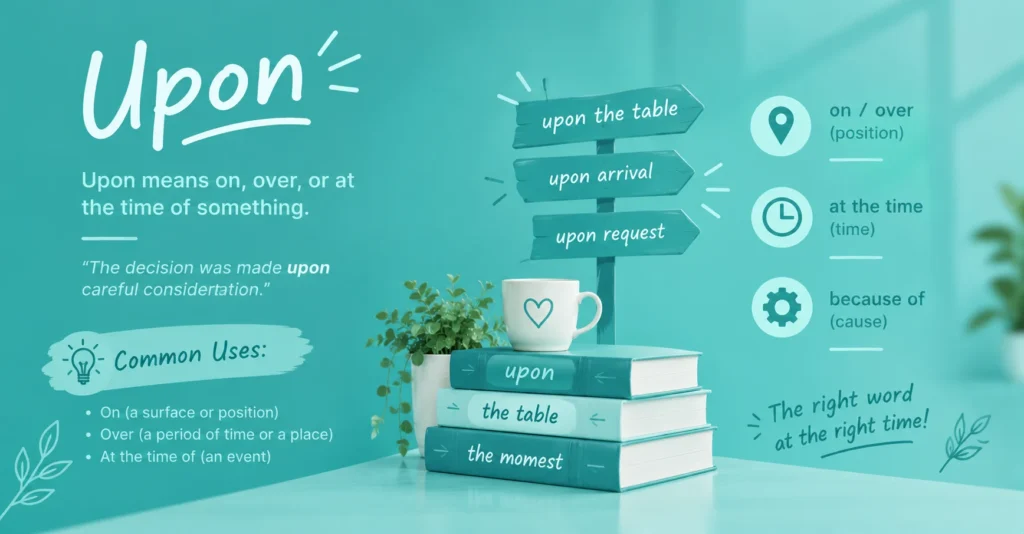
The most common meaning of upon is “on,” as in placing an object on a surface. It can also mean “immediately after” when one event follows another. The intended meaning depends on the surrounding words, the sentence structure, and the situation in which the word appears.
For example, “The keys are upon the desk” describes a physical location, while “Upon receiving the email, Maya replied” describes timing. In both sentences, upon connects ideas. It often sounds more formal than on or after, so understanding the context is more useful than memorizing a single translation.
Quick definition at a glance
| Expression | Meaning |
| The book is upon the table. | The book is on the table. |
| Upon arrival, call me. | Call me when you arrive. |
| Success depends upon practice. | Success relies on practice. |
| The holidays are upon us. | The holidays are approaching or here very soon. |
| Once upon a time | A traditional way to begin a story. |
Upon Meaning in Physical Position
When upon meaning describes physical position, it usually means that one object rests on, touches, or is supported by another. This usage resembles on and is particularly common in formal descriptions, literature, and carefully written English. The phrase describes a relationship between objects rather than the timing of an event.
Consider the sentence, “She placed the letter upon the table.” The letter is physically on the table. In ordinary American conversation, most people would say, “She placed the letter on the table.” Both versions are understandable, but upon can create a more formal or literary tone.
Examples of physical position
- The child climbed upon the horse.
- Snow rested upon the rooftops.
- He placed his hand upon her shoulder.
- The crown sat upon the king’s head.
Each example describes position or contact. In everyday conversation, on is generally the simpler choice, but upon remains useful when the writer wants a formal, traditional, or expressive style.

Upon Meaning in Time and Sequence
Another important meaning of upon is “immediately after” or “when.” It introduces an event that happens after a particular action or point in time. This construction is especially common in instructions, workplace communication, official notices, and formal written English.
For example, “Upon completing the application, submit it online” means that you should submit the application after finishing it. Likewise, “Upon hearing the news, Jordan called his family” means the call followed the news. The word connects the first event with the next step in a concise way.
Common time-related examples
- Upon arrival, check in at the front desk.
- Upon receiving payment, the seller will ship the order.
- Upon completion of the course, students receive a certificate.
- Upon hearing the announcement, everyone applauded.
- Upon opening the package, she found a handwritten note.
Notice that upon is often followed by a noun or an -ing form, such as arrival, completion, receiving, or hearing. In many sentences, you can replace it with “after” or “when” without changing the essential meaning.
Upon Meaning in Formal English
In formal English, upon is often used where on would also be grammatically correct. It appears in professional correspondence, academic writing, legal documents, policies, and literary passages. Its presence can make a sentence sound more traditional, measured, or official, but it does not automatically make the writing clearer or more accurate.
For example, “The decision was based upon the available evidence” and “The decision was based on the available evidence” communicate essentially the same idea. The second version is more direct and common in contemporary American English. Choose upon when it fits the established expression or the tone of the text, not simply to make a sentence sound sophisticated.
When should you use upon instead of on?
Use upon when it sounds natural in a familiar expression, formal instruction, or literary sentence. Use on when you want straightforward everyday language. In phrases such as “once upon a time” and “call upon,” replacing the word may change the expression’s tone or conventional form.
For instance, “Please call upon your supervisor if you need assistance” sounds formal, while “Please ask your supervisor for help” is more conversational. Both can work, but the best option depends on your audience, purpose, and preferred writing style.
Upon Meaning in American and British English
In both American and British English, upon generally carries meanings similar to on. It can indicate a position, an event that follows another, or something that is about to happen. There is no major difference in the word’s central meaning between the two varieties of English.
The more noticeable difference is often stylistic. American speakers commonly prefer on in casual conversation, while upon is still used in formal writing, literature, and established expressions on both sides of the Atlantic. For example, “The weekend is upon us” is understandable in both varieties and suggests that the weekend is arriving soon.
Is upon old-fashioned?
Not entirely. Some uses of upon sound literary or formal, but the word remains active in modern English. Expressions such as “upon arrival,” “depend upon,” and “the deadline is upon us” continue to appear in instructions, business communication, news, and ordinary writing.
The important distinction is between the word itself and the tone of a sentence. Upon is not incorrect or obsolete; it simply tends to be less conversational than on in many contexts.
Upon Meaning in Idioms and Common Expressions
The meaning of upon can become more specific when it appears in an established phrase. Idioms and verb combinations often carry meanings that are not fully explained by translating each word separately. Learning these expressions helps readers understand formal notices, stories, professional communication, and common English phrases.
One familiar example is “once upon a time,” which traditionally introduces a fairy tale or fictional story. Other expressions, such as “depend upon,” “call upon,” and “take it upon oneself,” have different meanings depending on the verb and context. Learning the whole phrase is often more useful than memorizing the definition of upon alone.
Common expressions using upon
| Expression | Meaning | Example |
| Once upon a time | A traditional story opening | Once upon a time, a young traveler lived near the sea. |
| Upon arrival | When someone arrives | Upon arrival, show your ticket. |
| Depend upon | Rely on | We depend upon accurate information. |
| Call upon | Request help or formally ask someone to act | The teacher called upon Sam to answer. |
| Take it upon oneself | Voluntarily accept responsibility | She took it upon herself to organize the event. |
| Agree upon | Reach agreement on something | The team agreed upon a final date. |
| Upon further review | After examining something more closely | Upon further review, we corrected the report. |
These expressions illustrate why context matters. In “depend upon,” the word expresses reliance; in “upon arrival,” it indicates timing. The spelling stays the same, but the phrase determines how the reader interprets the sentence.
Upon Meaning in Example Sentences
The easiest way to understand upon is to compare it with simpler wording in complete sentences. The examples below demonstrate position, time, dependence, and approaching events. Reading each sentence aloud can also help you notice whether upon sounds natural or unnecessarily formal in that context.
In everyday American English, you will often be able to replace upon with on, after, or when. However, do not make substitutions automatically in established idioms. The goal is to understand the relationship the word expresses and then choose wording that suits the situation.
Seven clear examples
1. “The cat jumped upon the sofa.” Meaning: The cat jumped onto the sofa.
2. “Upon receiving the package, call the office.” Meaning: Call the office after the package arrives.
3. “The outcome depends upon your decision.” Meaning: The outcome relies on your decision.
4. “The holidays are upon us.” Meaning: The holidays are approaching or beginning very soon.
5. “Once upon a time, a farmer lived in a small village.” Meaning: This is a traditional opening for a fictional story.
6. “Upon reviewing the document, we noticed an error.” Meaning: We noticed the error after reviewing the document.
7. “The responsibility fell upon the manager.” Meaning: The manager became responsible for the task.
These examples show that upon does not have one identical meaning in every sentence. Position, timing, responsibility, and reliance are related through grammar and context, but each sentence requires the reader to interpret the complete phrase.
Upon Meaning and Word Origin
The history of upon helps explain why it resembles on. Dictionary sources trace it through Middle English, connecting the elements up and on. Its recorded history extends back several centuries, and the word has continued to serve different grammatical and stylistic purposes as English has evolved.
Although the word has a long literary history, its modern uses are not limited to old stories or poetry. It still appears in instructions, business writing, news, and familiar phrases. Understanding both its historical background and present-day usage gives readers a clearer sense of why upon sometimes sounds formal while remaining perfectly natural in the right context.
Conclusion
Understanding the meaning of “upon” helps make everyday English easier to read, write, and understand. This word is commonly used to describe something happening after an event, being placed on a surface, or depending on a particular situation. Its exact meaning can change depending on the sentence, so looking at the surrounding words is important.
Although “upon” is slightly more formal than “on,” both words can have similar meanings in many contexts. Learning how to use “upon” correctly can improve your vocabulary and communication skills. With regular practice and simple examples, you can confidently recognize this useful word and use it naturally in your writing and conversations.
FAQs
Author

Ethan Carter is an SEO blogger specializing in internet slang, text abbreviations, and social media meanings. He creates clear, accurate, and reader-friendly content backed by thorough research. His goal is to help readers understand modern online language with reliable, easy-to-read guides.