WTH Meaning: 15 Shocking Interpretations & Amazing Examples in Online Chats
WTH usually means “what the hell?” or the milder “what the heck?” in text messages and online conversations. People use this common internet slang abbreviation to express surprise, confusion, disbelief or frustration when something unexpected happens. The intended tone depends on the words, punctuation and situation surrounding it.
If you’ve received a message containing wth meaning and wondered whether the sender was joking or upset, you’re not alone. Understanding texting abbreviations, digital communication and informal American English can help you interpret a message more confidently. This guide explains the full form, real-world examples, social media usage and polite alternatives so you can respond naturally without guessing what someone meant.
What Does WTH Mean in Texting?
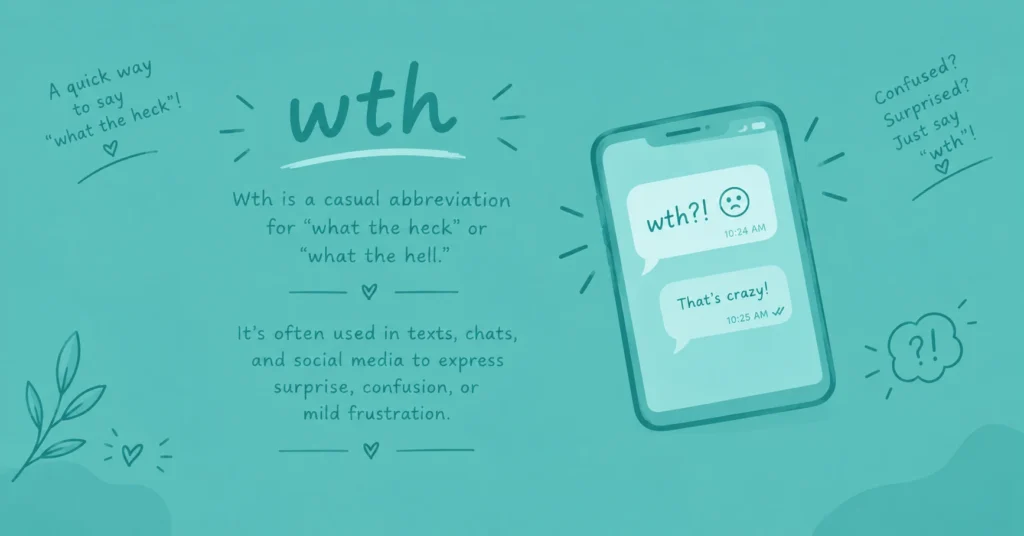
In texting, wth meaning most commonly stands for “what the hell” or “what the heck.” Both expressions communicate a strong reaction to something unexpected, strange or difficult to understand. WTH is an informal initialism used in text messages, online chats and social media conversations.
For example, imagine your friend tells you that a concert was canceled just minutes before it started. You might reply, “WTH? I was already on my way!” Here, the abbreviation communicates surprise and frustration. It doesn’t automatically mean you’re angry at your friend; the situation determines the emotional meaning.
Example
Consider this everyday exchange:
Alex: “I accidentally sent our private group chat screenshot to the whole class.”
Jordan: “WTH”
Jordan’s response expresses disbelief and perhaps nervous laughter. In another conversation, the same abbreviation might communicate irritation. Emojis, punctuation and the surrounding messages help readers understand the intended tone.
What Is the Full Form of WTH?
The two most common expansions of WTH are “what the hell” and “what the heck.” The first can sound stronger, while the second is a milder alternative. People often choose WTH because it is quicker to type than the complete phrase and is familiar in informal digital communication.
| Expression | Typical meaning | Tone |
| WTH | What the hell / what the heck | Surprise, confusion or frustration |
| What the heck | A milder exclamation | Casual, sometimes playful |
| What the hell | A stronger exclamation | Shock, disbelief or annoyance |
| WTF | What the f | Generally more vulgar and forceful |
The letters can also take on other interpretations in a specific context. For instance, a sentence asking “WTH happened?” is usually asking what happened, while “WTH are you?” could be intended as “where the heck are you?” or “what the heck are you?” depending on the conversation. Don’t assume every occurrence has precisely the same expansion.
Why Do People Use WTH?
People use WTH to react quickly when something surprises, confuses or frustrates them. Instead of typing an entire sentence, they can use three letters to communicate an immediate emotional response. This shorthand is particularly useful in casual texting, group chats, online gaming and social media comments, where conversations often move quickly.
Imagine opening your phone and discovering that your flight has been delayed for six hours. You might text a friend, “WTH, the airline just changed everything!” The abbreviation conveys disbelief without requiring a long explanation. It can also be humorous: “WTH, you finished the entire pizza yourself?” may be friendly teasing rather than genuine criticism.
WTH Makes a Message Feel More Emotional
Compare “You changed the plan?” with “WTH, you changed the plan?” The second version sounds more surprised or frustrated because the abbreviation adds an emotional reaction. However, it doesn’t reveal the sender’s exact feelings on its own. Their relationship, previous messages and the circumstances all contribute to interpretation.
Is WTH Rude?
WTH is not automatically rude, but it can sound impolite depending on how it is used. Among close friends, it may be a playful reaction to an unexpected joke or surprising announcement. During an argument, however, the same abbreviation can make a message sound confrontational, impatient or dismissive.
Consider the difference between “WTH 😂 you actually did that?” and “WTH is wrong with you?” The first might communicate amused disbelief, while the second directly challenges another person’s behavior. If you aren’t sure how a recipient will interpret your words, use a neutral question such as “What happened?” or “Can you explain what you mean?”
WTH Can Be Playful
A friend says, “I ate ice cream for breakfast.” You reply, “WTH 😂.” The laughing emoji and familiar relationship make the response sound like friendly teasing. In this situation, the abbreviation communicates surprise without necessarily criticizing the person’s decision.
WTH Can Be Annoyed
Now imagine a coworker deletes the only copy of an important shared document. Responding with “WTH! That was our only copy!” may express genuine frustration. Although understandable, the wording could escalate the disagreement. A calmer response “What happened to the document? Can we recover it?” is more constructive.
WTH Can Sound Aggressive
When WTH is directed at a person during a tense conversation, it may sound like an accusation. For example, “WTH are you doing?” can communicate anger rather than simple curiosity. If your intention is to ask for clarification, wording the question neutrally can reduce the chance of a misunderstanding.
Is WTH a Bad Word?
Whether WTH counts as a bad word depends on which phrase the sender intends. “What the heck” is generally considered mild, while “what the hell” may be regarded as mild profanity by some people. WTH is usually less vulgar than WTF, but it remains informal slang.
In a conversation with friends, WTH may be perfectly acceptable. In a school assignment, formal email, customer-service response or professional presentation, spelling out your question more politely is usually a better choice. The important distinction is between understanding the abbreviation and deciding whether it suits your audience.
Avoid WTH in Formal Messages
Instead of writing “WTH happened to the report?” to your manager, try “Could you clarify what happened to the report?” The alternative communicates the same request without sounding frustrated. Professional language is particularly useful when you don’t know the recipient well or when the issue is sensitive.
WTH Meaning on Social Media
On social media, WTH commonly appears in comments, captions, direct messages and group conversations. Users employ it to react to surprising videos, confusing posts, unexpected announcements or funny situations. The abbreviation saves space and communicates emotion quickly, which makes it useful in informal digital communication.
For example, someone might comment “WTH did I just watch?” beneath a bizarre video. Another person might reply “WTH 😂” to a friend’s unexpected announcement. Neither response necessarily indicates anger. The content of the post, the surrounding discussion and the use of emojis help clarify the intended reaction.
Social Media Example
Suppose a friend posts a photograph of a cake that looks completely different from what they intended to bake. You comment, “WTH happened to the frosting? 😂” In a friendly exchange, this can be humorous rather than insulting. With a stranger or a sensitive subject, the same words might feel unnecessarily critical.
WTH Meaning in Gaming
In online gaming, WTH is a quick way to express confusion, surprise or frustration when something unexpected happens. Players might type it after a surprising move, an unusual game result or a sudden technical glitch. The abbreviation works well in fast-moving chats because it communicates a reaction without requiring a lengthy explanation.
For example, a player might write, “WTH was that move?” after an opponent performs an unexpected maneuver. Another might say, “WTH, how did we win that match?” after a surprising victory. The meaning depends on the moment: it could signal disbelief, amusement, irritation or genuine confusion.
Gaming Example
Imagine playing a multiplayer match when your character suddenly gets stuck behind a wall. You type “WTH is happening?” to show confusion about the game’s behavior. Teammates can usually infer that something unexpected has occurred, although a clearer description may be necessary if you want help fixing the problem.
How to Respond
The best way to respond to WTH depends on what the sender is reacting to. If they seem confused, explain what happened. If they’re joking, a playful response may fit. If they sound upset, acknowledge their concern and answer calmly instead of matching their frustration.
For example, if a friend sends “WTH? You bought another car?” you might reply, “I know, it was an unexpected decision!” If they write “WTH happened to the deadline?” at work, a more useful response would be, “The timeline changed yesterday; let me explain why.” The aim is to respond to the message’s intent, not just the abbreviation.
Casual Replies
If a friend uses WTH jokingly, you could reply with “I know, right?” or “Honestly, I was surprised too.” If the sender is genuinely confused, give a short explanation. Matching the conversational tone helps keep the exchange natural without creating unnecessary misunderstanding.
Funny Replies
When the conversation is lighthearted, a response such as “I was wondering the same thing 😂” can keep the joke going. Humor works best when both people understand the context. If the sender is angry or discussing something serious, a funny reply may come across as dismissive.
Calm Replies
If the message seems frustrated, acknowledge the situation before explaining. You might say, “I can see why that surprised you,” or “Let me explain what happened.” This approach is more constructive than replying with another emotional abbreviation and can help prevent a minor misunderstanding from becoming an argument.
Professional Replies
In a work conversation, replace slang with clear, courteous language. Instead of replying “WTH?” to an unexpected change, ask, “Could you clarify what changed?” This communicates confusion without sounding confrontational and makes it easier for colleagues, managers or clients to respond helpfully.
Conclusion
The most common WTH meaning is “what the hell” or “what the heck.” People use this informal abbreviation in texting, gaming and social media to express surprise, confusion, disbelief or frustration. The exact meaning depends on the surrounding conversation, punctuation, emojis and relationship between the people communicating.
WTH can sound playful between friends but may seem rude during an argument or inappropriate in a professional message. When you’re unsure, consider the context before responding. Understanding this small piece of internet slang makes it easier to interpret online conversations and choose a reply that fits the situation.
FAQs
Author

Ethan Carter is an SEO blogger specializing in internet slang, text abbreviations, and social media meanings. He creates clear, accurate, and reader-friendly content backed by thorough research. His goal is to help readers understand modern online language with reliable, easy-to-read guides.