TMW Meaning: 2 Surprising Meanings in Text & Social Media
TMW meaning in text usually refers to “tomorrow” in casual messages or “that moment when” in memes and social media posts. The correct interpretation depends on the sentence, the conversation, and what the sender is trying to communicate. For example, “See you tmw” refers to the next day, while “TMW you forget your password” introduces a relatable situation.
If you have ever received an unfamiliar abbreviation from a friend, seen it on Snapchat, or encountered it in a TikTok caption, you are not alone. Understanding texting slang can make online conversations less confusing. This guide explains both meanings, everyday examples, platform-specific usage, and the simple clues that help you interpret TMW correctly.
What Does TMW Mean in Text?
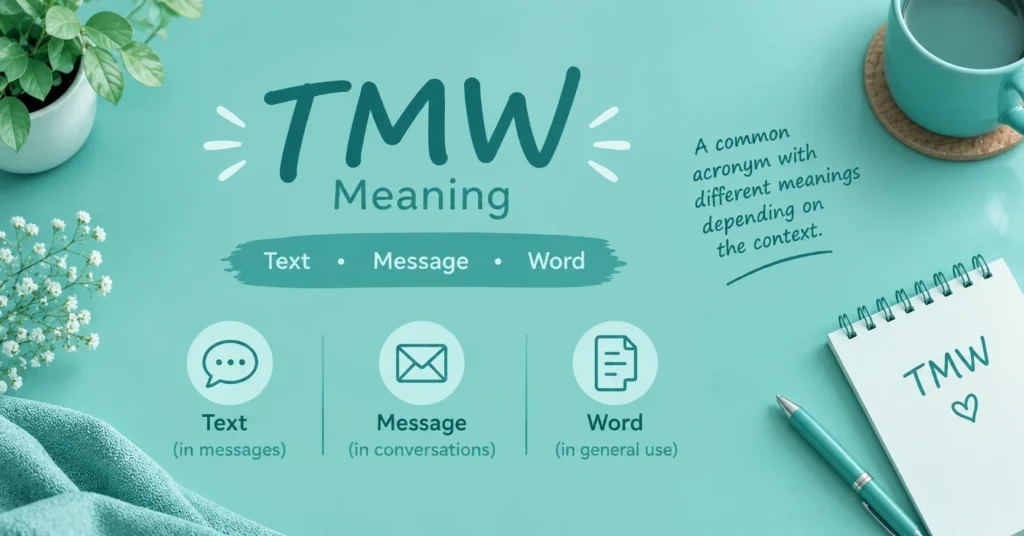
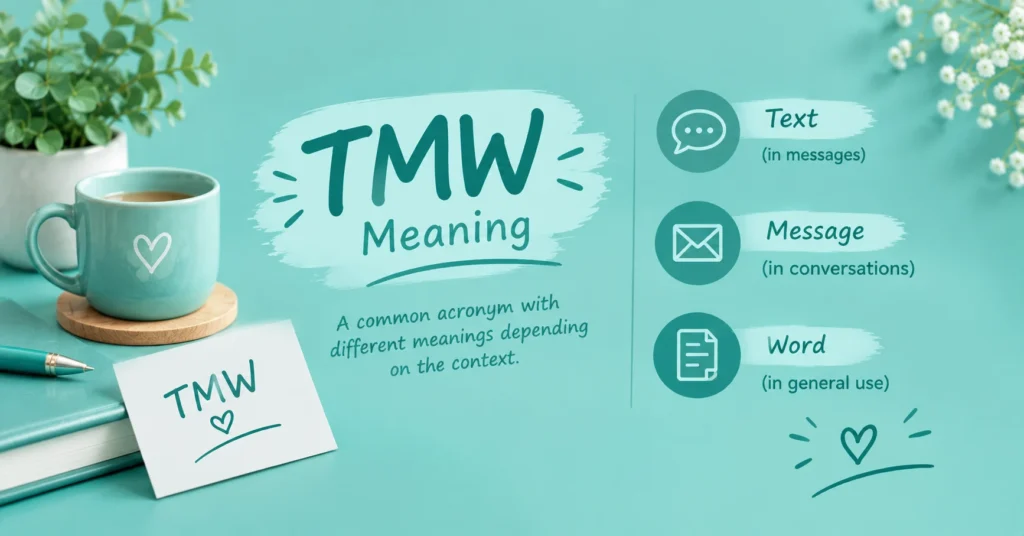
TMW has two common meanings in digital communication: “tomorrow” and “that moment when.” In everyday texting, people use the first meaning to discuss plans, appointments, deadlines, and upcoming events. The second meaning is common in meme captions, humorous posts, and relatable online situations.
Consider these examples: “Can we talk tmw?” means “Can we talk tomorrow?” Meanwhile, “TMW you open the fridge for the fifth time” introduces a familiar experience. Although the abbreviation looks identical, the sentence structure makes its intended meaning clear. Reading the complete message is more reliable than guessing from the letters alone.
Quick answer: TMW meaning at a glance
| Expression | Meaning | Example |
| TMW or tmw | Tomorrow | “See you tmw!” |
| TMW | That Moment When | “TMW your favorite song starts playing.” |
| TMW in a specialized context | Context-dependent initials | Check the relevant industry or conversation |
The two main meanings are the ones most useful to recognize in ordinary online communication. Other interpretations may exist within specific communities, but they should not be assumed without contextual evidence.
Full Form, Stands For & Short Meaning of TMW
When TMW refers to tomorrow, it is an informal shortened spelling of the word. It saves typing time without changing the intended date. People may use it when arranging a meeting, discussing schoolwork, confirming an appointment, or telling someone when a task will be completed.
When TMW means “that moment when,” it functions as an initialism formed from the first letters of three words. This version introduces a recognizable situation or reaction. It is especially suitable for humorous captions, awkward experiences, relatable jokes, and online storytelling. The surrounding words determine which interpretation makes sense.
TMW meaning as “tomorrow”
Imagine a friend texting, “Are we still going shopping tmw?” The friend is asking whether the plan is still happening the next day. Similarly, “I have an exam tmw” communicates an upcoming school responsibility without spelling out the entire word.
This abbreviation is casual, not a replacement that works equally well in every situation. It fits naturally in direct messages and group chats, where participants already understand one another. In a formal email or official document, writing “tomorrow” is generally clearer and more professional.
TMW meaning as “that moment when”
The expression “that moment when” introduces a situation people recognize or find emotionally relatable. For instance, “TMW you wave at someone who was waving at the person behind you” describes an awkward experience many people can imagine.
This format is popular in meme-style communication because a short phrase establishes the situation before the joke or reaction. The feeling might be embarrassment, excitement, relief, frustration, or amusement. Unlike the scheduling meaning, this version does not refer to the following calendar day.
How People Use TMW in Everyday Messages
In ordinary conversations, tmw meaning can make a message shorter and more relaxed. Someone arranging a coffee date might write, “Coffee tmw?” A student might send, “Can you share the notes tmw?” A coworker might write, “I’ll finish the draft tmw.” In each example, the abbreviation refers to the next day.
In meme-style communication, TMW serves a different purpose. It introduces a moment that the reader is expected to recognize. A caption such as “TMW you finally find the phone you’ve been holding” uses the phrase to set up a humorous situation. The meaning becomes obvious when you consider whether the message describes a future plan or a recognizable experience.
Real text conversations using TMW
Conversation 1: Making plans
Alex: “Are you free tmw?”
Jordan: “Yeah, after 4.”
Here, TMW means tomorrow because the participants are discussing availability.
Conversation 2: Talking about a deadline
Sam: “I’ll send the assignment tmw.”
Taylor: “It’s due tmw morning!”
Both uses refer to the following day, although the second message makes the deadline more urgent.
Conversation 3: A relatable meme
Caption: “TMW you study for hours and the teacher postpones the test 😂”
Here, TMW means “that moment when.” The caption presents a situation and invites readers to recognize the feeling.
These examples also show that the abbreviation itself does not automatically communicate emotion. The rest of the sentence, punctuation, emojis, and relationship between the people provide the tone.
TMW Meaning Across WhatsApp, Instagram, TikTok & Snapchat
TMW does not have a completely separate definition for every social platform. Instead, the type of content and the surrounding conversation provide the strongest clues. Direct messages often use the scheduling meaning, while meme captions and reaction posts can use “that moment when.”
On WhatsApp, someone might write, “I’ll call you tmw.” On Instagram, a Reel caption might begin, “TMW your favorite artist notices your comment.” On TikTok, a video might show an awkward situation with a TMW caption. On Snapchat, a friend might send, “See you tmw!” Each example should be interpreted according to its context rather than the platform alone.
TMW on WhatsApp
WhatsApp conversations often involve plans, family arrangements, work messages, and everyday updates. In these situations, TMW commonly refers to tomorrow.
Example: “Please send me the pictures tmw.”
The sender means that the pictures should be sent the following day. If the abbreviation appears in a joke shared through WhatsApp, however, “that moment when” might be the intended interpretation.
TMW on Instagram
Instagram users may encounter TMW in direct messages, comments, Stories, Reels, and meme posts. A message saying “Are you coming tmw?” refers to tomorrow. A caption saying “TMW your favorite song comes on at the perfect moment” introduces a relatable experience.
The content around the abbreviation matters more than whether it appears in a caption or private message. Check the sentence before deciding what the sender means.
TMW on TikTok
TikTok’s short-form videos and meme captions provide a natural setting for “that moment when.” A creator might show an embarrassing mistake and add a TMW caption to introduce the situation.
For example, “TMW you realize you were on mute the entire meeting” describes a recognizable experience. In a direct message about an upcoming event, TMW can still mean tomorrow. The format of the content helps you distinguish the two.
TMW on Snapchat
On Snapchat, friends may use TMW to coordinate plans or add text to a Snap. “Movie tmw?” is a casual invitation to watch a movie the next day.
A humorous Snap could instead use “TMW your alarm rings on your day off.” In this case, the phrase introduces a relatable moment. Neither interpretation is inherently rude or offensive; the surrounding message determines the tone.
TMW vs Tomorrow: What Is the Difference?
The difference is mainly spelling, style, and context. When TMW means tomorrow, it communicates the same basic time reference as the full word. When it means “that moment when,” however, it serves a different grammatical and conversational purpose.
| Feature | TMW meaning tomorrow | TMW meaning that moment when |
| Main purpose | Refer to the following day | Introduce a recognizable situation |
| Common setting | Texts and scheduling chats | Memes, captions, and jokes |
| Example | “Meeting tmw at noon” | “TMW you forget why you entered the room” |
| Typical tone | Casual and practical | Humorous, emotional, or relatable |
| Best clue | A future plan or deadline | A situation or experience follows |
Capitalization usually does not change the intended meaning in casual messaging. You may see “tmw,” “TMW,” or “Tmw.” Similarly, “TMRW” is another informal abbreviation for tomorrow. It is useful to recognize these variations, but you should not assume that every abbreviation has one universal interpretation.
Should you use TMW in professional communication?
For a message to a close coworker, TMW might be understood without any difficulty. In a formal email to a client, manager, teacher, or unfamiliar contact, writing “tomorrow” is usually the safer choice.
For example, “I’ll submit the report tomorrow morning” is clearer than “I’ll submit the report tmw.” The full word avoids unnecessary ambiguity and maintains a professional tone. The goal is not to eliminate informal language everywhere; it is to choose wording appropriate to the audience and purpose.
Conclusion
The easiest way to understand TMW meaning is to read the entire sentence. In everyday texts about meetings, deadlines, and future plans, it usually means “tomorrow.” In meme captions and relatable online posts, it can mean “that moment when.”
Recognizing these two meanings helps you understand messages on WhatsApp, Instagram, TikTok, Snapchat, and other online platforms without guessing. When clarity matters especially in professional communication use the complete word “tomorrow.” When reading a caption or joke, look for the situation that follows TMW. Context is the simplest and most reliable guide.
FAQs
Author

Ethan Carter is an SEO blogger specializing in internet slang, text abbreviations, and social media meanings. He creates clear, accurate, and reader-friendly content backed by thorough research. His goal is to help readers understand modern online language with reliable, easy-to-read guides.