
RDW Blood Test High Meaning: Causes & Results Explained
A high RDW blood test means your red blood cells vary more in size than expected, but it does not identify a diagnosis by itself. RDW, or red cell distribution width, is commonly included in a complete blood count (CBC) and is interpreted alongside hemoglobin, MCV, RBC count, hematocrit, and other red blood cell indices.
Seeing an abnormal result can be unsettling, especially when a lab report simply flags a number as “high.” The good news is that RDW is a clue rather than a verdict. Understanding red blood cell size variation, anemia, iron deficiency, vitamin B12, folate, MCV, and the laboratory reference range can make the result much easier to discuss with a healthcare professional.
What Does High RDW Mean? RDW Blood Test High Meaning
A high RDW means there is greater variation in the size and volume of your red blood cells. The medical term for this variation is anisocytosis. RDW is generally part of a CBC, and clinicians use it with other blood measurements to understand patterns involving red blood cell production, anemia, and nutritional deficiencies.
The result does not tell you why the cells differ in size. A high RDW may occur with iron deficiency, vitamin B12 or folate deficiency, some forms of anemia, recent blood loss, recovery from blood loss, or other medical conditions. Your symptoms, medical history, hemoglobin, and MCV help give the number its clinical meaning.
For example, imagine someone sees “RDW: high” on a routine CBC and immediately worries that the result means a serious disease. That conclusion would be premature. RDW alone cannot diagnose anemia, cancer, or another specific condition. The rest of the CBC and, when appropriate, additional testing provide the missing context.
What Is a Normal RDW Range? RDW Blood Test High Meaning
There is no single universal RDW reference range for every laboratory. RDW-CV is commonly reported as a percentage, and many adult laboratory ranges fall around 12% to 15%, although the exact interval depends on the laboratory, analyzer, and reporting method. Your own report’s reference range should take priority over a generic internet range.
Cleveland Clinic lists a typical RDW range of about 12% to 15%, while MedlinePlus emphasizes that reference ranges can vary between laboratories. This is why an RDW of a particular value should not automatically be labeled abnormal without looking at the range printed beside your result.
It is also important to determine whether your report gives RDW-CV or RDW-SD. RDW-CV is generally expressed as a percentage, whereas RDW-SD is reported in femtoliters. These measurements use different calculations and should not be interpreted using the same reference range.
What Causes High RDW? RDW Blood Test High Meaning
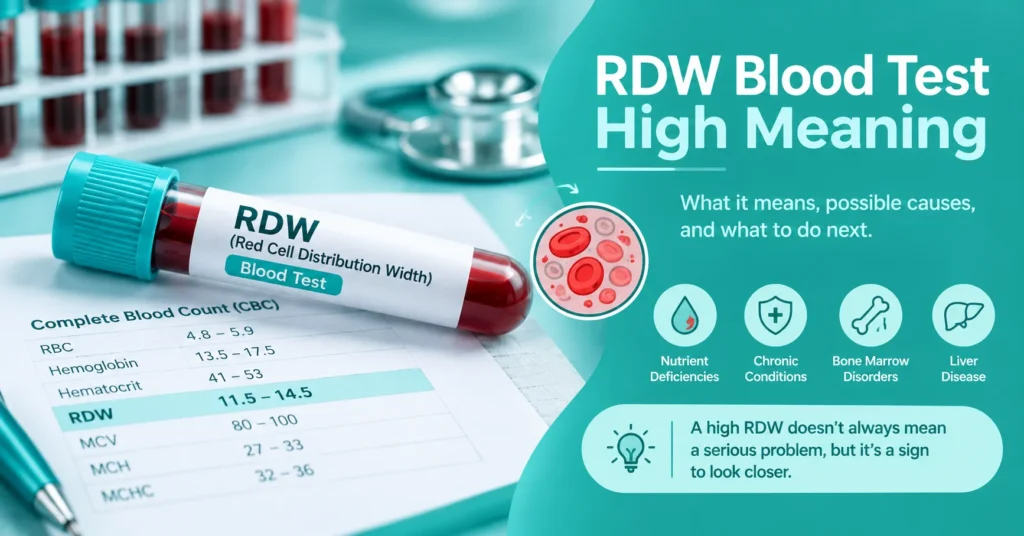
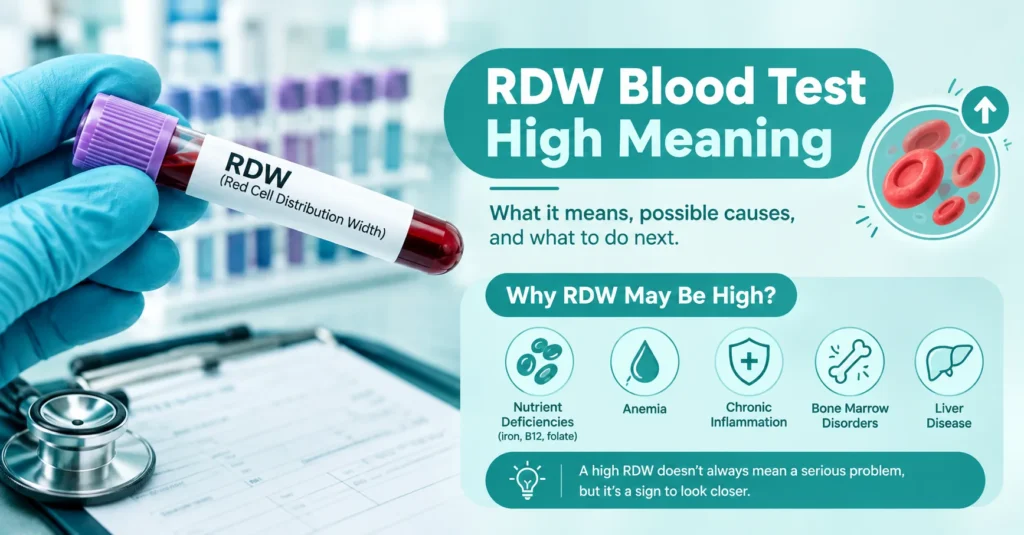
A high RDW can have several possible causes, which is why the number should be interpreted with the rest of the CBC. Common possibilities include iron deficiency, vitamin B12 deficiency, folate deficiency, certain types of anemia, recent blood loss, mixed nutritional deficiencies, and recovery after changes in red blood cell production.
Iron deficiency is especially important because red blood cells produced during iron deficiency can differ in size from older cells already circulating in the bloodstream. Vitamin B12 and folate deficiency can produce a different pattern involving larger red blood cells. A recent transfusion can also temporarily introduce red blood cells with different characteristics.
Other medical conditions have been associated with abnormal RDW, including chronic disease, kidney disease, liver disease, diabetes, cardiovascular disease, and some cancers. However, an elevated RDW does not mean that you have one of these conditions. These associations are reasons clinicians consider the broader clinical picture rather than treating RDW as a standalone diagnosis.
High RDW and Anemia RDW Blood Test High Meaning
RDW can be useful when clinicians are evaluating anemia, a condition in which the blood does not have enough healthy red blood cells or hemoglobin to adequately carry oxygen. Symptoms associated with anemia can include fatigue, weakness, dizziness, pale skin, headaches, and shortness of breath.
A high RDW can help provide clues about the type or possible cause of anemia, but it cannot diagnose anemia on its own. Hemoglobin and hematocrit are particularly important when determining whether anemia is actually present, while MCV helps describe the average size of the red blood cells.
This distinction matters because two people can have the same elevated RDW but completely different underlying situations. One person may have early iron deficiency, another may have vitamin deficiency, and another may have a different reason for variation in red blood cell size.
High RDW and Low MCV Meaning RDW Blood Test High Meaning
When RDW is high and MCV is low, the combination can be seen with iron deficiency anemia and other microcytic conditions. MCV, or mean corpuscular volume, measures the average size of red blood cells, while RDW describes how much those cell sizes vary.
Iron deficiency is one important possibility because newly produced red blood cells may become smaller as iron availability falls, while older cells may remain closer to their previous size. This mixture can increase the variation detected by RDW.
Still, the combination does not prove iron deficiency. A healthcare professional may consider ferritin, serum iron, transferrin-related measurements, hemoglobin, RBC count, medical history, dietary factors, and possible sources of blood loss before determining what the pattern means.
High RDW and High MCV Meaning RDW Blood Test High Meaning
When RDW is high and MCV is high, the pattern may be associated with vitamin B12 deficiency, folate deficiency, macrocytic anemia, or certain other conditions. MCV tells you that red blood cells are larger than average overall, while RDW indicates that their sizes are also more variable.
This combination can occur when the body is not receiving or absorbing enough nutrients needed for normal red blood cell production. Vitamin B12 and folate are important for healthy blood-cell development, so clinicians may consider those nutrients when the CBC shows this pattern.
A high MCV can have other explanations as well, meaning the result should not be interpreted as proof of a vitamin deficiency. Medication use, liver disease, alcohol exposure, thyroid disorders, and other clinical factors can sometimes affect red blood cell indices.
Can RDW Be High Without Anemia? RDW Blood Test High Meaning
Yes, RDW can be high even when hemoglobin is normal. This is an important reason not to interpret a single flagged RDW result as an anemia diagnosis. RDW describes red blood cell size variation, while hemoglobin helps determine whether the blood has an adequate concentration of its oxygen-carrying protein.
A person can therefore have increased red blood cell size variation while other CBC measurements remain within their laboratory’s reference ranges. Early nutritional changes, recovery from blood loss, or other changes in red blood cell production can contribute to this pattern.
The appropriate response is usually to look at the complete CBC and clinical context rather than trying to “treat” the RDW number itself. Depending on the overall results and symptoms, a healthcare professional may recommend monitoring or additional laboratory evaluation.
Is High RDW Dangerous? RDW Blood Test High Meaning
A high RDW is not, by itself, a diagnosis or a measure of how dangerous a condition is. Its importance depends on the degree of abnormality, the laboratory’s reference range, other CBC results, symptoms, medical history, and whether the finding persists over time.
A mildly elevated result with otherwise reassuring blood counts may have a different significance from a substantially abnormal RDW accompanied by low hemoglobin, abnormal MCV, persistent fatigue, shortness of breath, dizziness, or other concerning findings.
This is why online searches for a single “dangerous RDW level” can be misleading. There is no universal RDW number that independently establishes an emergency. If your report is abnormal, the most useful step is to review the entire result with the clinician who ordered the test.
What Tests May Be Checked After High RDW? RDW Blood Test High Meaning
If an RDW result is abnormal, additional testing depends on the rest of the CBC and your individual circumstances. Possible tests can include ferritin, serum iron and other iron studies, vitamin B12, folate, reticulocyte count, and a peripheral blood smear.
Ferritin can help assess stored iron, while vitamin B12 and folate testing can help investigate nutritional causes. A reticulocyte count provides information about newly produced red blood cells. A peripheral smear allows a laboratory professional to examine blood-cell appearance directly.
Not everyone with a high RDW needs every test listed above. The appropriate workup depends on symptoms, age, medical history, medications, dietary factors, other CBC values, and the clinician’s assessment.
How does an RDW test work? RDW Blood Test High Meaning
RDW is generated from measurements of red blood cells in a blood sample and is commonly included with a CBC. The result describes how widely red blood-cell sizes vary. A blood draw generally takes only a few minutes, with minor discomfort or bruising possible afterward.
What other tests check on red blood cells? RDW Blood Test High Meaning
Other red blood cell indices include MCV, MCH, and MCHC. MCV describes average red blood cell size, MCH describes the average amount of hemoglobin per red blood cell, and MCHC describes hemoglobin concentration within the cells. Looking at these values together provides more context than RDW alone.
Conclusion
A high RDW blood test means there is more variation than usual in the size of your red blood cells. While this result can be linked to conditions such as iron deficiency, vitamin deficiencies, anemia, or other health issues, it does not identify a specific disease on its own. Doctors usually consider RDW alongside hemoglobin, MCV, and other blood test results to understand the bigger picture. If your RDW is elevated, there is no need to panic, but it is worth discussing the result with a healthcare professional.
Understanding what is causing the change can help guide the right next steps and ensure any underlying issue is addressed.
FAQs
Author

Ethan Carter is an SEO blogger specializing in internet slang, text abbreviations, and social media meanings. He creates clear, accurate, and reader-friendly content backed by thorough research. His goal is to help readers understand modern online language with reliable, easy-to-read guides.






One Comment