AWL Meaning: What It Really Means
AWL means a small, pointed hand tool used to pierce or punch holes in materials like leather, wood, fabric, and paper. It has a sharp metal point set into a wooden or plastic handle, and it’s one of the oldest hand tools still in everyday use leatherworkers, cobblers, sailmakers, and woodworkers all rely on it.
The word is not a texting abbreviation or internet acronym. It’s a standard English noun that predates texting by roughly a thousand years.
What an Awl Looks Like and What It’s Used For
An awl has two parts:
- A handle usually wood, sometimes plastic or metal, shaped to fit comfortably in the palm
- A tapered metal shaft thin, rigid, and sharpened to a fine point
People use awls for
- Leatherworking — punching holes before hand-stitching (the most common modern use)
- Cobbling and shoe repair — piercing thick soles and uppers
- Sewing and upholstery — starting holes in tough fabric that a needle can’t push through alone
- Woodworking — marking or starting a hole before drilling a screw
- Sailmaking and canvas work — historically essential for repairing sails at sea
A scratch awl and a stitching awl are the two most common types: a scratch awl is used mainly for marking and starting holes, while a stitching awl has a curved or straight point designed to carry thread through the material in one motion.
Where the Word “Awl” Comes From
“Awl” comes from Old English æl, related to Old Norse alr both referring to the same pointed piercing tool. It’s one of the oldest tool names still in active use in English, and it hasn’t changed meaning in over a thousand years. That stability is part of why “awl” almost always refers to the tool itself rather than functioning as slang.
Is AWL an Abbreviation for “Always”?
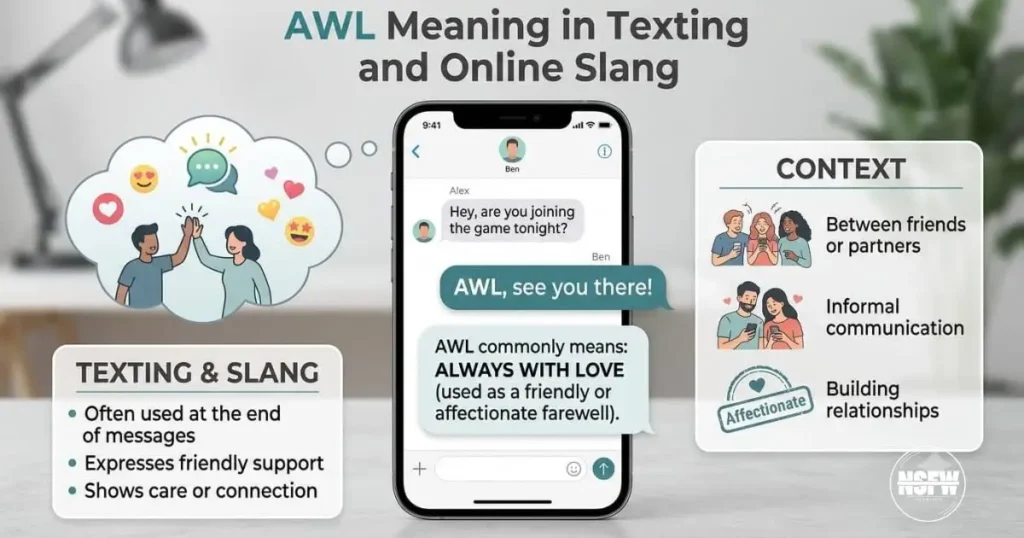
You may occasionally see “awl” used informally online as a playful stand-in for “all” or, less often, “always” for example, “friends awl the way.” This is not an established or widely recognized abbreviation the way LOL, BTW, or IDK are. It shows up mostly as a stylistic misspelling or in-joke rather than a defined shorthand, so if you see it used this way, the surrounding sentence not the letters themselves is what tells you the intended meaning.
If you’re writing for clarity, it’s best to just spell out “all” or “always” or “awl” as slang isn’t standardized enough to guarantee your reader understands it.
AWL in the Bible
The awl appears in the Old Testament as part of a specific legal ritual. In Exodus 21:6 and Deuteronomy 15:17, a Hebrew servant who chose to remain with his master permanently rather than go free after six years, as the law allowed had his ear pierced with an awl against the doorpost as a symbol of lifelong service. The tool itself is the same pointed instrument described above; its use in this ritual is symbolic rather than a separate meaning of the word.
AWL as an Acronym
In some specific professional or organizational contexts, AWL is used as an acronym rather than the tool or slang. Two examples:
- Absent Without Leave (AWOL is more common, but AWL appears in some military and HR contexts) referring to unauthorized absence
- Academic Word List a set of words commonly used in academic English, used in ESL and TOEFL/IELTS study contexts
If you see “AWL” capitalized inside a specific professional, academic, or military document, it’s worth checking that field’s glossary the acronym meaning depends entirely on the industry using it.
How to Tell Which Meaning Is Intended
Use the topic of the conversation as your guide:
| If the context is about… | AWL likely means… |
| Crafts, leather, sewing, tools | The pointed hand tool |
| Casual texting or captions | Possibly a stylized spelling of “all” or “always” |
| Military, HR, or workplace documents | An acronym (context-specific) |
| ESL, TOEFL, or academic writing | Academic Word List |
| Religious or biblical text | The tool, used in a specific ritual |
When still unsure, simply asking “Do you mean the tool, or something else?” resolves it faster than guessing.
Conclusion
Ninety-nine times out of a hundred, “awl” refers to the pointed hand tool used in leatherwork, sewing, and woodworking a tool whose name and meaning have barely changed since Old English. The slang and acronym uses exist, but they’re rare, context-dependent, and never the default assumption. When in doubt, picture the tool first.
FAQs
Author

Ethan Carter is an SEO blogger specializing in internet slang, text abbreviations, and social media meanings. He creates clear, accurate, and reader-friendly content backed by thorough research. His goal is to help readers understand modern online language with reliable, easy-to-read guides.

One Comment