
Gotcha Meaning: What It Means in Text & Chat Today
“Gotcha” usually means “I understand,” “I got it,” or “I caught you,” depending on the context. It is an informal English expression that comes from the spoken form of “got you.” In American English, you may see it in texting, chat, social media, gaming, and everyday conversation.
The tricky part is tone. A simple “Gotcha meaning” after an instruction signals acknowledgment, while “Gotcha!” after a joke can mean “I caught you.” This guide explains the slang expression, texting meaning, pronunciation, usage, related phrases, and professional context so you can understand exactly what the sender means.
Gotcha Meaning in Text + Definition
“Gotcha meaning” is an informal expression used as an acknowledgment, confirmation, reaction, or playful catch. In a text message, it most often means “I understand,” “I get it,” or “I got the information.” It can also signal that someone has discovered a trick, mistake, secret, or surprise.
The important semantic clue is what happened immediately before the word. If someone gives directions, “Gotcha” means “I understand.” If someone hides something and you discover it, “Gotcha!” means “I caught you.” The surrounding conversation, punctuation, relationship, and tone determine the intended meaning.
Definition
In ordinary American English, “gotcha” is a pronunciation spelling of “got you” rather than a formal acronym. Oxford describes it as the written representation of how “I’ve got you” is pronounced, while Cambridge also records the understanding sense. Its U.S. pronunciation is approximately /ˈɡɑːtʃə/, or “GOT-chuh.”
Primary Meaning
The most common texting sense is straightforward: “I understand” or “I got it.” For example, if a friend writes, “The meeting moved to 4 PM,” replying “Gotcha” confirms that the information has been received. It is shorter, more relaxed, and more conversational than saying “I understand.”
What Does GOTCHA Mean in Texting? (Alternate Meanings)
In texting, “gotcha” can communicate several ideas: understanding, acknowledgment, catching someone, figuring something out, or reacting to a successful joke. Compare “Gotcha, thanks” with “Gotcha!” The first normally confirms information; the second can suggest discovery, surprise, or playful teasing. Context is the deciding factor.
| Text | Likely meaning | Tone |
| “Gotcha, thanks.” | I understand | Friendly |
| “Gotcha. I’ll do it.” | I got it | Helpful |
| “Gotcha!” | I caught you | Playful |
| “Oh, gotcha.” | Now I understand | Realizing |
| “Gotcha 😂” | I caught the joke | Playful |
Gotcha Meaning in Chat
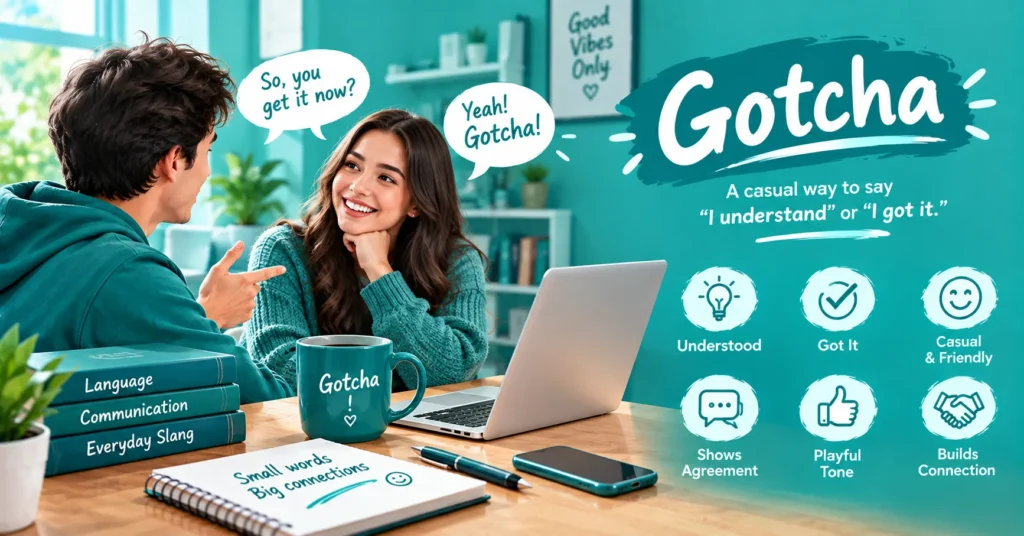
In online chat, “gotcha” commonly works as a quick acknowledgment or confirmation. It can replace “okay,” “I understand,” “I got it,” or “message received.” Because chat moves quickly, the expression lets someone confirm that they followed the conversation without interrupting the flow with a longer response.
A useful way to read the message is to look backward rather than overanalyze the single word. After instructions, think “understood.” After an explanation, think “now I see.” After a reveal or mistake, think “I caught you.” The same spelling can therefore perform different conversational jobs.
Quick Examples
Consider three everyday exchanges. “The restaurant is now on Main Street.” “Gotcha.” means the listener received the update. “Send me the file tonight.” “Gotcha, I will.” confirms the instruction. “You said you didn’t eat the cookies!” “Gotcha!” signals that someone has been caught.
Understanding Meaning
When “gotcha” follows an explanation, its meaning is usually “I understand what you’re saying.” Cambridge specifically documents this use in American English. It can also communicate recognition, as in “Oh, gotcha, now I see why the app failed.”
Catching Meaning
When the expression is delivered with excitement, especially as “Gotcha!”, it can mean “I caught you.” This appears in games, jokes, pranks, playful accusations, and moments when someone notices a contradiction. Cambridge gives catching or gaining an advantage as another established sense.
Gotcha Meaning in Chat in English
In English conversation, “gotcha” is informal and conversational. It is natural among friends, family members, teammates, and people who already have a relaxed relationship. It is less suitable when you need a polished, formal, or especially empathetic response, such as an official letter or sensitive professional exchange.
Gotcha Pronunciation
In American English, gotcha is pronounced approximately “GOT-chuh,” with the first syllable receiving the stronger emphasis. Cambridge gives the U.S. pronunciation as /ˈɡɑːtʃ.ə/. The spelling reflects connected speech, which is why the written form looks different from the original phrase “got you.”
Gotcha in a Sentence
Here are natural examples: “Gotcha, I’ll meet you at six.” “Gotcha, thanks for explaining.” “Ah, gotcha—that makes sense.” In a playful situation, “Gotcha! You thought I wouldn’t notice” means “I caught you.” The surrounding words make the intended sense much easier to identify.
Gotcha vs Similar Text Expressions
“Gotcha” overlaps with “got it,” “I understand,” “okay,” “I see,” and “I got you,” but they are not identical in tone. “I understand” is clearer and more formal. “Got it” is neutral. “I got you” can additionally mean “I’ll help you.” “Gotcha” feels especially casual.
| Expression | Common meaning | Typical tone |
| Gotcha | I understand / I caught you | Casual |
| Got it | I understand | Neutral |
| I understand | Clear comprehension | Formal |
| I got you | I’ll help / I understand | Supportive |
| Noted | Information received | Professional |
| Okay | General acknowledgment | Broad |
Gotcha Meaning in Chat from a Girl
When a girl sends “gotcha,” the word itself does not automatically communicate romantic interest. In most situations, it simply means she understands, acknowledges what you said, or has received the information. The emotional meaning should be interpreted from the complete conversation rather than from one casual expression.
For example, “I’ll text you after work.” “Gotcha.” normally means “Okay, I understand.” If she writes “Gotcha 😊,” the emoji can make the message feel warmer, but even then, it does not establish a particular romantic meaning by itself. Context, relationship, and the surrounding messages matter more.
Example 1
You: “I might be ten minutes late.”
Her: “Gotcha.”
Here, the natural interpretation is simply “Okay, I understand.” There is no need to search for a hidden message. The statement before “gotcha” is logistical, so the reply functions as a casual acknowledgment.
Example 2
You: “I finally figured out why the app wasn’t working.”
Her: “Oh, gotcha.”
Here, “gotcha” means something closer to “I see what you mean” or “Now I understand.” The word responds to new information rather than signaling that she caught you doing something.
Gotcha Meaning Programming
In programming, a gotcha has a different but related sense. Developers use the term for a surprising language rule, unexpected behavior, hidden detail, or easy-to-miss issue that can lead to bugs or confusion. This technical usage connects to the broader idea of being caught off guard by something.
For example, a developer might say, “There’s a gotcha with this function,” meaning that the code behaves in a way that isn’t immediately obvious. Here, “gotcha” is a noun rather than simply a conversational response. It describes a trap or unexpected behavior that someone needs to understand before relying on the code.
Gotcha Full Form
“Gotcha” does not have an official acronym-style full form. It developed from the spoken phrase “got you” or “I’ve got you.” Treating GOTCHA as a set of initials is therefore misleading. It is a colloquial contraction represented in writing.
What Does Gotcha Stand For?
Technically, it doesn’t “stand for” a series of words in the way an acronym does. Instead, the spelling represents natural spoken English. “Got you” becomes compressed in rapid speech and is represented as “gotcha.” Oxford specifically describes the word as a pronunciation spelling.
GOTCHA Meaning in Text
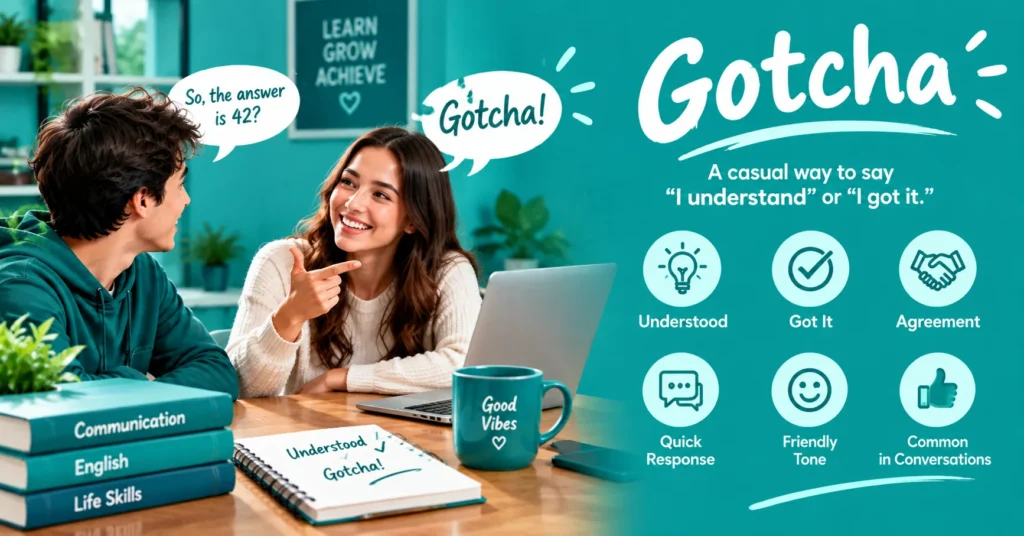
The broader texting meaning becomes easier when you classify the situation. If someone is giving you information, “gotcha” normally confirms understanding. If someone is joking or revealing a trick, it can mean “I caught you.” If you suddenly understand an explanation, “oh, gotcha” signals realization.
This flexibility explains why a single-word message can sometimes feel ambiguous. Text removes facial expression and voice tone, so punctuation and nearby words become useful clues. “Gotcha, thanks” sounds cooperative; “Gotcha!” sounds energetic; “Gotcha…” may suggest uncertainty or hesitation depending on the conversation.
How People Use GOTCHA Online (With Examples)
Online, people use gotcha in text messages, Instagram conversations, TikTok comments, gaming chats, Discord, YouTube discussions, and other informal spaces. The underlying meanings remain similar, although the tone changes with the community. A gamer may mean “I caught you,” while a friend may simply mean “I understand.”
Quick Tip for Understanding “Gotcha”
Look at the sentence immediately before “gotcha.” An explanation usually produces “I understand.” An instruction usually produces “I got it.” A revealed mistake suggests “I caught you.” A joke or prank can indicate “You fooled me.” This simple context check prevents most misunderstandings.
1. To Show Understanding
“Upload the photos to the shared folder.” “Gotcha.” Here, the response confirms that the instruction was understood. There is no implication of catching, tricking, or exposing anyone. This is one of the most common functions of the expression in everyday digital communication.
2. To Confirm a Plan
“Dinner starts at seven.” “Gotcha, I’ll be there.” In this situation, gotcha acknowledges the arrangement and signals that the speaker has registered the plan. A longer response is unnecessary because the purpose is simply confirmation.
3. To Catch Someone
“You said you weren’t checking my profile, but you liked my old photo. Gotcha!” Here, the expression means “I caught you.” The tone is usually playful, teasing, or lightly accusatory. The exclamation mark strengthens that sense of discovery.
4. During Gaming
Gaming conversations provide a natural setting for the catching sense. A player who finds another player’s hiding place might write “Gotcha!” The expression can communicate discovery, a successful prediction, or catching an opponent. The exact meaning depends on the game and situation.
5. In Jokes and Pranks
After a successful prank, “Gotcha!” often announces the reveal. It tells the other person that the trick worked or that the speaker successfully surprised them. In this context, the expression is about playful deception rather than simple acknowledgment.
6. In Social Media Conversations
On social platforms, “gotcha” can acknowledge a point, react to a reveal, or playfully call attention to something someone did. The same word can therefore appear in an Instagram DM as a friendly response and in a TikTok comment as a reaction to a surprise.
Top Mistakes People Make When Using GOTCHA
A common mistake is assuming that “gotcha” always means “I understand.” It doesn’t. The expression can also mean “I caught you,” “I figured it out,” or “you fooled me.” Another mistake is using it automatically in formal communication where “understood” or “I understand” would communicate more precisely.
1. Assuming It Always Means “I Understand”
If someone says “Gotcha!” immediately after revealing that they discovered a trick, translating it as “I understand” misses the point. Always connect the expression to the preceding event. Context is more informative than the word alone.
2. Using It in Formal Communication
“Gotcha” is casual. In a formal email, customer complaint, legal communication, academic document, or sensitive workplace exchange, “Understood,” “Acknowledged,” or a complete sentence may be more appropriate. The issue is tone, not that the expression is inherently incorrect.
3. Ignoring the Tone
Punctuation can change how the message feels. “Gotcha.” can be a calm acknowledgment, while “Gotcha!” can sound excited or teasing. An emoji can also add warmth or humor. When tone matters, don’t interpret the word without considering the rest of the message.
4. Using It When Someone Is Sharing Something Serious
If someone is describing grief, a personal crisis, a serious health concern, or another sensitive experience, “Gotcha” may sound too casual. A response such as “I understand,” “I’m sorry you’re dealing with that,” or “I hear you” can better match the emotional situation.
5. Confusing “Gotcha” With “Got You”
The two expressions are closely related, but “I got you” can mean “I’ll help you” or “I’ve got your back.” “Gotcha” more often functions as a quick acknowledgment or a playful “I caught you.” Context determines the exact interpretation.
6. Using It Without Checking the Context
If you encounter “gotcha” in a meme, comment, text, article, or technical discussion, read the surrounding sentence. A dictionary definition gives the possible senses, but context tells you which sense is active in that particular exchange.
Gotcha Meaning in 2026
The expression is not a newly invented 2026 slang term. It is an established informal expression that continues to work well in modern digital communication because it is short, recognizable, and flexible. Current usage spans ordinary texting, social media, gaming, workplace chat, and technical discussions.
The continued popularity of “gotcha” comes from its ability to compress a longer response into one familiar word. Depending on context, it can confirm information, signal realization, announce a catch, or highlight a playful reveal. Its meaning changes with the conversation, but its linguistic foundation remains the spoken form of “got you.”
Conclusion
Understanding the gotcha meaning can make everyday conversations and online chats much easier to follow. Most often, “gotcha” simply means “I understand,” “I got it,” or “I see what you mean,” but its tone can change depending on the situation. It may sound friendly and casual, while in some contexts it can suggest teasing, catching someone in a mistake, or confirming information.
Paying attention to the conversation and the speaker’s tone helps you understand the intended meaning. Whether you hear “gotcha” from a friend, coworker, or someone online, recognizing the context makes it easier to respond naturally and keep the conversation clear.
FAQs
Author

Ethan Carter is an SEO blogger specializing in internet slang, text abbreviations, and social media meanings. He creates clear, accurate, and reader-friendly content backed by thorough research. His goal is to help readers understand modern online language with reliable, easy-to-read guides.
2 Comments