
MRR Meaning: 20+ Powerful Facts About Its Hidden Impact & Benefits
MRR meaning most commonly refers to Monthly Recurring Revenue, a business metric that measures the predictable monthly income generated by active subscriptions. SaaS companies, membership platforms, and other subscription businesses use MRR to understand revenue trends, track customer retention, and forecast future income. It provides a clearer picture of recurring revenue than total sales alone.
If you’ve encountered mrr meaning in a business report, startup discussion, or software company’s financial dashboard, understanding the term can make those numbers much easier to interpret. This guide explains the MRR definition, calculation formula, practical examples, related financial metrics, and common mistakes. Because the acronym has other meanings, we’ll also clarify how context determines which definition applies.
What Is MRR (Monthly Recurring Revenue)?
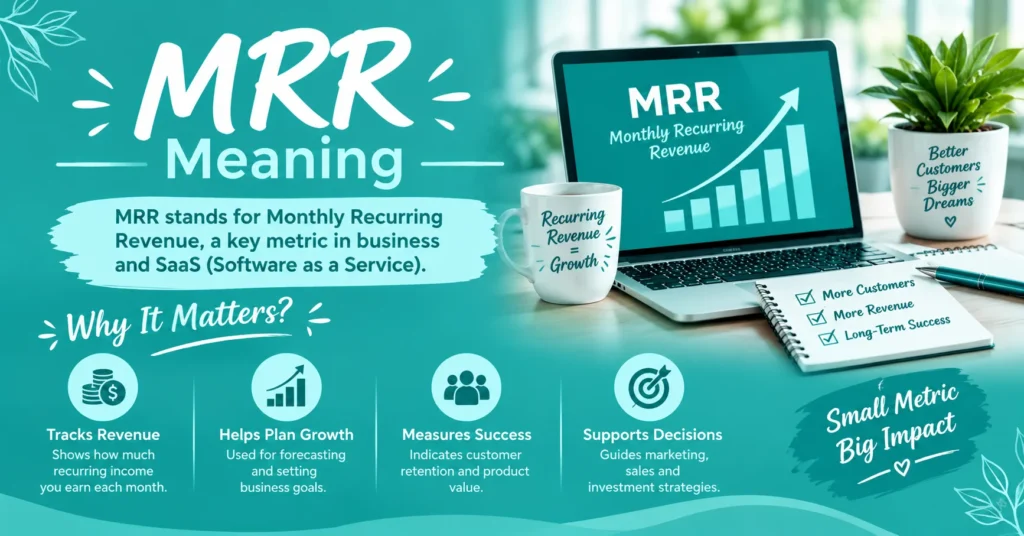
MRR stands for Monthly Recurring Revenue. It represents the normalized monthly value of recurring payments from active customer subscriptions. Businesses commonly use this metric in software as a service (SaaS), online memberships, subscription boxes, and other recurring billing models. Its main purpose is to show how much subscription revenue a company can reasonably expect each month.
For example, imagine a software company with 200 active customers, each paying $40 per month. Its MRR is $8,000. That figure helps the business understand its recurring revenue base without mixing it with one-time setup fees, consulting projects, or hardware sales. MRR is a management metric, however, not a guarantee that every customer will pay or remain subscribed.
The acronym can mean different things in other settings. In online business, MRR may refer to Master Resell Rights, a licensing arrangement associated with reselling digital products. In information retrieval, it can mean Mean Reciprocal Rank, a metric used to evaluate search-result ordering. When the conversation concerns startups, subscription pricing, or SaaS financial performance, Monthly Recurring Revenue is usually the intended meaning.
How to Calculate MRR
The simplest MRR formula is:
MRR = Active paying customers × Average monthly recurring revenue per customer
This works when customers pay the same monthly price. If a business has several subscription tiers, a more accurate approach is to calculate the recurring amount for each active subscription and add the monthly equivalents together. Annual subscriptions are normalized by dividing the recurring subscription amount by 12.
Consider a company with 100 customers paying $30 monthly and another 50 paying $60 monthly. Its MRR is $3,000 plus $3,000, or $6,000. If ten additional customers join the $30 plan, MRR rises by $300, assuming the existing subscriptions remain active and the new customers are eligible to be counted under the company’s reporting policy.
Consistency matters as much as arithmetic. A company should document how it treats discounts, free trials, paused subscriptions, overdue payments, refunds, and variable usage charges. Industry definitions are not perfectly standardized, so two businesses can report different MRR figures if they use different inclusion rules. A consistent methodology makes monthly comparisons more meaningful.
Examples of MRR Calculations
Imagine a small project-management software company offering two plans. It has 80 customers paying $25 per month and 40 customers paying $75 per month. The first group contributes $2,000, while the second contributes $3,000. The company’s total MRR is therefore $5,000.
Now suppose the company offers an annual subscription for $600. Each eligible annual subscription contributes $50 in normalized monthly recurring revenue, rather than the full $600 in the month the customer pays. If 20 customers purchase that plan, they contribute $1,000 to MRR. This normalization helps the company compare annual and monthly subscription plans on a consistent basis.
A third example shows why revenue movements matter. If a customer paying $100 monthly cancels, MRR falls by $100. If an existing customer upgrades from $100 to $150 per month, MRR increases by $50. Looking at these changes alongside the total makes it easier to see whether growth comes from new customer acquisition, upgrades, or improved retention.
| Subscription activity | MRR impact |
| 80 customers × $25 | $2,000 |
| 40 customers × $75 | $3,000 |
| 20 annual plans × $600 ÷ 12 | $1,000 |
| Total normalized MRR | $6,000 |
The table illustrates the calculation method. Actual reported figures depend on the business’s subscription definitions and reporting rules.
Types of MRR
Businesses often break monthly recurring revenue into categories to understand what is driving growth or decline. New mrr meaning comes from newly acquired subscribers. Expansion MRR represents additional recurring revenue from existing customers who upgrade plans or add paid features. Both can help explain why a company’s recurring revenue is growing.
Other categories reveal revenue losses and recoveries. Churned MRR represents recurring revenue lost when customers cancel. Contraction MRR describes reductions when customers downgrade or reduce their paid subscriptions. Reactivation MRR comes from customers returning after previously canceling. Together, these measures provide a more detailed view of subscription performance than a single headline figure.
A common summary metric is net new MRR, which captures the net effect of revenue movements during a reporting period. One simplified formula is:
Net new MRR = New MRR + Expansion MRR + Reactivation MRR − Churned MRR − Contraction MRR
For example, a business that gains $2,000 in new MRR and $500 in expansion MRR, while losing $700 to cancellations and $200 to downgrades, adds $1,600 in net new MRR if reactivation is zero. Tracking each component helps managers identify which changes need attention.
MRR vs. ARR
MRR and ARR both measure recurring subscription revenue, but they express it over different timeframes. MRR represents the normalized monthly recurring revenue base, while ARR stands for Annual Recurring Revenue and is used to express recurring revenue on an annual basis. A common simplified calculation is ARR = MRR × 12.
For example, a business with $10,000 in MRR has a simple annualized run rate of $120,000. This is not necessarily the same as the revenue it will actually recognize or collect during the next 12 months. Customer cancellations, price changes, annual contract terms, and accounting policies can all affect actual results.
| Metric | Meaning | Common use |
| MRR | Monthly Recurring Revenue | Monthly monitoring and operational planning |
| ARR | Annual Recurring Revenue | Annualized planning and subscription business reporting |
| Total revenue | Revenue from all applicable sources over a period | Broader financial reporting |
MRR and ARR are management metrics, and their calculation policies can vary. Neither should automatically be treated as equivalent to recognized revenue under formal accounting standards. Businesses should use clearly documented definitions when comparing results across companies.
Why MRR is important for businesses
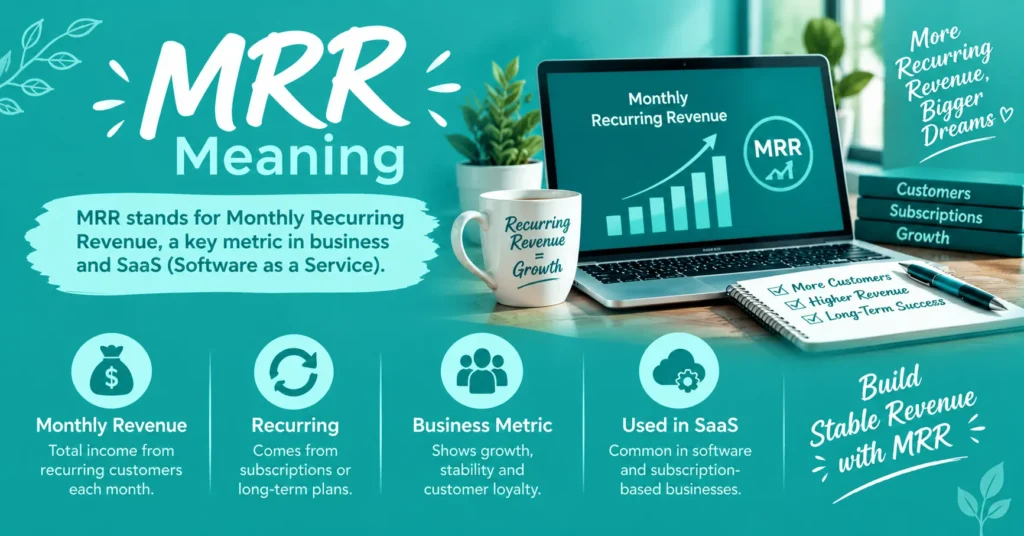
MRR helps a subscription business evaluate its revenue momentum. A stable or growing recurring revenue base can support budgeting, hiring plans, marketing decisions, and product investment. It can also help managers spot warning signs, such as recurring revenue declining despite a growing customer base, which may indicate downgrades or cancellations.
The metric becomes more useful when interpreted with other indicators. Customer acquisition costs, churn rate, average revenue per account, customer lifetime value, and net revenue retention can explain whether revenue growth is efficient and sustainable. For example, rising MRR combined with rapidly increasing acquisition costs may tell a different story from rising MRR driven by satisfied customers upgrading their plans.
MRR is also useful for forecasting, but it is not a crystal ball. Subscriptions can be canceled, payments can fail, and customers may change their plans. Companies should combine MRR trends with historical retention, contract terms, cash flow, and collection data before making major financial decisions.
What are the disadvantages of MRR?
The main limitation of mrr meaning is that it simplifies a complicated financial picture into one number. A business may show rising MRR while struggling with refunds, expensive customer acquisition, weak cash collection, or high cancellation rates. The metric alone does not reveal profitability, cash on hand, or the full financial health of a company.
Calculation differences can also make comparisons misleading. One company may include certain recurring usage charges, while another excludes them. Some businesses normalize annual contracts differently or apply different rules to discounts, overdue accounts, and free trials. Investors and analysts should understand a company’s methodology before comparing its MRR with that of a competitor.
Another risk is confusing an annualized run rate with guaranteed future revenue. A company with $50,000 in MRR does not automatically have $600,000 of secured revenue for the next year. If customers cancel or reduce their subscriptions, the actual outcome may be lower. MRR is most useful when reported consistently and interpreted alongside churn, cash flow, margins, and contractual obligations.
How to increase MRR
Businesses can grow MRR by attracting suitable new customers, improving retention, and helping existing subscribers find additional value in paid products or features. These strategies work best when they address a genuine customer need rather than relying on aggressive sales tactics or unsustainable discounts.
Pricing is one possible lever. A company might introduce clearer subscription tiers, offer useful premium features, or adjust prices to reflect the value delivered. Upselling and cross-selling can also increase expansion MRR when the additional product genuinely helps customers. Businesses should monitor cancellations and customer feedback after a pricing change to make sure the extra revenue does not come at the expense of retention.
Retention deserves equal attention. Improving onboarding, providing reliable support, fixing recurring product problems, and communicating value can help customers continue their subscriptions. A business should regularly review new MRR, expansion MRR, contraction MRR, and churned MRR to understand where changes originate. Sustainable growth comes from delivering value consistently, not merely adding subscriptions faster than customers leave.
Conclusion
Understanding MRR meaning helps readers interpret one of the most widely used metrics in subscription businesses. Monthly Recurring Revenue shows the normalized recurring income associated with active subscriptions, while related metrics explain where revenue growth or losses come from.
Whether you’re learning SaaS terminology, evaluating a business report, or exploring online business discussions, context is essential. For subscription companies, combining MRR with ARR, churn, retention, and cash flow provides a more complete understanding of financial performance.
FAQs
Author

Ethan Carter is an SEO blogger specializing in internet slang, text abbreviations, and social media meanings. He creates clear, accurate, and reader-friendly content backed by thorough research. His goal is to help readers understand modern online language with reliable, easy-to-read guides.