Stay Tuned Meaning: 5 Surprising & Essential Uses You Need to Know
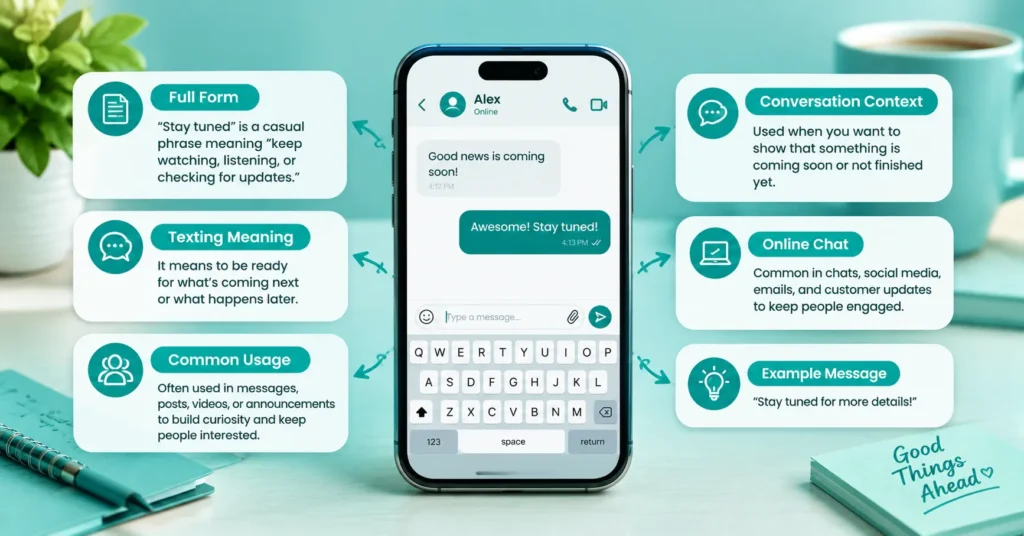
“Stay tuned” means keep watching, listening, or paying attention because more information, news, or an update is coming soon. If you’ve ever heard it during a TV broadcast, seen it in a social media caption, or received it in a text, the basic message is the same: something else is coming, so don’t stop paying attention.
The phrase connects broadcasting, communication, updates, announcements, social media, texting, marketing, and everyday conversation. From its radio-and-television roots to modern digital communication, “stay tuned meaning” has remained useful because it creates anticipation without revealing everything at once. This guide explains the phrase’s meaning, history, tone, examples, and modern uses so you can recognize and use it naturally.
Stay Tuned Meaning and Origin: Where Did This Phrase Come From?
The stay tuned meaning originally had a much more literal connection to radio and television. To “tune” a radio meant adjusting the receiver to a particular frequency or station. When broadcasters told listeners to “stay tuned,” they were essentially asking them to remain on that station rather than change the channel or turn the device off.
Over time, the expression developed a broader figurative meaning: remain attentive because something important or interesting is coming next. Dictionary.com now gives both the broadcasting sense and the broader sense of remaining attentive to future updates or developments. That transition explains why the phrase works naturally today even when no radio, television, or physical tuning is involved.
Historical Examples
The phrase has been associated with broadcasting for decades. U.S. Dictionary cites examples from publications such as The Billboard Magazine and Life Magazine showing “stay tuned” being used in mid-20th-century broadcasting contexts. Wiktionary likewise traces its etymology to dial-tuned radio receivers.
The BBC’s English-learning material explains the modern connection clearly: presenters traditionally used “stay tuned” before an advertisement break or upcoming segment to encourage audiences to keep watching or listening. The same phrase later expanded naturally into ordinary conversation, online announcements, podcasts, videos, and digital updates.
What Does “Stay Tuned” Mean?
In simple English, “stay tuned” means “keep paying attention because more is coming.” Depending on the situation, it can mean keep watching, keep listening, wait for an announcement, check back for information, or remain alert for developments.
For example, imagine a friend says, “I have some exciting news, but I can’t tell you yet. Stay tuned.” They are not asking you to literally watch television. They are creating a little suspense and telling you that additional information will arrive later.
How Do You Use Stay Tuned in a Sentence?
“Stay tuned” commonly appears at the end of a statement, especially when the speaker wants to create anticipation. It can be followed by for, as in “stay tuned for updates,” or to, as in “stay tuned to this channel.” The surrounding context makes the intended meaning clear.
Here are natural examples:
- The results aren’t ready yet, so stay tuned.
- Stay tuned for more details about the event.
- We have a big announcement coming tomorrow. Stay tuned!
- Stay tuned to our page for the latest updates.
- I can’t reveal the surprise yet stay tuned.
- More information is coming soon, so stay tuned.
The phrase can sound exciting, reassuring, playful, or simply informative. Dictionary.com currently provides contemporary examples involving interviews, forecasts, news, and upcoming episodes, showing that the expression remains active in modern English.
Stay Tuned vs Stay Posted: What Is the Difference?
“Stay tuned” and “stay posted” overlap, but they are not always interchangeable in tone. Stay tuned often carries a sense of anticipation: something is about to be revealed, announced, or released. Stay posted more often emphasizes receiving continuing information or updates about an ongoing situation.
For example, “Stay tuned for our new product launch” sounds like a teaser. “Stay posted on the delivery schedule” sounds more like an ordinary update. Other alternatives such as watch this space, more to come, and keep an eye out shift the tone slightly depending on the audience and purpose.
Is Stay Tuned Formal or Informal?
“Stay tuned” is best described as neutral to conversational or semi-formal, rather than slang. It is perfectly understandable in workplace communication, announcements, newsletters, websites, and social media, but it can feel too conversational for highly formal legal, academic, or official writing.
The key is context. A company newsletter might naturally say, “Stay tuned for our next update,” while a formal regulatory notice might prefer “Further information will be provided when available.” The underlying message is similar, but the register changes.
Can You Say Stay Tuned in Professional Emails?
Yes. “Stay tuned” can work in professional emails when the communication has a friendly or conversational tone. It is especially natural for internal announcements, newsletters, marketing messages, product launches, event updates, and team communications.
For highly formal situations, a more precise phrase may be better. Instead of “Stay tuned,” you could write “Further details will follow,” “We will provide additional information shortly,” or “Updates will be shared as they become available.” MeaningAbout similarly distinguishes conversational professional use from formal proposals and legal communication.
Stay Tuned in Texting: What Does It Mean?
In texting, the stay tuned meaning is usually simple and casual: wait for more information because the sender has something else to tell you. It can suggest exciting news, a surprise, an unfinished story, or even a little bit of playful drama.
For example:
“I just heard something crazy. Stay tuned 😂”
Here, the person is not asking you to watch a particular channel. They are telling you to wait for the next update. It can also be used sarcastically when someone deliberately creates suspense about something minor or humorous.
Stay Tuned Meaning in Social Media and Marketing
On social media, the phrase often functions as a teaser. A creator, company, or individual may announce that something is coming without revealing the complete details. “Stay tuned” therefore works alongside phrases such as coming soon, big announcement, new release, reveal, update, and more to come.
Marketing makes particularly frequent use of this approach because anticipation can encourage people to return for the next announcement. For example, a brand might post, “Something exciting is launching Friday. Stay tuned.” The phrase doesn’t provide the complete information; it invites the audience to keep following the story.
A useful distinction is that “stay tuned” does not itself guarantee a specific timeframe. If a brand wants to be clearer, “Stay tuned this Friday” or “Stay tuned for the announcement tomorrow” gives the audience a stronger expectation.
When Should You Say Stay Tuned?
Use “stay tuned” when there is genuinely more information, an announcement, a development, or content coming later. It works especially well when you want to keep someone interested without revealing the full story immediately.
Common situations include:
| Situation | Example |
| News update | “Stay tuned for the latest details.” |
| Product launch | “Our new collection arrives Friday. Stay tuned.” |
| Social media | “Big announcement tomorrow—stay tuned!” |
| Texting | “I have news. Stay tuned.” |
| TV or radio | “Stay tuned after the break.” |
| Event | “Stay tuned for the final schedule.” |
| Workplace | “Stay tuned for the project update.” |
| Marketing | “Stay tuned for an exclusive reveal.” |
The phrase is less effective when there is no actual follow-up. Telling people to stay tuned and then providing nothing can make an announcement feel vague or disappointing. The strongest use connects the phrase to a real next step.
Stay Tuned Synonyms: What Else Can You Say?
If you have used “stay tuned” too many times, several alternatives communicate similar ideas. The best choice depends on whether you want a casual, professional, enthusiastic, or direct tone.
| Alternative | Typical tone | Example |
| Stay posted | Casual | “Stay posted for updates.” |
| Watch this space | Modern/conversational | “Watch this space for news.” |
| Keep an eye out | Friendly | “Keep an eye out for the announcement.” |
| More to come | Neutral | “More to come next week.” |
| Check back soon | Direct | “Check back soon for details.” |
| Don’t go anywhere | Casual | “Don’t go anywhere—we’ll be right back.” |
| Keep checking back | Direct | “Keep checking back for updates.” |
| Await further updates | Formal | “Please await further updates.” |
| Stay alert | Serious | “Stay alert for additional information.” |
| Be on the lookout | Neutral | “Be on the lookout for the announcement.” |
U.S. Dictionary lists several of these as alternatives, while MeaningAbout also identifies “stay posted,” “watch this space,” “more to come,” “check back soon,” and “updates to follow.”
Is Stay Tuned Still Used or Is It Outdated?
No. “Stay tuned” is still widely understood and actively used in modern English. Its technology-specific origin may sound old-fashioned, but the figurative meaning has adapted remarkably well to digital communication.
Instead of radio dials and television channels, people now “stay tuned” to websites, social accounts, podcasts, YouTube channels, newsletters, group chats, and live updates. Dictionary.com continues to show recent examples from major contemporary publications, demonstrating that the phrase remains part of current American English usage.
That said, individual speakers may perceive it as slightly traditional because of its broadcasting history. In some contexts, “keep me posted” or “check back soon” may sound more natural. In others, the familiar phrase adds exactly the right amount of anticipation.
Stay Tuned Meaning in Different Contexts: A Quick Summary
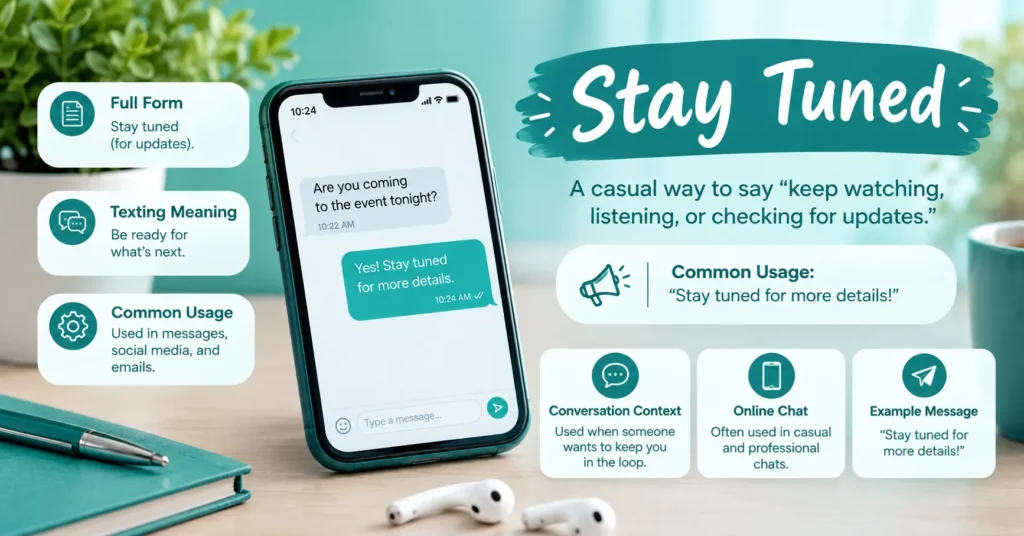
The stay tuned meaning stays remarkably consistent even though the medium changes. In radio and television, it means keep watching or listening. In texting, it usually means wait for the sender’s next update. On social media, it often signals an upcoming announcement, reveal, or piece of content.
In marketing, it can create anticipation around a launch or promotion. In a professional email, it can communicate that additional information is coming, although a more specific phrase may be preferable for formal communication. Across all these situations, the central idea remains: more information is coming, so keep paying attention.
Examples of “Stay Tuned” in Sentences
The following examples show how the phrase changes slightly with context while keeping its central meaning:
- “Stay tuned for tomorrow’s announcement.”
More information will be announced tomorrow. - “We don’t have the final results yet. Stay tuned.”
The results are still pending. - “Stay tuned to our social page for updates.”
Keep checking the account for new information. - “I can’t tell you what happened yet. Stay tuned.”
The speaker promises more information later. - “Stay tuned after the break for the final interview.”
Keep watching the broadcast. - “The weather could change, so stay tuned for updates.”
Continue following new information. - “Something big is coming next week. Stay tuned!”
An upcoming announcement is being teased. - “Stay tuned I think this story is about to get interesting.”
The speaker expects further developments. - “We are finalizing the schedule. Stay tuned.”
The details aren’t ready yet. - “Stay tuned for more photos from the event.”
Additional content will be published later.
These uses reflect the contexts identified by the leading reviewed pages, including broadcasting, social media, casual conversation, professional communication, announcements, and updates.
Examples of “Stay Tuned” in Pop Culture
The expression has also appeared in entertainment and popular culture. U.S. Dictionary notes examples including the 1965 film Stay Tuned for Terror and other media-related uses. Its long association with broadcasting helps explain why the phrase can immediately evoke the feeling of waiting for the next segment or announcement.
More broadly, “stay tuned” has become a familiar phrase for creators and audiences. A YouTube presenter might say it before revealing an upcoming video, while a podcast host may use it when previewing the next episode. The physical act of tuning a dial has disappeared from everyday life, but the conversational metaphor remains.
Conclusion
The stay tuned meaning is simple: keep paying attention because more information, news, content, or developments are coming. The phrase began with radio and television broadcasting, where listeners and viewers were literally encouraged to remain on the same frequency or channel. Today, its meaning has expanded into texting, social media, marketing, email, online video, and everyday conversation.
The most natural way to understand it is “wait for what comes next.” Use it when you genuinely have something more to share, especially when you want to create anticipation without revealing everything immediately. If you need a more formal tone, choose an alternative such as “further details will follow” or “additional information will be provided.”
FAQs
Author

Ethan Carter is an SEO blogger specializing in internet slang, text abbreviations, and social media meanings. He creates clear, accurate, and reader-friendly content backed by thorough research. His goal is to help readers understand modern online language with reliable, easy-to-read guides.