Hacienda Meaning: 40+ Fascinating Facts About Its Origin, Definition & Examples
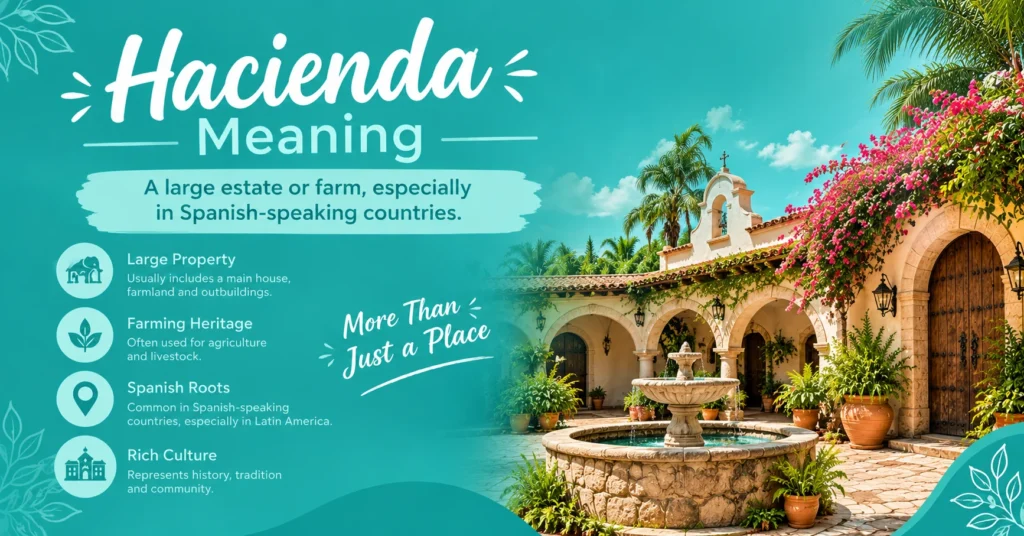
The hacienda meaning is a large estate, ranch, or plantation, particularly in a Spanish-speaking region. The word can also refer to the main house on that property. In English, it commonly describes a traditional rural estate associated with farming, livestock, landownership, and Spanish-speaking cultures.
If you have encountered hacienda in a book, a travel description, a property listing, or a discussion of Spanish history, its exact meaning may depend on context. Understanding its Spanish translation, pronunciation, historical background, and modern architectural use makes the term much easier to interpret.
Definition of hacienda
A hacienda is traditionally a large rural property used for agricultural production, ranching, or other commercial activities. Depending on the context, it may mean the entire estate, including its land and operations, or the principal residence located on that property.
For example, a family might own a hacienda where workers grow crops, care for livestock, and maintain a substantial country house. In a historical novel, the same word might describe the landowner’s residence and the surrounding grounds. Both uses are valid, so the surrounding sentence helps determine the intended meaning.
The term is closely associated with Spain and Latin America, although its precise historical associations differ across countries. Some estates focused on crops, while others combined livestock, orchards, workshops, mines, or manufacturing. A hacienda was therefore not necessarily just a house or a single type of farm.
In everyday English, useful equivalents include estate, ranch, and plantation. These words overlap with hacienda, but they are not perfect synonyms in every situation. An estate emphasizes land and property, a ranch usually emphasizes livestock, and a plantation generally emphasizes large-scale crop production.
Consider this sentence: “The travelers spent the weekend at a restored hacienda in Mexico.” Here, the word likely refers to a traditional estate or its main house, perhaps adapted for accommodation. The property could preserve historic architecture while operating today as a hotel, event venue, or private residence.
A simple way to remember the definition is that a hacienda can describe both a substantial rural estate and its principal house. Context determines which meaning is most appropriate. This distinction is particularly useful when reading historical accounts, Spanish-language translations, or descriptions of traditional homes.
Hacienda in British English
In British English, hacienda refers to a ranch or large estate in Spain or another Spanish-speaking region. The term may also describe a substantial rural establishment associated with livestock raising, mining, or manufacturing, as well as the principal house on a ranch or plantation.
The pronunciation commonly shown for British English is approximately “has-ee-EN-duh,” with variation between speakers and dictionaries. The emphasis falls on the syllable containing “en.” Because the word comes from Spanish, its original Spanish pronunciation differs from the anglicized pronunciation used by many English speakers.
In a British English sentence, a writer might say, “The historic hacienda overlooked the surrounding farmland.” The reader would understand that the property was a large estate with a distinctive rural setting. In a historical context, it could also suggest a working agricultural establishment rather than a decorative country home alone.
The term is not a standard replacement for farmhouse, country house, or manor house in every situation. Those words carry different cultural and architectural associations. A hacienda specifically evokes a Spanish-language cultural context or a property described through that tradition, which is why retaining the original word can be more accurate.
Hacienda in American English
In American English, a hacienda meaning is generally understood as a large estate, ranch, or plantation in Spanish America, or as the main dwelling associated with such a property. American dictionary definitions also recognize the term’s use for a substantial landed estate used for farming or ranching.
American readers may encounter the word in discussions of Mexican history, Southwestern architecture, tourism, or real estate. In a property listing, for instance, “hacienda-style home” usually refers to a house inspired by traditional Spanish or Spanish Colonial design rather than a claim that the property is a historical working estate.
A modern home described as a hacienda-style property may feature stucco walls, a courtyard, terracotta roof tiles, wooden beams, arched doorways, or a tiled patio. These features are common design associations, not a checklist that every authentic historical hacienda must satisfy. Architectural styles also vary by location and period.
The word may therefore have two related but distinct uses in the United States: a historical or geographical reference to an estate and a design reference to a house inspired by traditional regional architecture. When interpreting a listing, travel article, or home description, check whether the writer means the property’s history, its land, or its appearance.
This distinction matters because a modern hacienda-style home may sit on a relatively small suburban lot. It does not need to be a huge plantation or agricultural operation. The word is being used architecturally, drawing on an established visual tradition rather than describing the property’s current economic function.
Word origin of hacienda
The word hacienda meaning entered English from Spanish. Its deeper roots lead to Latin facienda, meaning “things to be done,” which comes from facere, meaning “to do” or “to make.” Oxford, Collins, and American Heritage all identify the Spanish and Latin connection in their etymological information.
This origin offers a useful clue to the word’s development. Rather than originally describing only a building, the term is connected to activity, work, and productive enterprise. Over time, its use came to encompass property, land, and rural establishments associated with economic activity. Historical usage varies, so the modern definition should not be treated as a complete description of every past hacienda.
The Spanish noun hacienda is feminine, which is why Spanish uses the article la: la hacienda. In English, the word functions as a countable noun. Its plural is haciendas, as in “Several haciendas operated in the region.” The English plural adds -s, following a familiar pattern for nouns ending in a vowel sound.
The word is also related to the Spanish verb hacer, meaning “to do” or “to make,” through the broader Latin root facere. This relationship is helpful for language learners, although it does not mean that a modern hacienda literally translates as “doing” or “making.” In contemporary use, the meaning is determined by established vocabulary and context.
Historically, haciendas became important in different parts of the Spanish world as systems of landownership and production. Some were involved in crop cultivation or livestock raising; others combined multiple activities. These estates were not all identical, and their organization reflected local economies, laws, labor systems, and historical periods.
The history also deserves nuance. Colonial haciendas were often tied to unequal landownership and labor relationships. A balanced explanation should recognize their economic and architectural significance without romanticizing the social conditions under which some estates operated. The term can evoke impressive buildings and landscapes while also referring to a complex historical institution.
In modern writing, the historical meaning appears in books, museum descriptions, heritage tourism, and discussions of agricultural history. The architectural meaning appears in home design and real estate. Recognizing which context is being used helps readers understand why a word associated with large rural estates may also describe a contemporary house.
Hacienda meaning in Spanish and English examples
The Spanish word hacienda has several English equivalents, and the best translation depends on how it is used. It may mean an estate, ranch, or plantation, while other Spanish-language contexts use it for property or wealth. In government and financial expressions, hacienda can also refer to public finances or the treasury.
| Spanish expression or context | Possible English meaning |
| La hacienda familiar | The family estate |
| Una hacienda ganadera | A cattle ranch or livestock estate |
| La hacienda de café | A coffee plantation or coffee estate |
| La hacienda pública | Public finances or the public purse |
| El dueño de la hacienda | The estate owner |
| Una antigua hacienda | An old or historic estate |
Here are some additional examples in natural English:
- “The hacienda produced coffee for export.” This describes a working agricultural estate.
- “The family restored the old hacienda.” This could refer to the estate’s main residence or the property as a whole.
- “We stayed at a hacienda-style hotel.” This suggests accommodation inspired by traditional estate architecture.
- “The museum explains the history of the hacienda.” This refers to the historical institution and its role in society.
Notice how the meaning shifts slightly with each sentence. A coffee hacienda emphasizes agricultural production, a restored hacienda emphasizes property and architecture, and a historical discussion may focus on landownership and labor.
Hacienda vs. ranch, estate, plantation, and farmhouse
These words overlap, but each highlights a different aspect of a property. Understanding the differences helps you select the right translation or interpret a sentence accurately.
| Word | Main meaning | Key distinction |
| Hacienda | A large estate, ranch, plantation, or its principal house | Strong Spanish-speaking cultural and historical association |
| Ranch | Land used primarily for raising livestock | Emphasizes livestock and ranching operations |
| Estate | A substantial property, often including land and buildings | Emphasizes ownership and property |
| Plantation | A large agricultural property, typically associated with commercial crops | Emphasizes crop production |
| Farmhouse | A house associated with a farm | Emphasizes the residence rather than the entire estate |
| Manor house | A principal residence historically associated with a manor | Has a distinct European historical association |
These are practical distinctions, not rigid boundaries. A hacienda may function as a ranch or plantation, and its main residence may be described as a farmhouse or estate house in a particular context. However, those alternative words do not always preserve the cultural or historical meaning of hacienda.
Hacienda pronunciation and plural form
In American English, hacienda is commonly pronounced approximately hah-see-EN-duh or has-ee-EN-duh. The Spanish pronunciation is closer to ah-SYEN-dah, with regional variation. The Spanish letter h is silent, which explains why the Spanish pronunciation begins with a vowel sound.
The word is a noun, and its plural in English is haciendas. For example, “The region contains several historic haciendas.” In Spanish, the singular form is la hacienda, and the plural is las haciendas. The feminine grammatical gender applies to the Spanish noun; it does not imply that the property itself is feminine.
When speaking English, use the pronunciation that feels natural while making the stressed syllable clear. When speaking Spanish, aim for the Spanish vowel sounds and silent h. Listening to a reputable dictionary’s audio pronunciation can help you distinguish the English and Spanish versions.
Hacienda-style homes in modern America
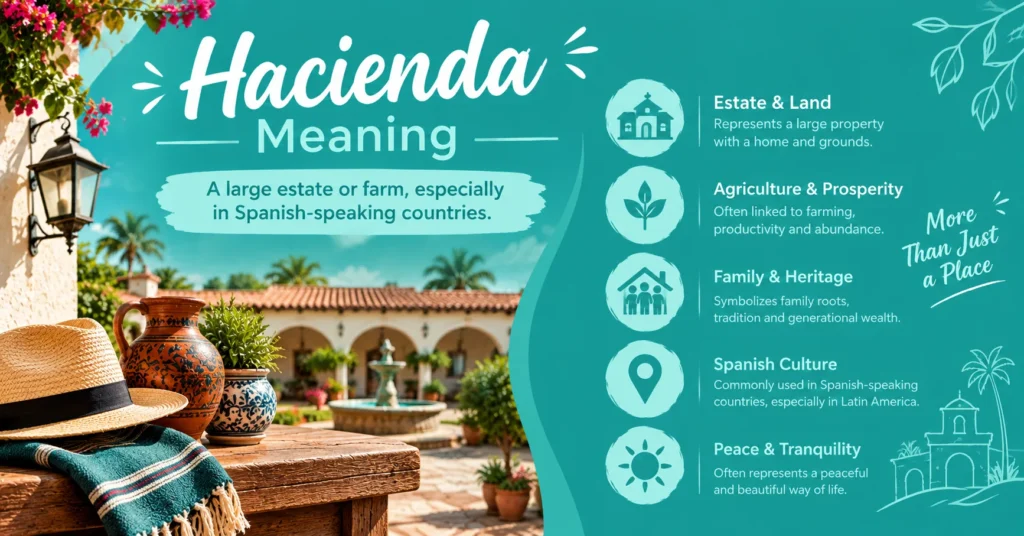
In the United States, hacienda often appears in descriptions of architecture and interior design. A hacienda-style home typically draws inspiration from Spanish or Spanish Colonial buildings and may include stucco exteriors, courtyards, exposed wood, tiled floors, arched openings, and warm natural materials.
These design elements create a connection between indoor and outdoor living. A central courtyard may provide privacy, while thick-looking walls, shaded verandas, and covered walkways can contribute to the character of the house. Actual construction methods and features differ depending on climate, location, and the architect’s interpretation.
A hacienda-style home does not have to be historic or located in Latin America. A newly built house in Arizona, California, or another US state may use the term to describe its architectural inspiration. Conversely, a historic hacienda may have little resemblance to a modern interpretation of the style.
When you see hacienda in a real estate listing, look for contextual clues. Words such as “courtyard,” “Spanish Colonial,” and “terracotta tile” often signal architectural style. References to acreage, livestock, crops, or estate history point more toward the traditional property meaning.
Conclusion
The hacienda meaning is broader than simply a large house. It generally refers to a substantial rural estate, ranch, or plantation in a Spanish-speaking context, while it can also describe the principal residence on that property. The word’s Spanish and Latin roots connect it to productive activity, and its modern use extends into architecture, tourism, and real estate.
When you encounter hacienda, pay attention to context: the writer may be discussing a historical landholding, an agricultural enterprise, a Spanish-language expression, or a modern hacienda-style home. That distinction will help you understand the word accurately and use it confidently.
FAQs
Author

Ethan Carter is an SEO blogger specializing in internet slang, text abbreviations, and social media meanings. He creates clear, accurate, and reader-friendly content backed by thorough research. His goal is to help readers understand modern online language with reliable, easy-to-read guides.