
WDYM Meaning: 10+ Essential & Surprising Ways to Use It in Texting and Reply Confidently
When someone sends you “wdym” in a text message, they usually mean “What do you mean?” WDYM is a common texting abbreviation used to ask for clarification, express confusion, or react to something surprising. You may encounter this internet slang in Snapchat messages, Instagram DMs, TikTok comments, and everyday online conversations.
Understanding WDYM meaning in text can help you avoid awkward misunderstandings and respond naturally. After researching established dictionary explanations and common digital communication patterns, this guide explains its full form, usage, examples, tone, and appropriate alternatives so you can understand exactly what someone means.
What Does WDYM Meaning in a Text?
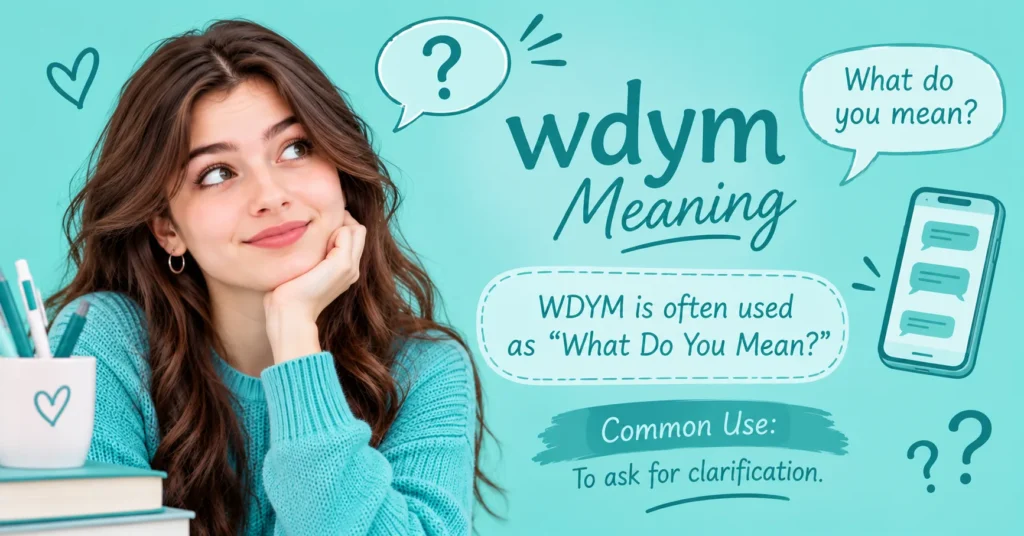
WDYM stands for “What Do You Mean?” It is an informal abbreviation people use when they want someone to explain a statement, clarify a confusing message, or provide additional information. Instead of typing the complete question, they use four letters to keep conversations short and convenient.
For example, imagine telling a friend, “I don’t think we’re meeting tomorrow.” Your friend might respond, “WDYM?” because they want to understand why the plan has changed. In this situation, the abbreviation communicates genuine confusion rather than anger or disagreement.
The expression is particularly common in text messages, online chats, group conversations, and social media discussions. Its meaning generally remains consistent across platforms, although the surrounding conversation can change its emotional tone.
What does WDYM meaning?
The full form of WDYM is What Do You Mean? Each letter represents the beginning of one word:
| Letter | Word |
| W | What |
| D | Do |
| Y | You |
| M | Mean |
Together, these letters create a shortened question that asks another person to explain their statement. It is useful when a conversation contains unclear information, an unexpected comment, an unfamiliar expression, or something that needs additional context.
However, wdym meaning does not always communicate confusion in a literal sense. Sometimes people use it rhetorically to express disbelief, surprise, or playful disagreement. For instance, “WDYM you have never watched that movie?” may suggest that the sender is surprised rather than genuinely asking for an explanation. Dictionary.com also recognizes this rhetorical use.
The simplest interpretation: When somebody sends wdym meaning, they generally want you to explain what you just said.
The difference between lowercase wdym and uppercase WDYM
You may encounter this abbreviation in several written forms, including wdym, WDYM, and Wdym. All three generally communicate the same question, so capitalization does not create a different full form.
Lowercase wdym often looks relaxed and conversational, particularly between friends. Uppercase WDYM can appear more direct or emotionally intense, especially when combined with multiple question marks. However, capitalization alone cannot reliably reveal someone’s feelings.
Why people use this texting abbreviation
People frequently choose abbreviations because they make digital communication quicker. Typing four letters is easier than repeatedly writing an entire question, particularly during fast conversations.
WDYM also provides a convenient way to request clarification without composing a longer message. It can keep a discussion moving when somebody shares an unexpected opinion, confusing explanation, or incomplete piece of information.
For example, if somebody writes, “Something happened at school today,” replying “wdym?” invites them to provide additional details. It creates an opening for the other person to continue explaining their experience.
Where does WDYM come from?
WDYM developed as a shortened written form of the everyday English question “What do you mean?” Like many internet abbreviations, it became useful in environments where people wanted to communicate quickly without repeatedly typing complete sentences.
Dictionary.com reports that WDYM has been used online since at least the early 1990s. This suggests that the abbreviation predates many modern social media platforms and is not exclusively a recent Gen Z expression.
Dictionary.com
Its continued use reflects a broader pattern in digital communication. From early internet chat rooms and discussion forums to modern messaging applications, people have regularly shortened familiar expressions to make conversations faster and more convenient.
WDYM and the growth of internet slang
Internet slang developed alongside online communities, instant messaging, and mobile communication. People began using shortened expressions such as LOL, BRB, IDK, and BTW to communicate common ideas without typing complete sentences.
WDYM fits naturally into this language pattern because its full expression is a question people ask frequently. Rather than inventing a completely new phrase, users shortened an existing English expression while keeping its original meaning.
As messaging platforms became part of everyday life, these abbreviations moved between different online environments. People now encounter them in private messages, public comments, online gaming conversations, and social media discussions.
More Detail…
Understanding the basic WDYM definition is only the beginning. The same abbreviation can communicate different intentions depending on the conversation, relationship between the people, and wording surrounding it.
Sometimes the sender genuinely does not understand your message. In other situations, they may be surprised by something you said or questioning an unexpected statement. A short message cannot always communicate tone clearly, so the previous conversation becomes especially important.
Consider this example: someone texts, “I might move next month,” and their friend responds, “WDYM?” The friend may want to know whether the move is permanent, whether another city is involved, or why the decision happened. The abbreviation requests additional context.
Can WDYM express sarcasm or disbelief?
Yes. Although WDYM normally requests an explanation, it can also function as a rhetorical question. A person might use it when a statement sounds unbelievable, unexpected, or difficult to accept.
For example, imagine your friend says, “I’ve never eaten pizza.” You respond, “WDYM you’ve never eaten pizza?!” You probably understand the sentence perfectly. Your response expresses surprise and invites a playful conversation rather than requesting a literal definition.
Does punctuation change its meaning?
Punctuation can influence how a message feels, even when the underlying definition stays unchanged.
| Written version | Possible interpretation |
| wdym | Casual question |
| wdym? | Straightforward clarification |
| wdym?? | Greater confusion or surprise |
| WDYM?! | Strong reaction or disbelief |
| wdym lol | Playful or lighthearted |
| wdym 😂 | Amused surprise |
These are common conversational interpretations, not fixed rules. A person might use several question marks simply because that is their normal texting style.
The best way to understand a message is to consider its context rather than assuming that punctuation automatically indicates anger.
Who uses WDYM?
WDYM is used by people who communicate through informal digital conversations. Teenagers and young adults may use it frequently, but the abbreviation is not limited to one age group or generation.
People use it in conversations with friends, family members, classmates, gaming communities, and online acquaintances. Because the full expression is familiar English, its shortened form is easy to understand once somebody encounters it.
The abbreviation also appears in public social media discussions when someone wants an explanation about a caption, opinion, joke, or unexpected statement.
WDYM across different social media platforms
The primary meaning does not normally change between platforms. What changes is the conversational environment and the reason someone might use it.
| Platform | Typical usage | Example |
| Snapchat | Asking about a confusing snap | “wdym where are we going?” |
| Responding to a story or DM | “wdym by that?” | |
| TikTok | Questioning a video or comment | “wdym this is the last episode?” |
| Clarifying a personal message | “wdym the plans changed?” | |
| X | Reacting to a public statement | “WDYM that happened yesterday?” |
| Discord | Asking for context in a server | “wdym which channel?” |
| iMessage | Clarifying a friend’s text | “wdym you’re leaving?” |
Snapchat: People may send WDYM when a friend shares a confusing photo, short video, or message. The abbreviation encourages the sender to explain what they intended.
Instagram: It can appear in direct messages, story replies, and comment sections. Someone might ask WDYM after reading an unusual caption or seeing an unexpected announcement.
TikTok: Users may write WDYM under videos or in comment replies when they need additional context about a statement, joke, or trending topic.
WhatsApp and iMessage: The abbreviation is useful in personal chats when people want to clarify plans, understand someone’s opinion, or respond to unexpected news.
The important point is that the platform rarely changes the fundamental definition. The surrounding message tells you what the sender wants to understand.
Social Media Dictionary by NapoleonCat

Examples of WDYM in Sentences
Looking at realistic conversations makes the WDYM definition much easier to understand. The following original examples demonstrate how people can use the abbreviation in different everyday situations.
Example 1: Asking for clarification
- Alex: “I don’t think we should go there anymore.”
- Jordan: “WDYM?”
- Alex: “The restaurant is closed on Sundays.”
Here, Jordan uses WDYM because Alex has not explained why the plan should change.
Example 2: Expressing surprise
- Emma: “I’ve never watched a single Harry Potter movie.”
- Mia: “WDYM?! You’ve never watched Harry Potter?”
Mia is surprised by Emma’s statement. She is not necessarily asking for a detailed explanation.
Example 3: Understanding a confusing message
- Ryan: “The assignment is different now.”
- Chris: “wdym?”
- Ryan: “Our teacher changed the questions.”
Chris uses the abbreviation to request more information about the assignment.
Example 4: Asking about someone’s feelings
- Sarah: “I think you misunderstood me.”
- Olivia: “WDYM? I thought everything was fine.”
- Sarah: “I wasn’t criticizing you. I was suggesting another idea.”
This example demonstrates how WDYM can help people address misunderstandings before they become bigger disagreements.
Example 5: Responding playfully
- Noah: “You really need to improve your cooking.”
- Liam: “WDYM 😂 You loved my pasta yesterday!”
- Noah: “The pasta was good. I’m talking about your pancakes.”
Here, the abbreviation creates a playful exchange between friends.
Example 6: Asking about plans
- Taylor: “We might have to change our plans tonight.”
- Morgan: “wdym?”
- Taylor: “The movie tickets are sold out.”
The message asks for a practical explanation rather than expressing frustration.
Example 7: Reacting to unexpected news
- Ava: “My brother is moving to California.”
- Lily: “WDYM? When did he decide that?”
- Ava: “He accepted a new job last week.”
In this conversation, WDYM shows surprise and encourages the other person to share more details.
Example 8: Questioning an online comment
- User 1: “That was definitely not the best decision.”
- User 2: “WDYM?”
- User 1: “I think waiting another week would have been better.”
This demonstrates how the abbreviation works in public online discussions.
These examples illustrate an important point: WDYM does not have a separate definition in every conversation. Its purpose remains connected to asking what somebody means, although its emotional tone changes.
An Academic Look at WDYM
From a linguistic perspective, WDYM is an initialism and an informal written abbreviation. An initialism is formed from the initial letters of a sequence of words, with the letters generally understood individually rather than pronounced as one conventional word.
In this case, W represents What, D represents Do, Y represents You, and M represents Mean. The complete expression functions as an interrogative sentence because it asks a question. In ordinary speech, people generally say the full phrase rather than pronounce each letter separately.
What Does WDYM Mean?
Is WDYM an acronym or an initialism?
People commonly call WDYM an acronym, but initialism is the more precise linguistic classification because its letters are normally read individually when spoken. Both terms are frequently used informally to describe shortened expressions formed from initial letters.
The distinction is useful when discussing language, although it rarely matters in everyday texting. Whether someone calls it an acronym, abbreviation, or initialism, its familiar meaning remains “What Do You Mean?”
Is WDYM considered proper English?
WDYM is understandable informal digital English, but it is not a substitute for the complete question in every setting. It works in casual conversations where the participants recognize texting shorthand and understand the surrounding context.
In academic assignments, professional documents, and formal correspondence, writing the full question is usually more appropriate. The choice depends on the audience, purpose, and communication environment rather than whether the abbreviation is inherently correct or incorrect.
What Did We Say before Texting and Social Media?
Before texting abbreviations became common, people generally asked the complete question, “What do you mean?” during everyday conversations. The expression was already a normal part of spoken English, so the shortened version did not introduce a new concept.
The development of internet messaging simply made shorter written expressions more convenient. Early chat rooms and online forums encouraged quick responses, while later SMS messaging made concise communication particularly practical because traditional text messages had character limits.
WDYM therefore represents a shortened written version of an established English question rather than a completely different expression. Its continued use demonstrates how familiar language adapts to changing communication technologies.
Why the full expression is still useful
Although abbreviations save typing time, the complete phrase can communicate more clearly in situations where tone or meaning might be misunderstood. This is especially important when discussing sensitive subjects, explaining important instructions, or communicating with people unfamiliar with internet slang.
For example, sending “WDYM?” to a close friend may feel completely natural. Sending “What do you mean by that?” to a colleague can sound more professional and provide a clearer understanding of your intention.
Conclusion
Understanding the meaning of WDYM makes everyday texting and online conversations much easier. This popular abbreviation stands for “What Do You Mean?” and is commonly used in text messages, social media comments, and casual chats when someone wants clarification. Depending on the conversation, it can express genuine curiosity, confusion, surprise, or even mild frustration.
While WDYM is a quick way to ask someone to explain their message, its tone can sometimes be misunderstood without context. If you’re unsure how someone intends it, consider their wording and the flow of the conversation. Knowing when and how to use WDYM helps you communicate clearly and confidently in digital conversations.
FAQs
Author

Ethan Carter is an SEO blogger specializing in internet slang, text abbreviations, and social media meanings. He creates clear, accurate, and reader-friendly content backed by thorough research. His goal is to help readers understand modern online language with reliable, easy-to-read guides.