
PM Meaning in Chat: 15+ Powerful & Shocking Meanings You Need to Know
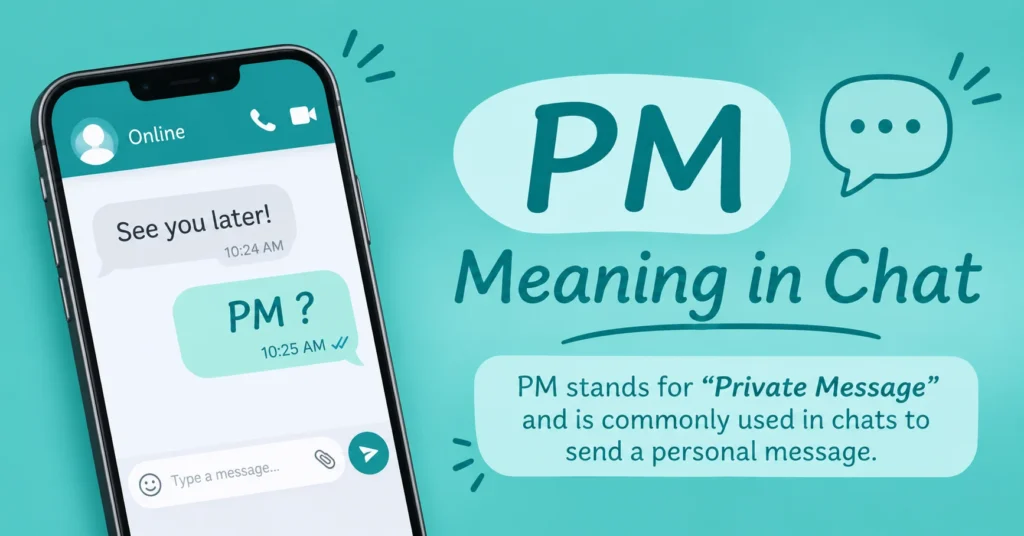
Have you received a message saying “PM me” and wondered what the person actually wanted? PM meaning in chat usually refers to “Private Message,” a way to continue an online conversation privately instead of posting in public. It is commonly understood across social media, texting, online forums, and digital communication.
Understanding private messages, PM me, direct messages, and chat abbreviations can make everyday conversations easier. In this guide, we’ll explore how people use PM, what it means on different platforms, how to respond naturally, and how context changes its meaning.
PM Full Form and What It Stands For
PM stands for Private Message in online communication. It describes a message sent directly to another person through a website, social network, forum, or messaging service. Instead of sharing information in public comments, someone uses a private inbox to communicate with the intended recipient.
You may also encounter the phrase Personal Message in some communities. Both expressions generally describe private communication rather than a public post. Dictionaries such as Cambridge and Dictionary.com recognize PM as a private-message abbreviation, including its use as a verb.
Private message
A private message is a conversation that is not displayed in a public discussion thread. Depending on the platform, it may be visible to the sender and recipient or to everyone included in the conversation. People use it to exchange relevant information without filling a public comment section.
For example, someone selling a used laptop might write, “PM me for the price.” They are asking interested buyers to contact them privately. The conversation can then move into the platform’s messaging area, where they can discuss availability, specifications, and other details.

Postmeridian
PM meaning in chat has another meaning when it appears after a clock time: post meridiem, a Latin expression meaning after midday. It identifies the period from noon until midnight in the 12-hour clock system. For example, 7 PM means seven o’clock in the evening, not a private conversation.
Context makes the distinction simple. If someone writes “PM me,” they are requesting a private message. If someone writes “Let’s meet at 7 PM,” they are describing a time. Cambridge Dictionary confirms this separate time-related meaning.
What Does PM Mean in Text?
When you see PM in a text message or online conversation, it usually means Private Message. The sender wants to communicate directly rather than continue speaking in a public comment, discussion board, or group conversation. The exact messaging feature depends on the platform being used.
For instance, a person might comment on a community post asking for information about a product. The seller responds, “I’ll PM you the details.” This means the seller intends to send the information through a private messaging feature instead of sharing everything publicly.
PM can also function as a verb in casual English. People say “I’ll PM you,” “She PMed me,” or “Check your PMs.” These expressions describe sending or receiving private messages. Dictionary.com lists forms such as PM’d, PMed, and PMing, illustrating how an abbreviation can become part of everyday informal communication.
Example
Consider this short conversation:
Alex: Does anyone know where I can find a reliable laptop?
Jordan: I know a good store. I’ll PM you the details.
Alex: Thanks! I’ll check my messages.
Jordan is offering to share information privately rather than posting the details in the public discussion. This is a typical example of how PM works in online communities, social media comments, and everyday digital communication.
Examples of PM in Real Conversations
Understanding an abbreviation becomes easier when you see how people actually use it. PM often appears in online marketplaces, community discussions, social media conversations, and gaming groups. Its meaning usually stays the same, although the reason for moving a conversation privately can differ.
Here are some original examples illustrating common situations:
| Conversation | Meaning |
| “PM me the link.” | Send the link privately. |
| “I’ll PM you later.” | I’ll send a private message later. |
| “Check your PMs.” | Look at your private-message inbox. |
| “PM for details.” | Contact me privately for more information. |
| “I sent you a PM.” | I sent you a private message. |
| “PM me if interested.” | Contact me privately if you want to participate. |
| “Can you PM the information?” | Can you send the information privately? |
Example
Imagine someone posts a bicycle for sale in a neighborhood group. A potential buyer comments, “Is this still available?” The seller replies, “Yes, PM me if you’re interested.” The seller wants to discuss the transaction privately instead of sharing every detail in the public comments.
Another example could involve a school community. A student asks whether someone has notes from a class discussion. Another member replies, “I’ll PM you the notes.” Here, PM simply means that the information will be sent through a private conversation.
PM on TikTok, Snapchat & Instagram
PM can appear on different social media platforms, but the terminology is not always identical. Some websites use Private Message, while others use Direct Message or simply Messages. Understanding the platform’s own features helps you interpret the abbreviation without confusing it with an ordinary text message.
On Instagram, people generally use DM because Direct Message is the platform’s familiar terminology. On TikTok, Snapchat, and other social networks, users may still say PM casually when asking someone to contact them privately. The abbreviation does not necessarily identify a separate feature within the app.
Example
Suppose someone comments on an Instagram post, “PM me for more information.” They probably mean that you should open a private conversation rather than leave additional details in the comments. The platform may call that conversation a DM, but the intended action is essentially the same.
You might also see phrases such as “PM for details” under a TikTok video or marketplace-style post. The person is inviting interested viewers to contact them privately. Always check the platform’s available messaging options instead of assuming that every social network uses the same terminology.
The Tone of PM
PM is generally neutral and practical. It does not automatically express affection, frustration, secrecy, or romantic interest. Most of the time, it simply tells someone where to continue a conversation. The surrounding words, relationship between the users, and subject being discussed help explain the intended tone.
For example, “PM me the assignment details” sounds straightforward, while “I’ll PM you when I have an update” is a simple offer to follow up privately. Neither expression has a special emotional meaning by itself. It is better to interpret the full conversation rather than make assumptions from two letters.
Example
Consider two different situations. A marketplace seller writes, “PM me for the price,” because they want to discuss a product with interested buyers. A friend writes, “I’ll PM you later,” because they want to share information separately. Both use PM, but their reasons for doing so are different.
Remember that private communication does not automatically mean something suspicious or confidential. It simply means the discussion is taking place outside the public thread. If a request makes you uncomfortable, you can ask for clarification or choose not to continue the private conversation.
How to Reply to PM
Your response depends on what the other person means. If someone says “PM me,” they are usually inviting you to send a private message. You can open the platform’s messaging area and contact them there, provided you are comfortable doing so and the request makes sense.
If someone says “I’ll PM you,” you generally do not need to send anything immediately. A simple response such as “Okay, thanks!” or “Sounds good” is enough. If you do not understand which platform they mean, ask, “Should I message you here?”
Example
Here are some natural responses for different situations:
| What someone says | Possible response |
| “PM me.” | “Sure, I’ll send you a message.” |
| “I’ll PM you later.” | “Okay, I’ll check my inbox.” |
| “PM for details.” | “Hi, could you share more information?” |
| “Check your PMs.” | “Thanks, I’ll take a look.” |
| “Can I PM you?” | “Sure, what would you like to discuss?” |
| “I sent you a PM.” | “Thanks, I’ll read it.” |
You do not have to accept every request to communicate privately. If you prefer to keep a discussion public, you can politely say, “Could you share the general information here instead?” This is especially useful when dealing with unfamiliar accounts or online marketplace conversations.
Common Mistakes With PM
One common misunderstanding is assuming PM always means Private Message. Although this is the usual interpretation in online chat, the abbreviation has other meanings in different contexts. For example, PM after a number refers to time, while workplace discussions may use PM to mean Project Manager.
Another mistake is treating PM and DM as completely unrelated terms. They usually describe similar forms of private online communication, although individual platforms may use different labels. People also sometimes confuse a private platform message with an ordinary SMS text, even though the two may use entirely different messaging systems.
Example
Look at these sentences:
- “PM me the address.” A private-message request.
- “The meeting starts at 6 PM.” A time reference.
- “Ask the PM about the deadline.” Could mean Project Manager in a workplace context.
- “The PM announced the decision.” – Could mean Prime Minister in a political discussion.
The words surrounding the abbreviation provide the most useful clue. Look for actions such as “send,” “message,” and “check” when interpreting online communication. If PM appears beside a number and a time-related phrase, it generally refers to post meridiem.
PM vs Related Slang
PM belongs to a broader group of online messaging abbreviations. DM, IM, and SMS are related terms, but they do not all describe exactly the same thing. Understanding their differences makes it easier to follow conversations on social networking websites, messaging applications, gaming platforms, and online forums.
| Abbreviation | Full form | Meaning |
| PM | Private Message | A message sent privately |
| DM | Direct Message | A direct private message |
| IM | Instant Message | A message sent through an instant-messaging service |
| SMS | Short Message Service | Traditional mobile text messaging |
Example
If someone says “DM me on Instagram,” they are asking you to send a direct message. If a forum member says “PM me,” they are asking for a private message through the forum or associated messaging service. Both expressions move communication away from a public discussion.
IM generally refers to instant messaging, while SMS refers to the mobile text-message service. These terms describe related communication methods, but their technical meanings are different. Choosing the wording used by the platform is usually the simplest way to avoid confusion.
Conclusion
PM meaning in chat is usually Private Message, an abbreviation people use when they want to move a conversation from a public discussion into a private messaging space. You may encounter it in texting, online forums, social media, and marketplace conversations.
Although PM and DM generally serve the same purpose, the preferred terminology varies between platforms. Remember that PM can also mean post meridiem when it follows a clock time. Once you understand the surrounding context, recognizing its intended meaning becomes simple.
FAQs
Author

Ethan Carter is an SEO blogger specializing in internet slang, text abbreviations, and social media meanings. He creates clear, accurate, and reader-friendly content backed by thorough research. His goal is to help readers understand modern online language with reliable, easy-to-read guides.