

Virile Meaning: 7+ Surprising Facts About This Powerful Word and Its Uses
Virile meaning describes someone or something associated with masculine strength, energy, vigor, orwhen referring to a malesexual potency and reproductive ability. In American English, the word is usually pronounced “VIR-uhl.” If you encountered it in a book, article, conversation, or description of someone’s personality, the exact meaning depends on context. Major dictionaries including Dictionary.com, Collins, and Oxford connect the adjective with masculinity, strength, energy, and traditional male characteristics.
For many readers, the confusing part is that virile meaning is broader than simply “masculine.” It can describe physical power, confident energy, vigorous performance, or male reproductive capability. Understanding those shades makes the word much easier to recognize without assuming that every use is sexual. This guide breaks down the word, its pronunciation, origins, synonyms, examples, and modern context.
Virile in American English
In American English, virile meaning is an adjective describing qualities traditionally associated with adult men, particularly masculinity, strength, vigor, forcefulness, and energy. Collins also lists a reproductive or sexual sense, meaning capable of copulation or procreation. Dictionary.com similarly includes masculine strength and the ability to procreate among its meanings.
So, if someone says, “He has a virile presence,” they may be emphasizing confidence, physical strength, energy, or traditionally masculine qualities rather than making a direct sexual comment. Context matters. A phrase such as “virile strength” generally highlights power or vigor, while a biological discussion may use the word closer to “sexually potent.”
Virile in British English
British English gives virile meaning a particularly clear connection with male sexual energy. Collins lists meanings involving adult male characteristics, high sexual drive, copulation or procreation, and being strong, forceful, or vigorous. Oxford likewise defines the word as describing men who are strong and energetic, especially in relation to sexual energy.
Pronunciation also differs somewhat between varieties of English. Oxford gives /ˈvɪraɪl/ and /ˈvɪrəl/, while Collins identifies the American pronunciation as /ˈvɪrəl/ and notes the British “-rile” pronunciation. Therefore, if you hear “virile” pronounced differently from how you expected, both forms may be legitimate depending on the speaker’s variety of English.
Origin of virile
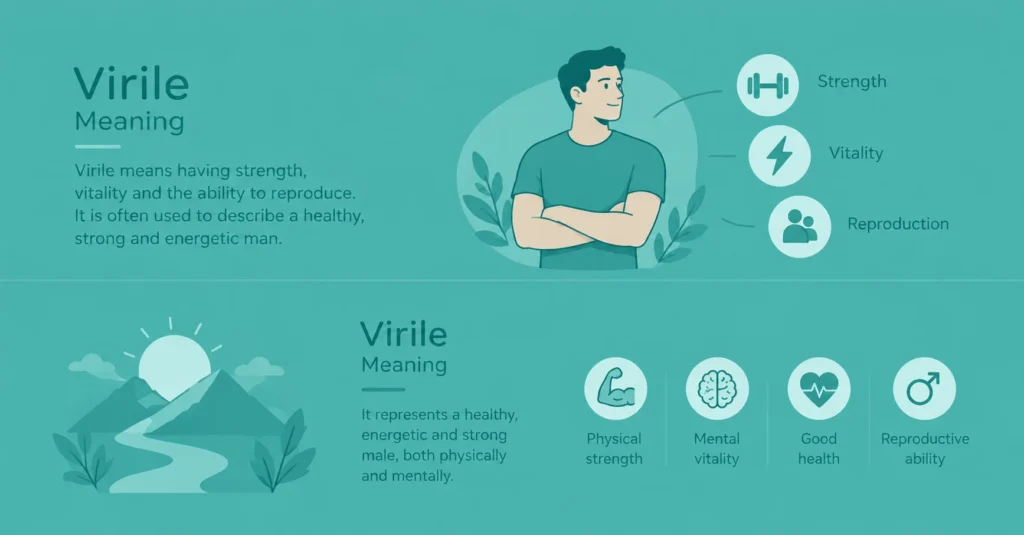
The word virile meaning has a long linguistic history. Dictionary.com traces it to the late 15th century and identifies its source as Latin virīlis, meaning “manly,” from vir, meaning “man.” Collins likewise traces the word to Latin virīlis. This history explains why the modern word remains closely connected with male identity and masculinity.
Knowing the origin also explains why related words such as virility carry similar ideas. Over centuries, the meaning expanded beyond simply “belonging to a man” to include strength, vigor, masculine energy, and reproductive capability. The historical root therefore provides a useful semantic bridge between manhood, vitality, potency, and physical or personal force.
Explanation
The easiest way to understand virile meaning is to think of three overlapping ideas: masculine qualities, vigorous strength, and male sexual or reproductive capability. Not every sentence uses all three. A writer describing a powerful performance might use “virile” figuratively, while a medical or biological discussion may use it in a reproductive sense.
The word can also carry cultural nuance because “virile” traditionally reflects qualities society has associated with men. These can include physical strength, confidence, courage, assertiveness, athleticism, and sexual energy. That does not mean every strong man is automatically “virile,” nor does the word objectively measure masculinity. It is a descriptive adjective whose meaning depends heavily on context.
Example Sentences
Here are several natural examples. “The athlete displayed a virile meaning energy throughout the competition” emphasizes vigor and strength. “The novel portrays its hero as virile and courageous” emphasizes traditional masculine qualities. “The writer described the performance as virile and forceful” uses the word figuratively for energetic power. These uses align with dictionary definitions connecting virile with strength, energy, and masculine spirit.
A biological sentence can have a different emphasis: “The study examined reproductive factors associated with male fertility.” In this setting, “virile” would be closer to its sexual or reproductive sense. The distinction is useful because readers sometimes assume the word always means “sexually attractive.” It does not. Virile can suggest masculinity or vigorous force without referring directly to attractiveness or sexual activity.
Derived forms
The most important related noun is virility, which refers to qualities traditionally associated with male strength, vigor, masculinity, or sexual and reproductive capability. Collins identifies virility as an uncountable noun, while Dictionary.com lists it among the other word forms associated with virile.
The adverb virilely also exists, although it is much less common in everyday American English. Other dictionary-listed forms include nonvirile, subvirile, and ultravirile. For ordinary writing, however, readers are far more likely to encounter “virile” and “virility.” Using the familiar forms generally produces clearer, more natural communication.
Word origin
Collins places the origin of virile meaning in Latin virīlis, from vir, meaning “man.” Dictionary.com similarly dates its English development to the late 15th century. The etymology is therefore directly connected to the word’s longstanding association with manhood and masculine qualities.
This history is useful when interpreting older literature. Historical writers frequently used masculine strength, vigor, courage, and reproductive capability as related ideas. Modern readers should nevertheless pay attention to context because language changes. A contemporary writer might use “virile” stylistically to mean vigorous or forceful rather than intending a literal statement about sexuality.
Synonyms of ‘virile’
Common synonyms include manly, masculine, macho, strong, vigorous, robust, potent, forceful, powerful, energetic, and lusty. Cambridge’s thesaurus also groups words such as muscular, mighty, hardy, brawny, courageous, and capable of fathering children with different senses of the term.
The best synonym depends on what you want to communicate. “Masculine” is useful for traditional male characteristics; “vigorous” emphasizes energy; “robust” suggests strength and health; “potent” can emphasize power or sexual capability; and “macho” usually carries a stronger cultural or informal tone. Because these words are not identical, replacing “virile” mechanically can change the sentence’s meaning.
| Word | Main emphasis | Typical tone |
| Virile | Masculinity, vigor, male potency | Formal/literary |
| Manly | Traditional male qualities | General |
| Masculine | Traits associated with men | Neutral |
| Vigorous | Energy and strength | Neutral |
| Robust | Health, strength, resilience | Positive |
| Macho | Exaggerated masculinity | Informal |
| Potent | Power or sexual capability | Context-dependent |
Trends of virile
“Virile” is not limited to descriptions of individual men. Dictionary.com provides modern examples in which the word is applied figuratively to capitalism, music, and other forms of expression, showing that contemporary usage can extend to things characterized by energy, force, or vigor.
That broader usage is important for understanding the word today. A “virile performance” does not necessarily mean a sexual performance; it can describe something vigorous, powerful, energetic, or strongly expressive. Similarly, “virile style” can communicate forcefulness or vitality. The safest interpretation is always to examine the surrounding nouns, verbs, and subject matter before choosing the intended meaning.
Quick meaning
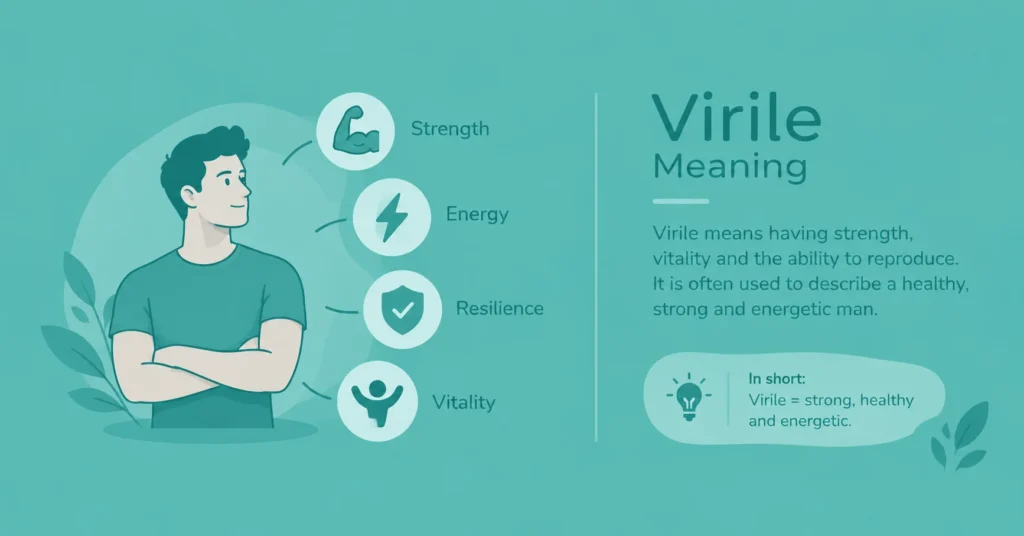
In simple English, virile means strongly masculine, vigorous, energetic, orwhen describing a male in a biological context sexually or reproductively capable.
Pronunciation
In American English, virile is commonly pronounced approximately VIR-uhl (/ˈvɪrəl/). A British pronunciation may sound closer to VIR-eye-ul (/ˈvɪraɪl/). Oxford lists both pronunciation forms.
Virile vs. masculine
“Masculine” is broader and generally means having qualities traditionally associated with men. “Virile” tends to add a stronger sense of physical vigor, energy, forcefulness, or male sexual/reproductive potency. In other words, something can be masculine without necessarily being described as virile.
Virile vs. macho
“Macho” usually suggests strongly or exaggeratedly masculine behavior and can carry a critical or informal tone. “Virile” is more formal or literary and can be positive when describing strength, energy, athleticism, or vitality. The two overlap, but they are not interchangeable in every context.
Virile vs. fertile
These words are related but different. Fertile refers specifically to the ability to produce offspring or support reproduction. Virile can include reproductive capability, but it can also describe masculinity, vigor, strength, energy, or forcefulness. Therefore, calling someone virile does not automatically mean that fertility has been medically established.
Is virile a positive word?
Usually, virile is neutral to positive when used to praise strength, energy, athleticism, or traditionally masculine qualities. Oxford labels the word “usually approving.” However, its connotations can vary because ideas about masculinity differ across cultures, generations, and contexts.
Can virile describe something other than a man?
Yes. Dictionary definitions and usage examples show that virile can describe performances, writing, music, leadership, styles, or other things perceived as vigorous and forceful. In those contexts, the word is generally figurative rather than biological.
Is virile the same as attractive?
No. Someone described as virile may be portrayed as strong, energetic, masculine, or sexually potent, but virile does not simply mean handsome, attractive, or sexy. The intended meaning depends on the sentence and context.
Conclusion
The clearest virile meaning is “having traditionally masculine strength, energy, or qualities,” with an additional sense involving male sexual or reproductive capability. The word can also describe something vigorous, forceful, or energetic in a figurative way. Its Latin origin, pronunciation, synonyms, and multiple contextual meanings explain why it sometimes sounds biological and at other times literary or descriptive.
FAQs
Author

Ethan Carter is an SEO blogger specializing in internet slang, text abbreviations, and social media meanings. He creates clear, accurate, and reader-friendly content backed by thorough research. His goal is to help readers understand modern online language with reliable, easy-to-read guides.






One Comment