Strut Meaning: Definition, Slang, Examples & Usage
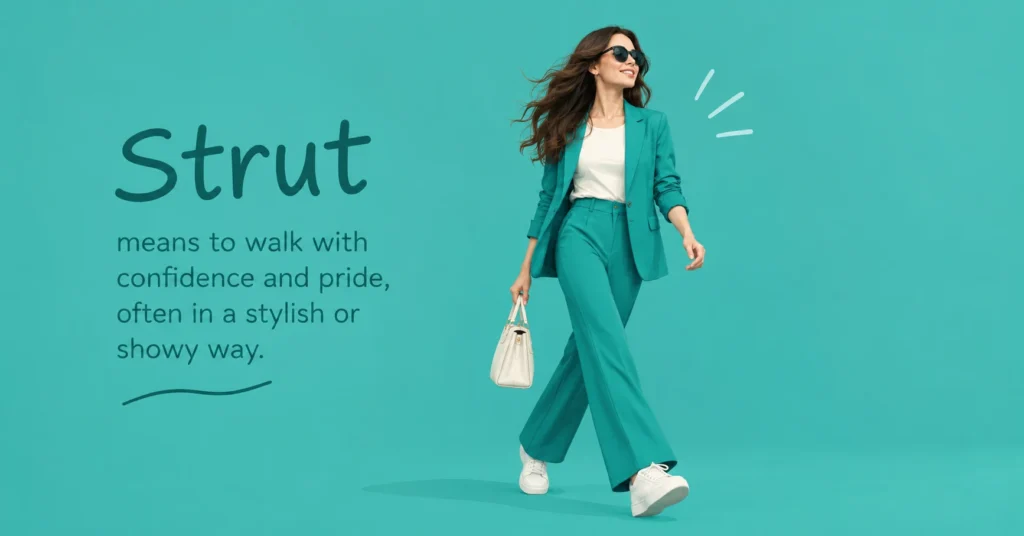
Strut meaning: to walk in a proud, confident, or showy way, often with your head held high and chest forward. In everyday American English, strut can describe someone who feels confident after an achievement or someone who seems to be showing off. Its tone depends on the situation, body language, and the speaker’s intention.
The word also has a practical meaning: a strut is a structural support used in buildings, vehicles, and other engineered objects. Understanding the difference between a proud walk, the idiom “strut your stuff,” and a physical support makes the word easier to recognize in conversations, books, entertainment, and technical writing.
Strut Meaning and Definition
The word strut meaning has two main everyday dictionary meanings. As a verb, it describes walking with an exaggerated sense of pride, confidence, or importance. As a noun, it can describe that distinctive walk or a physical component that supports part of a structure.
For example, imagine someone walking into a room after winning a competition. They hold their head high, smile, and move as though they are proud of their accomplishment. You might say, “She strutted into the room.” By contrast, a mechanic discussing a vehicle’s suspension might use strut to describe a mechanical component rather than a person’s behavior.
The key to understanding the word is context. When the subject is a person or animal, the word often describes movement or attitude. When the subject is a building, aircraft, or vehicle, it can refer to a supporting component.
What Does Strut Mean as a Verb?
As a verb, to strut meaning to walk in a noticeably proud, self-assured, or swaggering manner. The movement often looks deliberate: the person may hold their head high, keep their shoulders back, or walk in a way that attracts attention.
The word can express genuine confidence, but it can also suggest arrogance. Consider these examples:
- “He strutted onto the basketball court after making the winning shot.”
- “The peacock strutted across the garden.”
- “She strutted down the runway in her new outfit.”
- “He strutted around the office as if he owned the place.”
In the first and third examples, strutted can convey celebration or confidence. In the last example, the wording suggests that the person may be acting overly important.
Grammatically, strut meaning is the base form, struts is the third-person singular present form, strutted is the past tense, and strutting is the present participle. For example, “He struts,” “He strutted,” and “He is strutting.”
What Does Strut Meaning as a Noun?
As a noun referring to movement, strut meaning a proud, exaggerated, or self-important way of walking. Instead of describing the action itself, the noun identifies the manner or style of the walk.
For example, “His confident strut caught everyone’s attention” describes the distinctive way he walked. In “She recognized his arrogant strut,” the word suggests that her impression of his behavior was negative.
The noun also has a technical meaning. A strut can be a long, rigid component used to support or strengthen a structure. Such components appear in buildings, bridges, aircraft, and vehicles. The exact function depends on the design and engineering application.
The easiest way to distinguish the two noun meanings is to look at the surrounding words. If a sentence mentions posture, pride, or swagger, it probably refers to walking. If it mentions steel, suspension, a roof, or a framework, it probably refers to a physical support.
What Does “Strut Your Stuff” Mean?
“Strut your stuff” is an informal English idiom meaning to show your abilities, talents, appearance, or skills confidently. It often carries an enthusiastic, encouraging tone, although it can sometimes imply showing off.
For example, a dance instructor might tell students, “Go out there and strut your stuff!” The instructor is encouraging them to perform confidently and enjoy the spotlight. Similarly, a singer might be encouraged to strut their stuff during an audition.
The expression can also apply to fashion, sports, public speaking, and creative work. Someone wearing an outfit they love might confidently show it off, while an athlete may celebrate a strong performance. In each case, the central idea is displaying what you can do or what you are proud of.
Importantly, the phrase does not automatically mean that someone is arrogant. The setting and tone determine whether the expression sounds supportive, playful, boastful, or critical.
Strut Meaning in Slang and Everyday English
In informal conversation, strut meaning commonly describes someone walking with noticeable confidence, attitude, or swagger. It is useful when the ordinary word walk does not fully capture the person’s body language or the impression they create.
For example, “He walked into the party with a strut” suggests more than simply arriving. It creates an image of someone who appears confident, proud, or eager to be noticed. In a social-media caption, “Time to strut my stuff” could mean that someone is ready to show off a new outfit, perform a dance, or celebrate an achievement.
The word can be complimentary when the emphasis is on self-confidence. It can sound critical when the person seems conceited or is trying too hard to impress others. That distinction matters because a confident walk and an arrogant walk may look similar but carry different social meanings.
Although strut meaning is used informally, it is not exclusively slang. It is an established English word found in standard dictionaries, literature, everyday conversation, and technical contexts.
Examples of Strut in a Sentence
Seeing the word in context is one of the easiest ways to understand how it works. The examples below cover its common grammatical forms and meanings.
| Example sentence | Meaning |
| “She strutted into the room with a smile.” | She walked confidently or proudly. |
| “The players strutted after their victory.” | They walked in a celebratory or self-assured way. |
| “The peacock strutted around the garden.” | The bird moved with a proud, showy gait. |
| “He has an arrogant strut.” | His walk suggests excessive pride. |
| “Go out there and strut your stuff.” | Show your abilities or talents confidently. |
| “The roof uses wooden struts for support.” | The struts are physical structural components. |
| “The mechanic inspected the vehicle’s struts.” | The word refers to vehicle components. |
Notice how the subject changes the meaning. A person can strut, a bird can strut, and a structural component can be called a strut. These uses share the same spelling but differ according to context.
A useful writing tip is to choose strut when the manner of walking matters. If you simply want to describe ordinary movement, walk is usually more neutral.
Synonyms and Antonyms of Strut
Choosing the right synonym depends on whether you want to emphasize confidence, arrogance, or the physical movement itself.
| Word | Meaning or difference |
| Swagger | Walk or behave with conspicuous confidence |
| Stroll | Walk in a relaxed, leisurely manner |
| Parade | Walk or display oneself conspicuously |
| Show off | Try to attract attention or impress others |
| March | Walk with firm, regular steps |
| Slouch | Stand or walk with a drooping posture |
| Shuffle | Walk with short steps, often without lifting the feet much |
Swagger is one of the closest alternatives when describing a proud or self-important walk. Stroll is different because it emphasizes a relaxed pace rather than pride. Slouch and shuffle can serve as contrasts, but they are not exact antonyms in every context.
For example, “He swaggered into the room” suggests a similar impression to “He strutted into the room.” However, “He strolled into the room” suggests a more relaxed entrance without necessarily implying that he wanted attention.
When writing, avoid replacing every instance of strut with swagger. The best choice depends on whether the sentence emphasizes body movement, confidence, or a desire to impress others.
What Does Strut Mean in Construction and Cars?
Outside everyday conversation, a strut is a structural component that supports, braces, or helps stabilize another part of an assembly. It is commonly associated with engineering, construction, aircraft, and automotive systems. This meaning has nothing to do with showing confidence.
Struts in buildings
In construction, struts may help support a framework or resist forces acting on a structure. Depending on the design, they can be made from materials such as steel or timber. Their dimensions, connections, and load capacity must suit the particular engineering requirements.
For example, a construction professional might say, “The roof is supported by timber struts.” Here, the word identifies physical support members, not a way of walking.
Struts in cars
In automotive engineering, the term often refers to suspension components. A suspension strut forms part of the system connecting a vehicle’s wheel assembly to the body and can combine structural and damping functions, depending on its design.
For example, “The mechanic inspected the front struts” refers to a vehicle inspection, not someone’s posture. Automotive struts can affect ride quality, handling, and suspension performance, so problems should be assessed according to the vehicle manufacturer’s specifications.
The surrounding vocabulary is usually enough to identify this technical meaning. Words such as suspension, wheel, shock absorber, roof, and framework point toward engineering rather than everyday English.
Word Origin and Pronunciation of Strut
The word strut is pronounced /strʌt/, with the vowel sound found in words such as cut and shut in American English.
Oxford Learner’s Dictionaries traces the word to Old English strūtian, meaning to protrude stiffly. The modern walking-related sense developed historically from the idea of moving or standing stiffly and dates to the late sixteenth century.
Here are the main grammatical forms:
| Form | Example |
| Base form | I strut confidently. |
| Third-person singular | She struts onto the stage. |
| Past tense | He strutted into the room. |
| Present participle | They are strutting down the street. |
| Noun | His strut attracted attention. |
| Plural noun, structural sense | The bridge contains supporting struts. |
The past tense and present participle double the final t: strutted and strutting. This spelling is important when writing or checking grammar.
Conclusion
Understanding the meaning of “strut” helps you recognize how this word expresses confidence, pride, and self-assurance. Whether someone struts into a room, walks with an exaggerated sense of importance, or confidently shows off their style, the word often describes a noticeable way of moving. Depending on the context, it can suggest positive confidence or come across as arrogant or overly proud.
Beyond its use in everyday conversations and slang, “strut” also has meanings in construction and engineering, where it refers to a support structure. Understanding the context makes it easier to identify the intended meaning. Ultimately, strutting is about how someone carries themselves and the impression they leave on others.
FAQs
Author

Ethan Carter is an SEO blogger specializing in internet slang, text abbreviations, and social media meanings. He creates clear, accurate, and reader-friendly content backed by thorough research. His goal is to help readers understand modern online language with reliable, easy-to-read guides.