Diana Name Meaning: 7+ Beautiful Facts to Discover
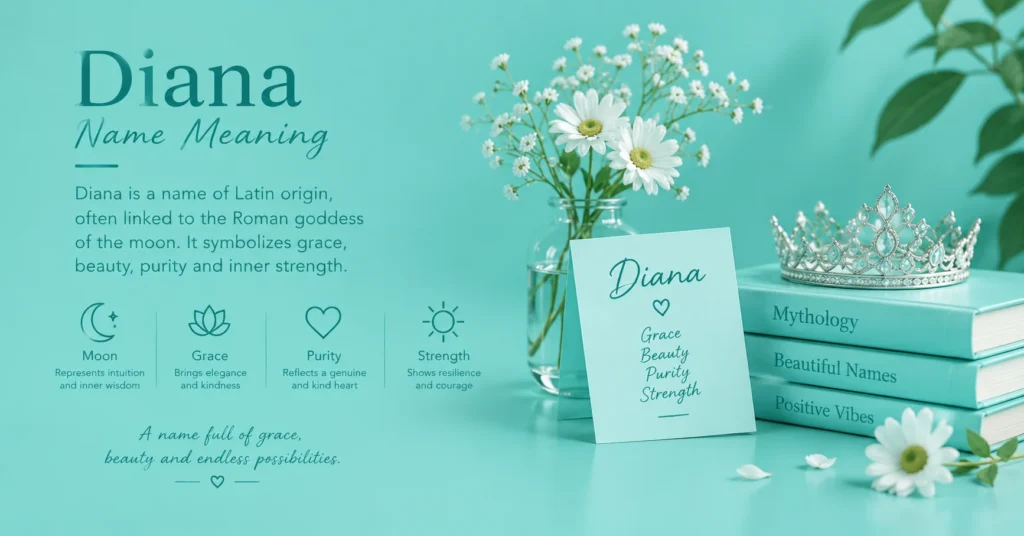
The Diana name meaning is most commonly understood as “divine” or “goddesslike,” reflecting its Latin roots and connection to the Roman goddess Diana. Pronounced dye-AN-uh in American English, this elegant name combines classical mythology, celestial symbolism, and a long history of use. For parents exploring baby girl names, Diana offers a recognizable spelling, a graceful sound, and a rich cultural background.
Choosing a name can feel deeply personal because it becomes part of a child’s identity and family story. Diana stands out among Latin girl names for its associations with the moon, nature, hunting, and the Greek goddess Artemis. This guide explores the name’s history, pronunciation, nicknames, famous namesakes, related spellings, and U.S. popularity to help you decide whether Diana is the right fit for your family.
Diana Name Meaning & History
The name Diana is traditionally associated with the meanings “divine” and “goddesslike.” Its background comes from Latin naming traditions and an ancient religious figure whose influence extended through Roman culture. Although people sometimes describe Diana as meaning “moonlight” or “bright light,” those expressions are better understood as symbolic associations than as universally agreed-upon literal translations.
Historically, Diana was the name of a Roman goddess associated with hunting, wild animals, forests, the moon, and childbirth. Her Greek counterpart is Artemis, although the two goddesses originated in distinct religious traditions. The name later became familiar in European literature and personal naming, eventually establishing itself as a classic choice in English-speaking countries.
The symbolic meaning behind Diana
For many families, Diana suggests independence, grace, strength, and a connection to nature. These qualities come from the goddess’s cultural imagery rather than from any scientifically established personality trait associated with the name. Parents may appreciate its combination of femininity and confidence, especially if they want a name with a meaningful historical story.
Is Diana a religious name?
Diana originated in Roman mythology rather than in the Bible. It is not traditionally a biblical name, although people from many different religious and cultural backgrounds use it today. Parents should distinguish its historical mythological origin from the personal or spiritual meaning they may choose to give the name within their own family.
About Diana: Origin and Pronunciation
Diana has a Latin origin and is commonly used as a feminine given name in English, Spanish, Italian, Portuguese, and several other languages. Its international familiarity makes it an accessible choice for multilingual households. Although pronunciation varies by language, the name’s spelling is recognizable across many cultures.
In the United States, Diana is usually pronounced dye-AN-uh, with the stress on the middle syllable. It has five letters and three spoken syllables in this pronunciation. The name is easy to recognize when written, and its familiar sound can work well in both formal settings and everyday conversation.
How to pronounce Diana
dye-AN-uh
Three syllables · Emphasis on AN
Say it slowly as “dye,” “AN,” and “uh,” then join the sounds smoothly. In Spanish and Italian, pronunciations commonly use a different vowel pattern, closer to dee-AH-nah.
Is Diana a classic or modern name?
Diana is best described as a classic name with enduring recognition rather than a newly invented modern name. Its roots reach back to ancient Roman culture, and it has remained in use across generations. That combination can appeal to parents seeking something established without choosing a name that feels overly elaborate or difficult to spell.
Diana Name Popularity & Trends
Diana has a substantial history in U.S. birth records. Nameberry’s page, using Social Security Administration data, reports that Diana ranked No. 244 among girls’ names in 2025, with 1,277 births that year. This makes it a recognizable choice that sits outside the very highest ranks while remaining familiar to many American families.
Popularity changes over time, so a name’s historical reputation does not necessarily reflect its current position. Diana reached a much higher level of popularity during the twentieth century than it holds today. For parents comparing names, the latest annual ranking provides a more useful snapshot than impressions based solely on relatives, celebrities, or people they know.
What Diana’s popularity means for parents
Diana may appeal to parents who want a name that is established but not at the very top of current baby-name charts. It is neither an obscure invention nor a name that needs a long explanation. However, popularity differs by region and community, so national rankings cannot tell you exactly how often a child named Diana will encounter another Diana at school.
For the most authoritative current statistics, consult the U.S. Social Security Administration’s. Check the relevant year and gender category before quoting a rank or birth count. That practice also helps keep a baby-name article accurate when annual data changes.
Common Nicknames for Diana
Diana has several short forms that can make it feel playful and affectionate in daily life. The Bump lists nicknames including Di, Didi, Annie, Dee, Nana, Danna, Dany, and Dena. Not every family will use all of them, but the range gives parents options for a nickname that feels natural rather than forced.
Baby Name Meaning, Origin and Popularity
A short nickname can develop from a child’s personality, a family tradition, or a variation that relatives find easy to say. Some parents may prefer the full name Diana for everyday use, while others enjoy a shorter form at home. There is no single correct nickname; the best choice is the one the person enjoys using.
| Nickname | Style |
| Di | Short and classic |
| Dee | Simple and friendly |
| Didi | Playful and affectionate |
| Nana | Familiar and warm |
| Danna | A distinctive alternative |
| Dany | Casual and contemporary |
| Dena | Soft and understated |
| Annie | A less obvious nickname option |
Choosing the right nickname
If you are naming a baby Diana, try saying the full name and your favorite nickname aloud with the family surname. Consider how each sounds in a casual conversation, a school introduction, and a professional setting. A nickname should feel comfortable for the person who carries it, and it can change naturally as that person grows.
Diana Name Variations & Related Names
Diana has spelling variations and related forms used in different languages and naming traditions. These include Dianna, Diane, Dayana, Daiana, and Deanna, although their histories and pronunciation may differ. Some are direct variants or adaptations, while others are related names that share a sound or historical connection.
The spelling Diana is the most direct option if you prefer the familiar traditional form. Dianna adds another “n,” while Diane has a different ending and pronunciation in English and French. Dayana and Daiana may appeal to families who want a variant that fits their linguistic or cultural preferences. It is worth checking the pronunciation in the languages your family uses.
Diana, Dianna, Diane, and Dayana
| Name | How it relates |
| Diana | Traditional form associated with Latin and Roman mythology |
| Dianna | Alternative spelling of Diana |
| Diane | Related French and English form |
| Dayana | Variant associated with Spanish-language naming |
| Daiana | Variant used in some Romance-language contexts |
| Deanna | Related-sounding name with its own naming history |
These forms are not always interchangeable. If the meaning and historical connection matter to you, research the particular spelling rather than assuming that every similar-sounding name has exactly the same origin.
Famous People Named Diana
Famous namesakes have helped keep Diana recognizable across generations. Diana, Princess of Wales, became one of the world’s best-known public figures through her royal role and humanitarian work. Her public image is one reason some people associate the name with compassion, elegance, and public service, although those qualities reflect her legacy rather than a literal name definition.
Another prominent namesake is Diana Ross, the American singer known for her work with The Supremes and her successful solo career. Her achievements connect the name to music and popular culture. These women have different backgrounds, yet both illustrate how a name can acquire layers of cultural meaning through the people who carry it.

Princess Diana’s influence
Diana, Princess of Wales, was born Diana Frances Spencer in 1961 and died in 1997. Her visibility brought worldwide attention to the name and helped associate it with modern royal history. Parents who admire her charitable legacy may find that connection meaningful, while others may simply appreciate Diana as a beautiful name with a long history.
Diana in music and entertainment
Diana Ross is an especially recognizable example of the name in American music. Beyond real-life namesakes, fictional characters named Diana appear in literature and entertainment, including Wonder Woman’s civilian identity, Diana Prince. Such references can help make the name familiar to children and adults alike.
Diana in Pop Culture
Diana’s place in popular culture extends well beyond baby-name lists. The Roman goddess appears in classical mythology and artistic representations, while modern uses include royalty, music, novels, and superhero stories. The name therefore bridges ancient and contemporary references, giving it more cultural depth than a name whose associations are limited to one era.
Literature also played a role in the name’s history. Behind the Name notes that Diana became more common in the English-speaking world after Walter Scott’s 1817 novel Rob Roy, which featured Diana Vernon. The name also appeared in George Meredith’s Diana of the Crossways, published in 1885. These literary connections help explain its established place in English-language naming.
Why cultural associations matter
A name’s cultural background can make it feel personal even when its meaning is shared by many people. One parent may connect Diana with mythology and the natural world, another with Princess Diana, and another with music or literature. Those different associations can coexist without changing the name’s linguistic origin.
Similar Names to Diana
If you like diana name meaning but want to compare alternatives, consider names with similar sounds, cultural backgrounds, or a classic feminine style. Diane, Dianna, Dayana, and Deanna are useful starting points because they share spelling, pronunciation, or historical associations. For a broader shortlist, names such as Elena, Helena, Victoria, Claudia, and Lydia offer a similarly established feel.
When comparing baby names, consider more than meaning alone. Read each name aloud with the surname, check its spelling in the languages your family uses, and decide whether you prefer a highly recognizable choice or a less common variant. A name’s best qualities often come from the combination of sound, family significance, and how comfortably it fits everyday life.
How to decide whether Diana is the right name
Diana may be a strong choice if you value a classic sound, a Latin origin, and a clear connection to mythology and history. Its familiar spelling and nickname options make it flexible, while its cultural associations give parents several possible stories to share with their child. Ultimately, the right choice depends on personal preference, family tradition, and the meaning you want the name to carry.
In summary, the Diana name meaning is most commonly described as “divine” or “goddesslike.” Its Latin roots, Roman mythological background, international use, and recognizable namesakes make it a distinctive classic for parents researching baby girl names. Whether you are drawn to its celestial symbolism, elegant pronunciation, or cultural history, Diana offers a meaningful combination of heritage and everyday usability.
Conclusion
The diana name meaning carries a beautiful blend of elegance, strength, and timeless charm. Rooted in Roman mythology, Diana is associated with the goddess of the moon, hunting, and nature, giving the name a sense of independence, grace, and mystery. Its connection to divine qualities makes it a meaningful choice for parents seeking a name with both historical depth and lasting appeal.
Whether you appreciate its celestial symbolism, cultural significance, or classic sound, Diana offers something special beyond its beauty. If you are considering this name for your baby girl or simply exploring its origins, Diana is a lovely reminder that a name can reflect both personal identity and timeless inspiration.
FAQs
Author

Ethan Carter is an SEO blogger specializing in internet slang, text abbreviations, and social media meanings. He creates clear, accurate, and reader-friendly content backed by thorough research. His goal is to help readers understand modern online language with reliable, easy-to-read guides.