
Decadent Meaning: 20+ Powerful & Surprising Definitions You Should Know
Decadent meaning can describe something rich, luxurious, and self-indulgent, or it can suggest moral, cultural, or social decline. The difference comes down to context. If you have ever wondered why a chocolate cake can be called decadent while a society can also be described as decadent, you are not alone.
After years of studying vocabulary, usage patterns, and how words change across everyday English, I find this word especially interesting because luxury, pleasure, excess, indulgence, and decline meet in one expression. This guide explains the definition, food usage, lifestyle meaning, synonyms, comparisons, examples, and common mistakes so you can understand and use “decadent” confidently.
Decadent Meaning: Definition & Core Meaning
At its core, decadent is an adjective associated with self-indulgence, luxury, excess, or decline. In a modern food description, it can be an enthusiastic compliment: a decadent dessert sounds wonderfully rich and pleasurable. In discussions of society, morality, or culture, however, it can suggest deterioration, excessive indulgence, or declining standards.
The word therefore has a fascinating double life. Think about a chocolate cake covered with ganache and cream: calling it decadent emphasizes richness and indulgence. Calling an empire decadent is different; it can imply that excessive luxury or weakened values are associated with decline. The surrounding noun and tone tell you which sense is intended.
Decadent Meaning at a Glance
| Context | Typical meaning | Tone |
| Food | Extremely rich or indulgent | Usually positive |
| Dessert | Luxuriously rich and pleasurable | Usually positive |
| Lifestyle | Excessively luxurious or pleasure-focused | Mixed |
| Society | Moral or cultural decline | Often negative |
| Art/Literature | Associated with aestheticism, excess, or decline | Context-dependent |
Dictionary.com records both the decline-related sense and the popular figurative use for extremely indulgent foods. It also notes the specialized capitalized sense connected with the late-19th-century French and English Decadent literary movement.
Decadent Meaning in Food and Desserts
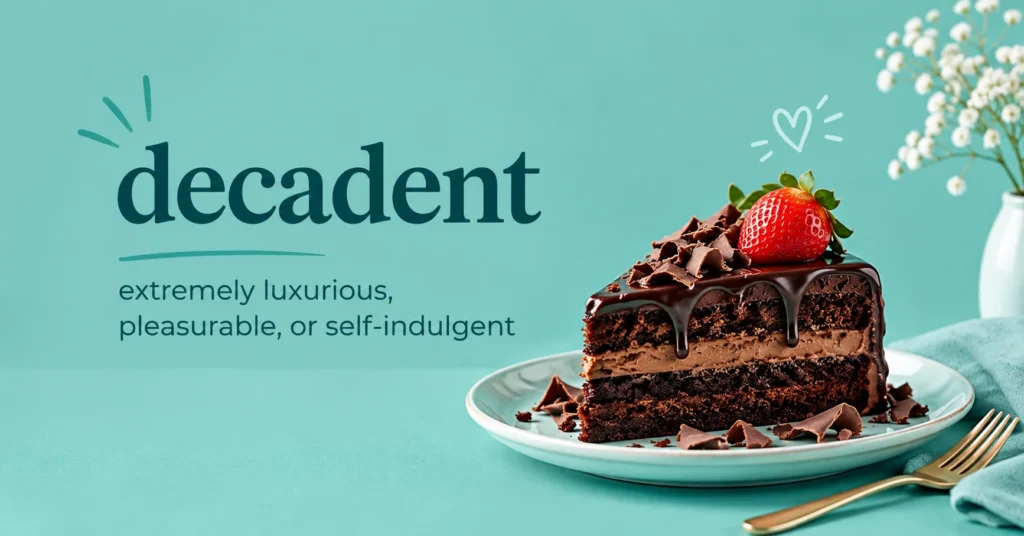
When Americans describe food as decadent, they usually mean exceptionally rich, indulgent, luxurious, or satisfying. Chocolate cake, cheesecake, mousse, ice cream, brownies, creamy pasta, and elaborate desserts can all receive the description. In this setting, the word is commonly positive and communicates that the food feels like an extravagant treat.
Imagine finishing a long workweek and ordering a warm chocolate brownie with vanilla ice cream, chocolate sauce, and whipped cream. Calling it decadent does more than say “delicious.” It suggests richness, abundance, pleasure, and perhaps a playful feeling that the treat is more indulgent than an ordinary snack.
The modern food sense is especially interesting because the older negative association with excess remains faintly present. That is why “decadent” can sound more expressive than simply “good.” It can imply that the food is so rich or pleasurable that moderation feels almost beside the point.
For example:
- The restaurant served a decadent chocolate dessert.
- We shared a decadent cheesecake after dinner.
- She made a decadent breakfast for the holiday.
- The chocolate mousse was creamy and decadent.
- They ordered a decadent ice-cream sundae.
These examples show why the word has become common in restaurant menus, food writing, recipes, and lifestyle descriptions. Current dictionary examples also show decadent being used for rich foods in contemporary American writing.
Decadent Meaning in Lifestyle and Society
When decadent describes a person, lifestyle, government, culture, or society, the tone becomes more serious. It can suggest excessive wealth, pleasure, luxury, self-indulgence, or a perceived decline in moral and cultural standards. Unlike the food sense, this usage can carry clear criticism.
For example, “They stayed at a decadent resort” may simply emphasize extravagant comfort. But “The ruler lived a decadent lifestyle” can imply something stronger: wealth and pleasure have become excessive, wasteful, or disconnected from responsibility.
The word is particularly useful when the writer wants to connect luxury with excess rather than merely describe quality. “Luxurious” can be straightforwardly positive; “decadent” often leaves open the idea that there may be too much of a good thing.
This distinction matters in history, politics, cultural criticism, literature, and formal writing. Dictionary.com notes that decadent can describe a society or era believed to be deteriorating, particularly through excessive self-indulgence or moral corruption.
A useful mental shortcut is:
Decadent food = pleasure pushed to richness.
Decadent society = excess associated with decline.
That simple distinction prevents many misunderstandings.
Decadent Meaning: How to Use “Decadent” Correctly
Using decadent correctly begins with identifying the thing being described. Food usually activates the rich-and-indulgent sense, while a society, lifestyle, or institution can activate the excessive or declining sense. Context, tone, and the surrounding nouns therefore matter more than memorizing one rigid definition.
Identify what you are describing
Start by asking whether you are describing food, a lifestyle, a society, art, literature, behavior, or an experience. A “decadent dessert” normally signals rich pleasure, while “decadent behavior” can suggest excessive self-indulgence. The noun gives the adjective its strongest contextual clue.
Think about the intended meaning
Next, listen for the emotional direction of the sentence. “We enjoyed a decadent dinner” sounds celebratory. “The aristocracy became decadent” sounds critical. Both sentences are grammatically correct because decadent can move between indulgent pleasure and decline depending on the speaker’s intended meaning.
Place “decadent” before a noun
Because decadent is an adjective, it commonly modifies a noun: decadent dessert, decadent lifestyle, decadent society, decadent meal, decadent art. It can also appear after a linking verb, as in “The dessert was decadent.” This is a straightforward grammatical pattern.
Decadent Meaning vs. Indulgent
Decadent and indulgent overlap, particularly when describing food, but they are not perfect synonyms. Indulgent focuses on allowing pleasure or treating yourself generously. Decadent usually adds a stronger sense of richness, luxury, excess, or “more than necessary.”
Compare these:
| Word | Main emphasis | Example |
| Indulgent | Allowing pleasure | An indulgent afternoon |
| Decadent | Rich, excessive pleasure | A decadent chocolate cake |
If someone says, “I had an indulgent dessert,” they are emphasizing the decision to treat themselves. If they say, “I had a decadent chocolate cake covered in cream and chocolate sauce,” the image becomes richer, heavier, more luxurious, and more excessive.
That small difference is why the two words can work together without becoming redundant. A person can indulge in a decadent dessert: “indulge” describes the act of allowing pleasure, while “decadent” describes the unusually rich nature of the thing being enjoyed.
Decadent Meaning vs. Luxurious
Luxurious generally describes comfort, quality, expense, or abundance in a positive way. Decadent can include those qualities, but it often adds the idea of excess or self-indulgence. A luxurious hotel sounds desirable; a decadent lifestyle may sound desirable and questionable at the same time.
Consider the difference:
The couple stayed at a luxurious hotel.
This simply communicates high comfort or quality.
The couple enjoyed a decadent lifestyle.
This can suggest wealth, pleasure, extravagance, and a lack of restraint.
The distinction is subtle but valuable. If you want to praise something without implying excess, luxurious is often safer. If you want to emphasize extraordinary richness or pleasure, decadent can be more vivid.
Decadent Meaning: Common Mistakes When Using “Decadent”
One common mistake is assuming that decadent is always negative. Another is treating it as a simple synonym for expensive. In reality, its meaning depends heavily on context. Competitor pages repeatedly identify this context problem, particularly the contrast between food descriptions and social or moral descriptions.
Mistake 1: Thinking “decadent” always means bad
A decadent chocolate cake is normally not a criticism. In contemporary food language, decadent can be an enthusiastic compliment meaning rich, luxurious, and indulgent. The negative sense becomes much more prominent when the word describes behavior, institutions, societies, or moral conditions.
Mistake 2: Using “decadent” for ordinary things
Decadent is a strong adjective. Calling an ordinary apple “decadent” would sound unusual unless the apple had been transformed into an unusually rich or elaborate dish. The word works best when the object genuinely suggests richness, extravagance, excess, or unusual indulgence.
Mistake 3: Ignoring the context
Context can completely change the emotional direction. “A decadent dessert” sounds pleasurable; “a decadent society” may sound critical. If you are unsure, look at the surrounding words. Are they describing taste and pleasure, or discussing decline, corruption, excess, or social values?
Decadent Meaning: Synonyms for Decadent
Useful synonyms include indulgent, luxurious, lavish, extravagant, rich, excessive, self-indulgent, corrupt, and declining, but these alternatives are not interchangeable in every sentence. The correct synonym depends on which sense of decadent is active.
For food, rich, indulgent, luxurious, sumptuous, and extravagant can work well. For a lifestyle, lavish, extravagant, hedonistic, or self-indulgent may be more precise. For moral or cultural decline, corrupt, declining, deteriorating, degraded, or degenerate may fit better.
A good vocabulary habit is to choose the synonym that preserves the exact nuance. “Lavish” emphasizes abundance, while “decadent” can suggest abundance combined with excessive pleasure. “Luxurious” emphasizes comfort or quality, while “decadent” may carry a stronger suggestion of overindulgence.
Decadent Meaning: Different Forms of the Word
The word family includes decadent, decadence, and decadently. Understanding these forms makes the vocabulary easier to recognize in books, articles, conversations, menus, and formal writing. Dictionary sources also recognize decadently as an adverbial form.
Decadent
Decadent is the adjective.
Example:
“They enjoyed a decadent meal.”
It describes the meal as unusually rich or indulgent.
Decadence
Decadence is the noun.
Example:
“The palace became a symbol of royal decadence.”
It refers to a condition or quality involving excessive luxury, self-indulgence, or decline.
Decadently
Decadently is the adverb.
Example:
“The guests dined decadently.”
It describes an action performed in a luxurious or indulgent manner.
The family can therefore be remembered simply as:
decadent → adjective
decadence → noun
decadently → adverb
Decadent Meaning: Popular Types / Variations of “Decadent”
Competitor research shows that modern usage extends beyond food into lifestyles, society, art, literature, fashion, experiences, behavior, décor, and mood. The strongest common thread is excess—sometimes pleasurable and sometimes criticized.
Decadent Food
Decadent food is usually rich, heavy, elaborate, or indulgent. Chocolate desserts are particularly common examples, but the description can apply to savory dishes when they are unusually rich or luxurious.
Decadent Lifestyle
A decadent lifestyle emphasizes luxury, comfort, pleasure, expensive experiences, and abundance. Depending on the speaker’s tone, this may sound glamorous, playful, or critical.
Decadent Society
A decadent society is generally one portrayed as losing discipline, vitality, or moral and cultural standards through excessive self-indulgence. This is a serious, analytical use rather than a compliment.
Decadent Art
In art and literary discussion, decadent can connect with aestheticism, artificiality, sensuality, beauty, excess, and decline. Capitalized Decadent can also refer specifically to the late-19th-century literary movement.
Decadent Literature
Decadent literature is associated historically with late-19th-century French and English writers and themes involving refined style, aestheticism, artificiality, and unconventional subjects. Dictionary.com identifies writers such as Oscar Wilde and Arthur Rimbaud in this historical context.
Why the Word Feels So Different in Different Sentences
There is a simple reason this word can initially feel confusing: its positive and negative senses are historically connected through the idea of excess.
A dessert can be decadent because it offers more richness and pleasure than an ordinary meal. A lifestyle can be decadent when pleasure and luxury become excessive. A society can be called decadent when critics connect excessive self-indulgence with cultural or moral decline.
That shared concept of “too much” ties the meanings together.
Recent American dictionary examples continue to show decadent used positively for foods and more critically for social or cultural contexts.
A Note on the Word’s History
The noun decadence traces back through French to Medieval Latin and ultimately to Latin roots associated with “falling away” or decline. Dictionary.com dates decadent in English to the 1830s–1840s as a back-formation from decadence.
The historical connection explains why the word can simultaneously suggest pleasure and deterioration. Its modern food usage developed a more playful or positive flavor, while the older critical sense remains alive in discussions of society, morality, art, and culture.
Decadent in Everyday American English
If you hear an American restaurant advertise a decadent chocolate cake, there is usually no serious moral judgment involved. It is promotional language designed to make the dessert sound rich, tempting, and luxurious. Contemporary dictionary examples show this usage remains active in U.S. writing.
But if a journalist writes about a decadent ruling class, the tone changes. The writer may be criticizing excessive wealth, pleasure, or self-indulgence. The same adjective therefore requires readers to interpret the surrounding noun and context rather than rely on one fixed translation.
Real-World Sentence Examples
Here are practical examples showing the difference:
- The bakery makes decadent chocolate brownies.
→ Very rich and indulgent. - We booked a decadent weekend at a luxury resort.
→ Extremely luxurious and pleasurable. - The celebrity was known for a decadent lifestyle.
→ Excessively luxurious or self-indulgent. - Critics called the ruling elite decadent.
→ Morally or culturally declining. - The novel explores a decadent society.
→ A society portrayed as weakened by excess or decline. - The dessert was so decadent that one slice was enough.
→ Rich and indulgent. - The mansion had a decadent interior.
→ Lavish, ornate, and excessively luxurious. - The critic described the era as culturally decadent.
→ Experiencing cultural decline.
The examples show why replacing decadent with one universal synonym can sometimes distort the intended meaning.
The Easiest Way to Remember Decadent Meaning
If you only remember one idea, remember “luxury or pleasure taken to an extreme.”
With food, that extreme often sounds delicious:
decadent chocolate cake
With lifestyles, it may sound extravagant:
decadent lifestyle
With society or culture, the same idea can become critical:
decadent society
So the word is not automatically positive or negative. The context determines whether the speaker is celebrating richness or warning about excess.
Decadent Meaning: What the Word Really Communicates
The most useful way to understand decadent is to see the connection between pleasure and excess. It can celebrate an extraordinarily rich dessert, describe an extravagant lifestyle, or criticize a culture believed to have declined through self-indulgence. That range is why the word remains expressive and memorable.
If you encounter the word in everyday American English, first look at what it modifies. Food usually activates the positive, indulgent sense. Society, culture, behavior, or an institution can activate the more critical sense. Once that contextual clue becomes familiar, decadent becomes much easier to understand and use naturally.
Conclusion
The word “decadent” can describe something richly luxurious, indulgent, or excessively pleasurable, especially when talking about food, experiences, or lifestyles. Depending on the context, it can also suggest moral decline, excessive self-indulgence, or a lack of restraint. That’s why the word can have either an appealing or critical tone.
When used for desserts, for example, “decadent” usually means wonderfully rich and satisfying, while “decadent behavior” may carry a more negative meaning. Understanding the context helps you recognize which sense is intended. Whether describing a luxurious dessert or an extravagant lifestyle, “decadent” adds a strong sense of richness and excess to everyday language.
FAQs
Author

Ethan Carter is an SEO blogger specializing in internet slang, text abbreviations, and social media meanings. He creates clear, accurate, and reader-friendly content backed by thorough research. His goal is to help readers understand modern online language with reliable, easy-to-read guides.




One Comment