
tdlr meaning: 25+ Powerful & Helpful Ways to Understand It in Text & Online Chats
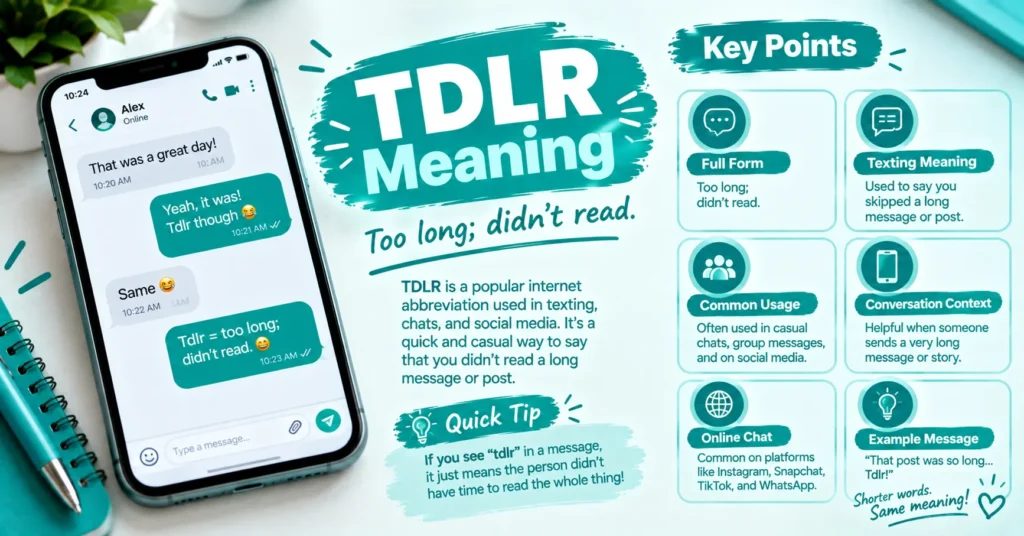
TDLR meaning usually refers to TL;DR, or “Too Long; Didn’t Read,” when the term appears in texting or online conversation. If you have ever received “TDLR?” after sending a long message, you may simply be looking at a typo or letter reversal. In everyday digital communication, the intended idea is usually a short summary, quick version, main point, or concise recap.
As someone who studies online language and communication patterns, I know how confusing tiny abbreviations can feel when context is missing. TDLR meaning can look like established internet slang, but the standard form is TL;DR or TLDR. This guide explains the meaning, texting usage, tone, examples, grammar, and the important difference between internet slang and the Texas government abbreviation.
What Does TDLR Mean in Text?
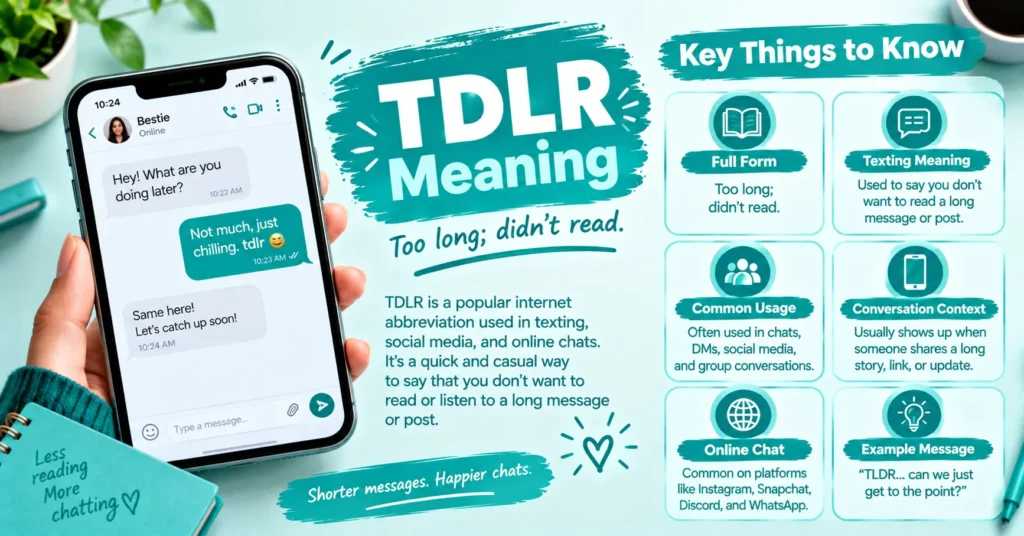
In text messages, TDLR usually means TL;DR, “Too Long; Didn’t Read.” The phrase is an internet abbreviation connected with a long message, online post, article, or explanation. A person may use it to request the short version, while a writer may use the standard TL;DR label before giving readers a concise summary.
For example, imagine your friend sends you ten paragraphs about a complicated situation. You reply, “TDLR?” They will probably understand that you want the main point rather than every detail. The intended meaning is therefore usually short version, quick summary, main takeaway, or brief explanation, even though TDLR itself is not the standard spelling.
Is TDLR an Acronym or Abbreviation?
TDLR is best treated as a nonstandard abbreviation or letter arrangement of TL;DR, rather than a separate established internet term. The recognized expression is TL;DR, while TLDR removes the punctuation. Oxford and Cambridge both recognize TL;DR/TLDR as an informal internet abbreviation associated with “Too Long; Didn’t Read.”
That distinction matters because people sometimes assume every four-letter internet expression has its own official definition. With TDLR, context is important. If it appears in a casual text, Reddit comment, group chat, or social-media conversation, the writer most likely intended TL;DR. In another context, however, TDLR can refer to an entirely different organization or technical term.
TL;DR vs. TDLR: What’s the Difference?
TL;DR is the standard and widely recognized form meaning “Too Long; Didn’t Read.” TLDR is the common version without punctuation. TDLR, by contrast, is generally understood as a typo, reversal, or nonstandard variation of the same internet abbreviation. The difference is mainly spelling and recognition rather than intended meaning.
| Form | Meaning | Typical use |
| TL;DR | Too Long; Didn’t Read | Standard internet abbreviation |
| TLDR | Too Long; Didn’t Read | Casual version without punctuation |
| tldr | Too Long; Didn’t Read | Informal online writing |
| TDLR | Usually intended as TL;DR | Nonstandard or reversed spelling |
Oxford lists TL;DR with forms including TLDR and tldr, while Cambridge similarly recognizes the variants and also defines TLDR as a noun meaning a short summary.
How TDLR Is Used in Text Messages
The most common TDLR-style usage is a request for a short summary or an informal introduction to one. In a busy group chat, someone may type “TDLR?” after a long explanation because they want the essential information first. A writer may instead write “TL;DR:” and immediately state the conclusion.
Consider this simple exchange:
A: “I wrote a huge explanation about what happened at work today.”
B: “TDLR?”
A: “The meeting was canceled, and everyone went home early.”
Here, TDLR functions as a request for the short version. The recognized abbreviation would normally be TL;DR or TLDR, but the intended message is still understandable from context.
Asking for a Short Summary
When someone writes “TDLR?” they are generally asking you to condense a lengthy explanation. A natural response might be “The short version is…” or “Basically…” followed by the essential point. The goal is information compression, not necessarily criticism of the original message or its writer.
Introducing a Summary
A writer can place TL;DR before a concise recap of a longer message. For example: “TL;DR: The deadline moved to Friday.” This format allows readers to understand the decision quickly and then continue reading the details if necessary. Cambridge specifically recognizes TLDR as a short summary of writing or a discussion.
TDLR Meaning in Different Texting Contexts
The intended meaning of TDLR can remain the same across different messaging platforms, but the surrounding tone changes. In SMS, WhatsApp, group chats, and direct messages, it usually signals a desire for a shorter explanation. Because casual messaging moves quickly, abbreviations can act as convenient shortcuts.
The same idea appears across social media and online communities. A long Reddit story, Discord discussion, Instagram message, or social-media thread can contain many details before reaching the central point. A TL;DR gives readers an entry point without requiring them to process every paragraph first.
In SMS and WhatsApp
In SMS or WhatsApp, TDLR may appear after a long personal story or detailed update. Someone might ask “TDLR please” when they are busy but still want to understand the outcome. In casual conversation, a short summary can keep the exchange moving without requiring a lengthy reread.
In Instagram and Snapchat DMs
In Instagram or Snapchat conversations, TDLR may be understood as a request for the short version. If someone sends a long explanation about plans, drama, or an event, “TDLR?” can mean “What is the main point?” Because TDLR is nonstandard, context remains more important than the letters themselves.
In Discord and Online Chats
Fast-moving Discord and online-chat conversations often contain multiple messages, replies, jokes, explanations, and updates. A TL;DR can condense that information into a few words. TDLR may be understood similarly, but TL;DR or TLDR remains the more recognizable form for a summary.
TDLR Tone Variations: Funny, Sarcastic, Playful, and Serious
The tone of TDLR depends heavily on context, relationship, punctuation, and surrounding language. A friend who writes “TDLR 😂” may be joking about a long story. A coworker who writes “TL;DR?” may simply want the key decision. The same abbreviation can therefore feel friendly, impatient, humorous, or dismissive.
Tone becomes especially important when emotions are involved. Asking for a summary after someone shares a personal problem can accidentally sound as though their story is unimportant. In contrast, using TL;DR to summarize your own lengthy message is generally more neutral and considerate.
Funny Tone
A funny use might look like: “I just wrote you an entire essay about my day. TDLR 😂.” The speaker is joking about the length of the message while inviting the listener to focus on the main event. Emojis, exaggeration, and a familiar relationship can make the shorthand feel playful.
Sarcastic Tone
A sarcastic example could be: “TDLR, please. I have a life.” The words are understandable, but the phrase may sound impatient because it emphasizes the speaker’s unwillingness to read the entire message. Sarcasm works differently from a neutral request, so the surrounding conversation determines whether it feels funny or rude.
Playful Tone
A playful version might be: “TDLR, but don’t skip the interesting part!” Here, the person wants efficiency without losing the entertaining details. Among friends, this kind of shorthand can become part of the natural rhythm of conversation rather than a serious complaint about message length.
Serious Tone
In a serious conversation, clearer language is usually safer. Instead of replying only “TDLR,” you could write “Could you give me the short version?” That communicates the same need without suggesting that the other person’s explanation is boring, excessive, or unimportant.
Grammar and Language Role of TDLR
TDLR is not normally treated as a standard English word. In digital communication, it functions conversationally as an abbreviation or shorthand expression. TL;DR can appear by itself, introduce a summary, or refer to the summary itself. The exact grammatical role depends on how the writer places it in a sentence.
For example, “TL;DR: The meeting was canceled” uses the abbreviation as a summary label. “Can you give me a TL;DR?” treats it more like a noun referring to a summary. The lowercase forms tl;dr and tldr are common in informal internet writing, while uppercase forms often appear in explanatory or more polished contexts.
How to Reply to TDLR in Text
If someone sends “TDLR?”, the easiest response is a one- or two-sentence explanation containing the essential facts. You do not need to repeat every detail. Start with the outcome, decision, or main event, then add one important piece of context if the reader needs it.
For example, if a coworker asks for the TDLR of a long project update, you might reply: “The launch is still on schedule, but testing needs two more days.” That is more useful than simply saying “It’s fine” because the reader learns both the current status and the important exception.
Funny Reply
“TLDR: I was right, everyone else was confused 😂.” A playful answer works when the relationship and conversation already support that kind of humor. The key is matching the tone instead of forcing a joke into a serious conversation.
Serious Reply
“Sure. The deadline has moved to Friday, and the final review is still pending.” A direct answer works well when TDLR is being used to simplify a practical update, workplace discussion, school assignment, or group announcement.
Neutral Reply
“Short version: Everything is fine, but we need one more day.” Neutral wording is useful when you are unsure about the other person’s tone. It gives the requested summary without adding sarcasm or unnecessary emotion.
Is TDLR Rude or Offensive?
TDLR is not inherently offensive, but asking someone for a summary can sound dismissive or impatient depending on the situation. A standalone “TLDR” after a heartfelt message may make the sender feel that their effort was not worth reading. With close friends, however, the same wording can be harmless or playful.
A useful distinction is who is providing the TL;DR. When a writer adds “TL;DR” to their own long article or message, it generally functions as a courtesy for busy readers. When someone replies “TLDR” to another person’s detailed explanation, it can sometimes sound like criticism. Cambridge recognizes both the commenting and summary uses of TLDR.
When TDLR Can Sound Rude
Be cautious when someone is sharing an emotional experience, explaining a disagreement, discussing an important problem, or asking for serious advice. In these situations, “Could you give me the short version?” or “What’s the main takeaway?” usually sounds more considerate.
Who Uses TDLR and TL;DR?
TL;DR is widely associated with internet communication, including social-media posts, forums, messaging, blogs, and online discussions. Current dictionary sources classify it as informal language connected with internet and online communication. Oxford specifically places TL;DR in its phones, email, and internet vocabulary.
There is no reliable reason to assume that the nonstandard spelling TDLR belongs exclusively to one age group or region. Someone typing TDLR may simply have reversed the letters accidentally. If the context is a Texas licensing discussion, however, TDLR may mean something completely different: the Texas Department of Licensing and Regulation.
TDLR Origin and Internet Culture
The phrase “Too Long; Didn’t Read” developed within internet discussion culture as people looked for ways to respond to lengthy online posts. Over time, TL;DR evolved from a potentially dismissive reaction into a practical label for a concise summary. Modern dictionaries now recognize both functions.
That evolution explains why TL;DR can seem contradictory. Literally, the phrase sounds like an admission that someone did not read something. In modern usage, however, a writer can carefully read a 2,000-word report and then add “TL;DR” before a one-sentence summary. The expression has effectively become shorthand for “here is the short version.”
Conclusion
The simplest TDLR meaning is usually TL;DR “Too Long; Didn’t Read.” When you see TDLR in a text, comment, or group chat, it most likely means someone wants the short version or is introducing a quick summary. The standard forms are TL;DR and TLDR, while TDLR is generally a typo or letter reversal.
Remember the context. A playful “TDLR 😂” between friends can be harmless, while the same reply to an emotional message can sound dismissive. And if TDLR appears in a Texas regulatory context, it may refer to the Texas Department of Licensing and Regulation, not internet slang.
FAQs
Author

Ethan Carter is an SEO blogger specializing in internet slang, text abbreviations, and social media meanings. He creates clear, accurate, and reader-friendly content backed by thorough research. His goal is to help readers understand modern online language with reliable, easy-to-read guides.


One Comment