
Inverse Meaning: Definition, Examples, Synonyms & Usage
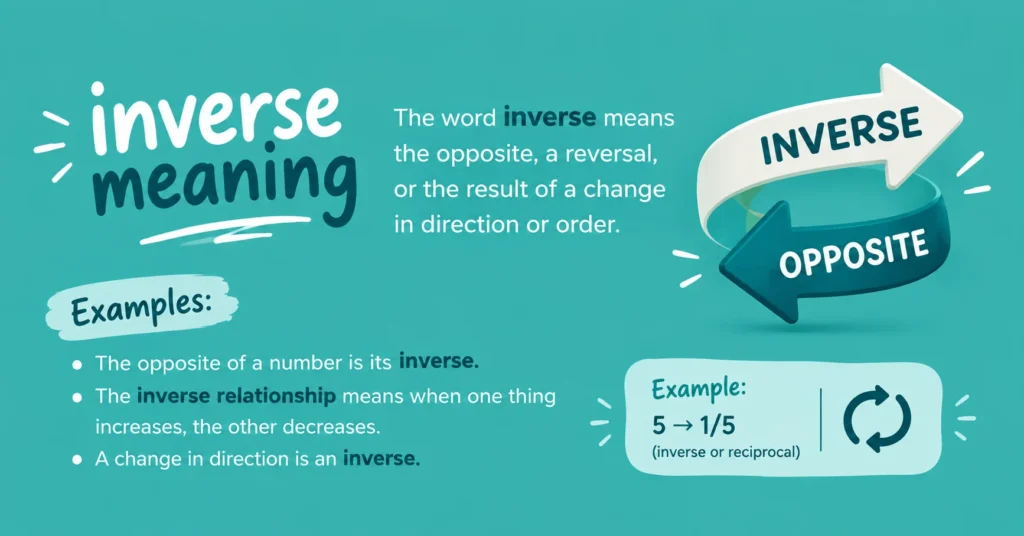
The inverse meaning of something is its opposite, reverse, or counterpart, depending on context. In everyday English, inverse can describe an opposite direction or effect; in mathematics, it often means an operation or function that reverses another. If you’ve ever wondered whether inverse, opposite, reverse, and reciprocal mean exactly the same thing, you’re not alone.
Learning the distinction makes English clearer, especially in academic writing, mathematics, science, economics, and everyday comparisons. In this guide, we’ll look at the inverse definition, related words, examples, pronunciation, mathematical usage, and common questions so you can recognize the intended meaning without guessing.
Inverse Meaning: What Does “Inverse” Mean?
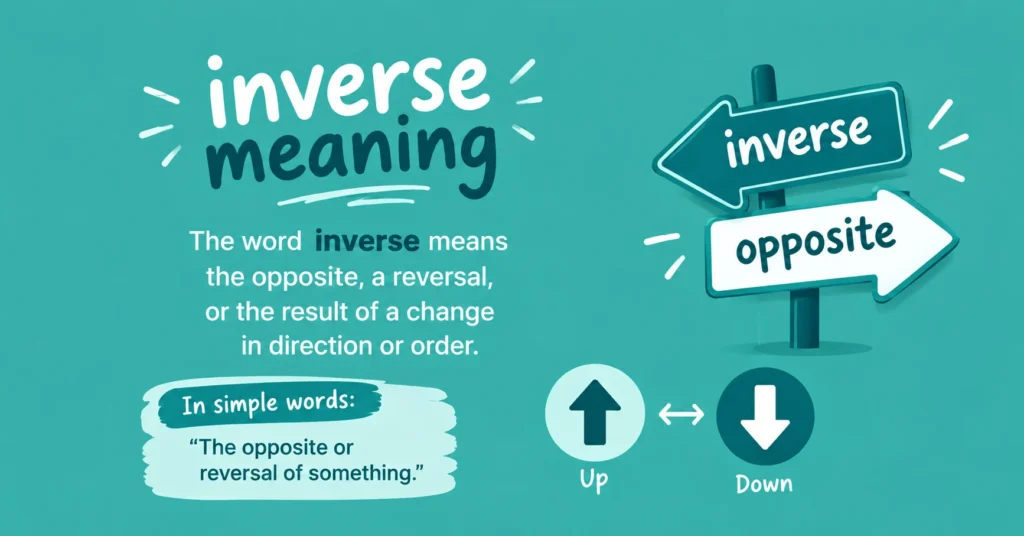
The inverse meaning of inverse is something opposite, reversed, or operating in the contrary direction. Common semantic terms include opposite, reverse, contrary, direction, and effect. Cambridge defines the adjective in relation to something else, while Collins describes an inverse as an exact opposite.
As a noun, the inverse can refer to the opposite or reverse counterpart of something. As an adjective, it describes a relationship, direction, order, or effect. That distinction matters because the word can describe either a thing that is opposite or a relationship that moves oppositely.
Inverse Meaning: Opposite Direction or Effect
When inverse describes direction or effect, it means that something moves or behaves in the opposite way. Useful related expressions include opposite direction, reverse order, contrary effect, and inverse relationship. For example, if one quantity rises while another falls, they may have an inverse relationship.
Consider this simple example: “As the temperature rises, demand for heavy winter coats falls.” The relationship is inverse because the variables move in opposite directions. However, inverse does not necessarily mean completely unrelated; it often describes a meaningful relationship between two things.
Inverse Meaning: A Reverse Counterpart
In ordinary English, the inverse meaning can refer to a reverse counterpart or opposite condition. Related words include reverse, opposite, contrary, and counterpart. Saying “the inverse of the original situation” suggests that the second situation reverses or contrasts with the first.
For example, if a company experiences rapid growth after years of decline, someone might describe the new situation as the inverse of what happened previously. The word sounds more formal and analytical than simply saying “opposite,” which explains why it appears frequently in academic, scientific, business, and technical writing.
Inverse Meaning: Mathematical or Logical Reversal
In mathematics, the inverse meaning becomes more precise. An inverse can be an operation, number, or function that reverses another operation or returns a process toward its starting point. Important related terms include inverse function, inverse operation, reciprocal, and identity.
For example, addition and subtraction are inverse operations because one can undo the effect of the other. Likewise, multiplication and division work as inverse operations. The multiplicative inverse of 5 is 1/5, because 5 × 1/5 = 1. This is different from simply calling something an everyday opposite.
| Context | Meaning of “inverse” | Example |
| Everyday English | Opposite or reversed | The inverse of the original result |
| Relationships | Opposite movement | One value rises while another falls |
| Mathematics | Reverses an operation | Subtraction reverses addition |
| Functions | Undoes a function | f⁻¹ reverses f |
| Numbers | Reciprocal or additive opposite, depending on context | 1/5 is the multiplicative inverse of 5 |
A useful caution: “the inverse of a number” can be ambiguous without context. In mathematics, additive inverse and multiplicative inverse are different concepts. For 5, the additive inverse is −5, while the multiplicative inverse is 1/5. U.S. Dictionary explicitly highlights this contextual distinction.
Inverse Meaning: Synonyms
Common synonyms associated with the inverse meaning include opposite, reverse, contrary, converse, and reciprocal. These words overlap, but they are not interchangeable in every sentence. Collins specifically lists opposite, reverse, and converse among its synonym groupings.
Opposite is the broadest everyday choice. Reverse emphasizes turning something around or changing its order. Converse often describes a reversed proposition or relationship. Reciprocal has a specialized mathematical meaning and can refer to a number multiplied by another to produce one. Choosing the precise term depends on context.
Inverse Meaning: Antonyms
The clearest antonym of inverse meaning in many dictionary contexts is direct, particularly when discussing relationships, operations, or direction. Other possible contrasts include same, identical, equal, and equivalent, although these aren’t universal antonyms in every context. For example, a direct relationship generally describes quantities moving in the same direction, while an inverse relationship describes them moving in opposite directions. The important point is context: an antonym for inverse in mathematics may differ from the most natural contrast in ordinary conversation.
Inverse Meaning: Examples in a Sentence
Seeing the inverse meaning in context makes the distinction much easier. Natural examples include inverse relationship, inverse proportion, inverse function, and inverse operation. These phrases show why context matters: the same word can describe opposition in everyday language or reversal in mathematics and logic.
Here are several practical examples:
| Example | Meaning |
| “The two variables have an inverse relationship.” | They move in opposite directions. |
| “Subtraction is the inverse of addition.” | It reverses the effect of addition. |
| “The inverse of the original decision produced a different result.” | The opposite or reversed decision did. |
| “Demand and price can have an inverse relationship.” | One may rise as the other falls. |
| “The function has an inverse.” | Another function can reverse its mapping. |
Notice how inverse becomes more specific when paired with another term. Inverse proportion concerns quantities changing in opposite directions under a particular mathematical relationship, while inverse function concerns reversing a function’s mapping. Cambridge and Collins both identify inverse relationships and inverse proportion as important usage patterns.
Inverse Meaning: Related Terms
The inverse meaning connects naturally with terms such as inversely, inversion, inverse function, inverse operation, reciprocal, reversal, and contradiction. These related terms form a useful semantic family because they all involve some idea of opposition, reversal, or undoing.
For language learners, inversely is especially useful because it functions as an adverb: “The two quantities are inversely related.” Inversion refers to the act or process of reversing something. In mathematics, meanwhile, inverse function and inverse operation have much more specific technical definitions.
Inverse Meaning: Etymology and Origins
The word inverse has a long history connected with the idea of turning or reversing. U.S. Dictionary traces it through Old French to the Latin inversus, associated with “turned upside down” or “reversed,” from invertere, meaning to turn about.
That history helps explain why today’s uses share a common semantic thread. Whether you’re discussing an inverse direction, an inverse relationship, an inverse operation, or an inverse function, the underlying idea involves some form of turning, reversing, or moving contrary to an original state.
Conclusion
Understanding the meaning of “inverse” becomes much easier when you think of it as something that reverses, contrasts with, or works in the opposite way of another thing. The word can appear in mathematics, science, everyday language, and even casual explanations, depending on the context.
While “opposite” can sometimes be a helpful synonym, inverse often has a more specific meaning involving reversal or a relationship between two things. Knowing the context helps you choose the right interpretation. Whether you encounter “inverse” in a math problem or ordinary conversation, recognizing the idea of reversal can make the term much clearer and easier to understand.
FAQs
Author

Ethan Carter is an SEO blogger specializing in internet slang, text abbreviations, and social media meanings. He creates clear, accurate, and reader-friendly content backed by thorough research. His goal is to help readers understand modern online language with reliable, easy-to-read guides.