
Thrust Meaning: 10+ Essential Facts, Powerful Examples & Hidden Uses
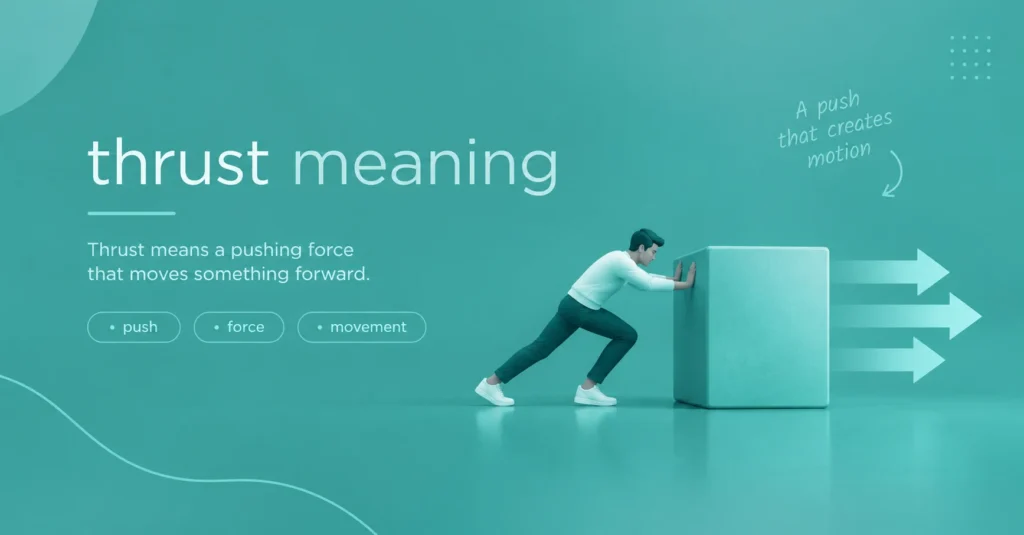
The thrust meaning is to push something suddenly and forcefully in a particular direction. As a noun, thrust can mean a strong push, the main point of an argument, or the force that moves an aircraft or rocket forward. Its exact meaning depends on context, including everyday conversation, writing, and science.
Understanding this word can make reading and communication easier, especially when you encounter phrases such as “the thrust of the argument” or “the engine produces thrust.” This guide explains the definition, pronunciation, grammar, synonyms, and common expressions in clear American English, with practical examples to help you recognize each meaning.
Thrust Meaning: Definition and Pronunciation
The word thrust meaning describes a forceful movement or push. Cambridge Dictionary and Oxford Learner’s Dictionaries define the verb in terms of moving or pushing something suddenly and strongly. The noun also has figurative and technical meanings, so context matters when interpreting the word.
In American English, thrust is pronounced /θrʌst/. The initial sound is the unvoiced “th” heard in think, followed by a short vowel similar to the one in cup. The word can function as both a verb and a noun, and its spelling stays the same in the simple past tense.
Quick definition: Thrust meaning to push forcefully, or a strong push. It can also describe the central idea of a discussion or the propulsive force produced by an engine.
For example, “She thrust the book into his hands” describes a quick, forceful action. In contrast, “The thrust of the presentation was clear” refers to its main idea. These sentences use the same word but communicate different concepts.

Thrust as a Verb
As a verb, thrust meaning to push, move, or direct something with sudden force. It often appears with words such as forward, into, through, away, or toward. The action may be literal, as when someone pushes a door open, or figurative, as when circumstances move a person into a new role.
Consider this example: “He thrust the documents across the desk.” The sentence suggests that he moved the papers forward quickly and emphatically. Another example is “The sudden announcement thrust the issue into public attention.” Here, the word describes an event that brought something into the spotlight rather than a physical push.
The verb can also describe a person entering a situation assertively. For instance, “She thrust herself into the discussion” suggests that she became involved forcefully or without waiting for an invitation. The tone may be neutral or critical depending on the surrounding sentence.
What Is the Past Tense of Thrust?
The past tense and past participle of thrust are both thrust meaning. The word does not normally change to “thrusted” in standard English.
Examples:
- Present: “I thrust the chair forward.”
- Past: “I thrust the chair forward yesterday.”
- Present perfect: “I have thrust the chair forward before.”
The present participle is thrusting, as in “The machine is thrusting the material forward.” Remembering these forms helps prevent common grammar mistakes in schoolwork and everyday writing.
Thrust as a Noun
As a noun, thrust meaning has several meanings. It can refer to a strong push or forward movement, the main point of an argument, or a propulsive force in engineering. The surrounding words usually make the intended meaning clear.
In a conversation about writing, “the thrust meaning of her argument” means the central idea she is trying to communicate. For example, if a speaker explains that public libraries should receive more funding, the thrust of the argument is that libraries provide important community services.
In a physical or technical context, the noun describes a force or movement. A textbook might discuss the thrust generated by an engine, while a general description might refer to a forward thrust. These meanings are connected by the broader idea of directed force or movement.
What Does “The Thrust of an Argument” Mean?
This expression refers to the main point, central message, or overall purpose of someone’s reasoning. It does not describe a physical movement. Instead, it summarizes what the speaker or writer most wants the audience to understand.
For example, “The thrust of the report is that schools need better access to technology.” The report may contain statistics, interviews, and recommendations, but its central message is that schools need improved technology access.
When reading essays or news articles, identifying the thrust can help you understand the author’s purpose without getting distracted by smaller details. Look for the main claim, the evidence supporting it, and the conclusion the writer wants readers to draw.
Other Word Forms of Thrust
Several grammatical forms of thrust appear in everyday English. The base form is thrust, the third-person singular form is thrusts, and the present participle is thrusting. The simple past and past participle remain thrust.
| Form | Example |
| Base form | They thrust the cart forward. |
| Third-person singular | She thrusts the door open. |
| Simple past | He thrust the papers toward me. |
| Past participle | They have thrust the proposal into public discussion. |
| Present participle | The mechanism is thrusting the object forward. |
| Noun, singular | The thrust of the speech was easy to understand. |
| Noun, plural | The machine produces brief thrusts. |
The correct form depends on the subject and sentence structure. For example, “She thrusts” is appropriate in the present tense, while “She thrust yesterday” is appropriate in the simple past. Using the correct form makes your writing clearer and more natural.
Origin of Thrust
The word thrust has a long history in English. Dictionary.com traces it to Middle English forms such as thrusten and thrysten, associated with the Old Norse word þrýsta, meaning to press or force.
This history helps explain why the modern word is associated with pushing, pressure, and directed movement. Over time, its use expanded beyond physical actions. English speakers began using thrust figuratively to describe ideas, responsibilities, and people being moved into new situations.
Today, the word appears in literature, journalism, everyday conversation, and technical writing. Its different meanings remain connected through the concepts of force, direction, emphasis, and movement. Understanding that connection can help you work out the meaning when you encounter an unfamiliar sentence.
Example Sentences Using Thrust
Seeing thrust in complete sentences makes its different meanings easier to recognize. The following original examples demonstrate common everyday, figurative, and technical uses without relying on one definition alone.
Everyday verb examples
- She thrust the envelope into her bag before leaving.
- The gardener thrust the stake into the soft soil.
- He thrust the chair forward to make room at the table.
- The child thrust both hands into the air to answer the question.
Figurative examples
- The unexpected promotion thrust Maya into a leadership role.
- The documentary thrust the issue into the public conversation.
- The thrust of the teacher’s explanation was that practice builds confidence.
- The new policy thrust additional responsibilities onto the department.
Noun examples
- The thrust of the article was easy to understand.
- The engine produced enough thrust to propel the aircraft.
- A sudden thrust of air pushed the lightweight panel forward.
- The presentation’s main thrust was improving access to education.
Notice how context changes the interpretation. In the sentence about a leadership role, thrust means that someone was suddenly placed in a new situation. In the sentence about an article, thrust means the central idea. In the engineering example, it describes a propulsive force.
Related Words, Idioms, and Phrasal Verbs
Words related to thrust include push, shove, drive, force, and propel. They overlap in meaning, but they are not interchangeable in every sentence. Push is the broadest everyday alternative, while propel often emphasizes making something move forward.
| Related word or phrase | Meaning | Example |
| Push | Apply force to move something | She pushed the box across the floor. |
| Shove | Push roughly or forcefully | He shoved the chair back under the desk. |
| Propel | Cause something to move forward | The engine propels the vehicle forward. |
| Thrust aside | Move something out of the way | She thrust aside the curtain. |
| Thrust upon someone | Impose a duty or situation on someone | Extra work was thrust upon the team. |
| Thrust into the spotlight | Bring someone or something into public attention | The discovery thrust the scientist into the spotlight. |
The phrase thrust upon someone commonly refers to an unwanted responsibility, task, or situation. For example, “The extra duties were thrust upon the new manager” means that the manager received those duties without necessarily choosing them.
Similarly, when someone is “thrust into the spotlight,” they suddenly receive public attention. The phrase often describes unexpected fame, publicity, or responsibility. Recognizing these expressions helps readers understand figurative language in articles, books, and conversations.
Conclusion
The thrust meaning depends on how the word is used. As a verb, it usually means to push or move something suddenly and forcefully. As a noun, it can mean a strong push, the main point of an argument, or the propulsive force produced by an engine.
The easiest way to identify the intended definition is to examine the surrounding sentence. If it describes movement, think of a forceful push. If it discusses a speech or report, think of the central idea. If it refers to an aircraft or engine, the meaning is related to propulsion.Learning these distinctions will help you understand thrust in American English and use it accurately in conversation, reading, and writing.
FAQs
Author

Ethan Carter is an SEO blogger specializing in internet slang, text abbreviations, and social media meanings. He creates clear, accurate, and reader-friendly content backed by thorough research. His goal is to help readers understand modern online language with reliable, easy-to-read guides.