
What Does PS Mean in Text The Real Meaning Explained
You finish reading a text, email, or social media post, and then you see two small letters at the end: PS. Maybe you have seen “P.S.” many times but never stopped to ask what it actually means. Or perhaps you know it has something to do with an extra message, but you are not sure how to use it correctly.
So, what does PS mean? The answer is usually “postscript,” a short extra note added after the main message has already been completed. You will often see it in emails, letters, messages, captions, and casual online conversations.
This guide explains the PS meaning, where the abbreviation comes from, how people use it today, and what it means in different contexts. By the end, you will be able to recognize PS instantly and use it naturally when you want to add one more thought without rewriting your entire message.
What Does PS Mean?
The most common meaning of PS is “postscript.” It comes from the Latin phrase post scriptum, which means “written after.”
A postscript is an extra thought added after the main message has already ended. You may see it at the bottom of a letter, email, text message, or social media post.
For example:
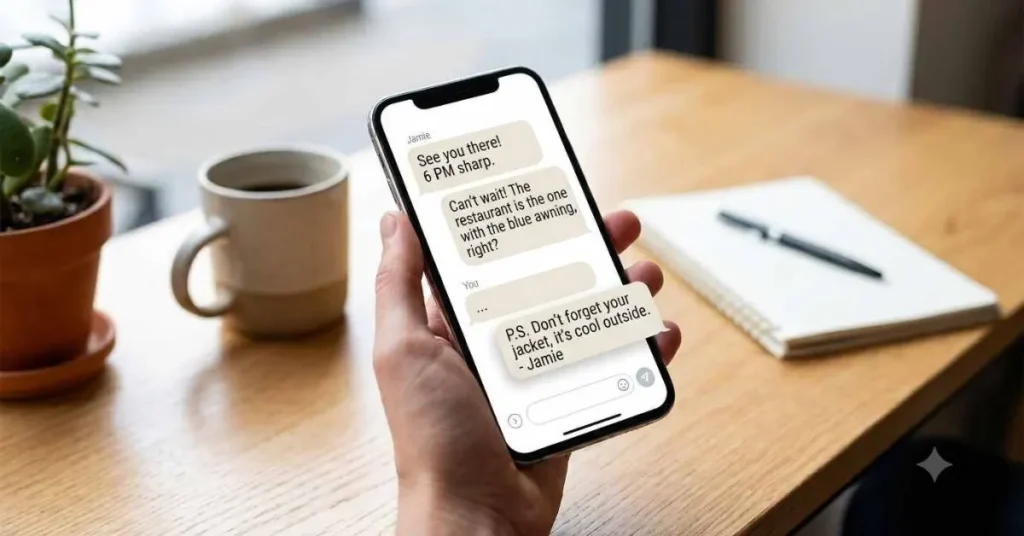
I’ll see you at 7 tonight.
P.S. Don’t forget your jacket.
The main message is finished, but the writer remembers one more thing. Instead of changing the entire message, they simply add a PS.
What Is the PS Meaning in Texting?
In texting and casual online conversations, PS usually means “postscript.” People use it when they want to add an extra comment after their main message.
For example:
“Thanks for helping me with my homework! PS, I finally understood that last question.”
Here, the main message is complete. The PS adds a related thought that the person remembered afterward.
It can also be used for something slightly separate from the original message:
“I’ll call you later. PS, your new profile picture looks great.”
That extra comment is exactly the kind of thing a postscript is meant for.
What Does P.S. Mean in a Letter or Email?
In a letter or email, P.S. is used to add information after the closing or main body of the message.
A simple example might look like this:
Best,
Alex
P.S. I left the tickets on your desk.
The writer has already finished the main message but wants to include one final detail.
In emails, PS can be useful when the extra information is not important enough to change the main structure of the message. It can also make a message feel more personal and conversational.
Why Do People Use PS?
People use PS because it is a simple way to add a final thought. Sometimes you remember something after finishing a message. Other times, you want to add a small detail without interrupting the main point.
A PS can be used to:
- Add a forgotten detail
- Make a personal comment
- Include a reminder
- Add a joke or lighthearted remark
- Mention something related but not central to the message
For example:
“Thanks for coming over today. P.S. The cookies were amazing.”
The main message works perfectly without the extra sentence, but the PS adds a friendly personal touch.
How Do You Use PS Correctly?
The traditional form is P.S., with periods after each letter. However, PS without periods is also common, especially in texting, social media, and casual online writing.
Both forms are widely understood.
You can place it after the main message:
“I’ll send you the details tonight. P.S. Bring a notebook.”
You can also use PPS if you want to add another postscript after the first one. This is less common, but it is still understood.
For example:
P.S. Don’t forget the meeting.
P.P.S. Bring coffee if you can.
PS Meaning on Social Media
On social media, people sometimes use PS to add a final thought to a caption or post.
For example:
“Had a great day at the beach. P.S. Yes, I did get sunburned.”
The PS gives the writer a way to add something extra, often with a more casual or humorous tone.
You may also see it in comments, direct messages, and online conversations. The meaning is usually the same: an additional thought added after the main message.
Does PS Have Other Meanings?
Yes. Like many abbreviations, PS can mean different things in different situations.
For example, in some contexts, PS may refer to:
- PlayStation, the video game console brand
- Public Service
- Police Sergeant
- Personal Statement
- Power Supply
The correct meaning depends entirely on the context.
For example:
“I bought a new PS5.”
Here, PS refers to PlayStation.
“I need to finish my PS for college.”
Here, PS may mean personal statement.
“P.S. I forgot to tell you something.”
Here, it means postscript.
The surrounding words usually make the intended meaning clear.
Simple Examples of PS in Messages
Here are a few everyday examples:
Example 1:
“Thanks for the birthday gift! P.S. I absolutely love it.”
Example 2:
“I’ll see you tomorrow. PS, can you bring the notes?”
Example 3:
“Great talking to you today. P.S. Let me know when you get home.”
In each example, PS introduces an additional thought after the main message.
PS vs. P.S. Which One Should You Use?
There is no major difference in meaning between PS and P.S.
P.S. is the traditional style and is common in formal or personal letters.
PS is more casual and often appears in texts, emails, social media captions, and online conversations.
The choice usually depends on the tone of your writing. If you are writing a traditional letter, P.S. may look more natural. If you are sending a quick message, PS is perfectly fine.
The Easiest Way to Remember PS
Think of PS as a small “one more thing” at the end of a message.
You have finished saying what you wanted to say, but then you remember one final detail. Instead of starting over, you add a PS.
That simple idea explains why the abbreviation is still used in letters, emails, texts, and social media posts today.
Conclusion
The most common PS meaning is “postscript,” which means an extra thought added after the main message has been completed. You might see it in a letter, email, text, social media caption, or casual conversation.It is often used for a forgotten detail, a quick reminder, a personal comment, or even a funny final thought. While PS can mean other things in different situations, thesurrounding context usually makes the intended meaning clear.So, when you see “P.S.” at the end of a message, think of it as the writer saying, “One more thing.” It is a small abbreviation, but it remains a useful and natural way to add something extra without changing the entire message.
FAQs
Author

Ethan Carter is an SEO blogger specializing in internet slang, text abbreviations, and social media meanings. He creates clear, accurate, and reader-friendly content backed by thorough research. His goal is to help readers understand modern online language with reliable, easy-to-read guides.

One Comment