iftar meaning: 50+ Powerful & Beautiful Facts About This Sacred Ramadan Tradition
Iftar meaning is the meal or moment when Muslims break their daily fast at sunset during Ramadan. It connects Ramadan fasting, Maghrib, dates, dua, gratitude, family, and Islamic tradition in one meaningful practice. Having researched Islamic terminology and Ramadan customs, I find that newcomers often understand Iftar simply as dinner, yet its deeper meaning includes worship, patience, community, and generosity.
For someone unfamiliar with Ramadan, the timing can be confusing: When does Iftar begin? Is it exactly sunset? Why are dates commonly eaten? What is the difference between Iftar and Suhoor? This guide explains those questions clearly while connecting the word to the Quran, Hadith, Sunnah, Prophet Muhammad, and Muslim communities, including those observing Ramadan in the United States.
What Is Iftar?
Iftar is the evening meal or act of breaking the daily fast during Ramadan. A Muslim fasts from dawn until sunset, and when the fast ends, food and drink become permissible again. In simple terms, Iftar means breaking the fast, while the meal that follows is commonly called the Iftar meal.
The word is closely associated with sunset, Maghrib, fasting, Ramadan, prayer, and nourishment. Yet Iftar is not merely about satisfying hunger. After a day of restraint, the first sip of water or first date can become a small moment of gratitude. Families, friends, neighbors, and mosque communities often turn that moment into shared worship, hospitality, and connection.
Iftar Meaning in Islam
In Islam, Iftar meaning marks the completion of a day’s Ramadan fast and the beginning of the evening period. It therefore has both a practical and spiritual role: the body receives nourishment while the believer completes an important act of worship. Ramadan fasting is connected with discipline, patience, remembrance of Allah, and concern for people experiencing hardship.
The communal dimension is equally important. Iftar may take place at home, at a mosque, at an Islamic community center, or around a larger public table. UNESCO describes Iftar traditions as practices that strengthen family and community relationships while encouraging charity, solidarity, and social exchange.
When Is Iftar Time?
Iftar time begins at sunset, when the day’s Ramadan fast ends and the Maghrib prayer time begins. Because sunset changes according to location and date, there is no single nationwide Iftar time in the United States. Someone in New York, Chicago, Houston, Los Angeles, or Seattle may have a different Iftar time on the same day.
For that reason, Muslims commonly use local mosque timetables, reliable prayer calendars, astronomical calculations, or community announcements to determine the appropriate time. The Islamic calendar is lunar, so Ramadan also moves through the Gregorian calendar over the years. Iftar therefore needs to be understood as a local sunset event, not a fixed clock time.
How Iftar Time Is Determined
The key marker is sunset rather than a universal clock reading. When the sun has set at a person’s location, the fast is complete. This is why Ramadan timetables are location-specific and why a person should use a reliable schedule for the place where they are actually observing the fast.
The Quran describes completing the fast “to the night,” and Islamic tradition connects the end of the daylight fast with sunset. Quran 2:187 is the principal Quranic passage associated with this timing.
Iftar Time vs Maghrib Prayer
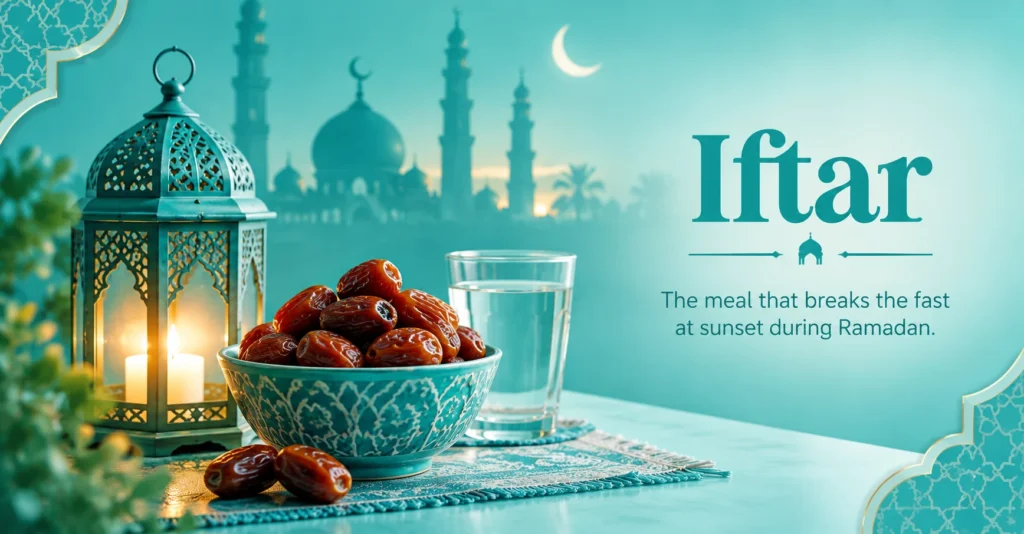
Iftar and Maghrib are closely connected but are not identical terms. Iftar refers to breaking the fast, while Maghrib refers to the sunset prayer and the prayer time that begins after sunset. Once Maghrib begins, the Ramadan fast has ended, so a Muslim may break the fast.
In practice, people may take a date or drink water and then perform Maghrib prayer before eating the larger meal. The exact order can vary according to individual practice and community tradition. The important point is that Iftar begins when the fast has legitimately ended at sunset.
Religious Importance of Iftar in Islam
Iftar is important because it completes the daily act of fasting during Ramadan. Fasting is one of Islam’s Five Pillars, and Ramadan is a month associated with worship, self-restraint, reflection, charity, and spiritual growth. Iftar therefore represents the transition from daytime restraint to evening nourishment and continued worship.
The emotional experience can be powerful. A person who has spent many hours without food or drink may feel relief when the fast ends, but that relief can also encourage gratitude. Iftar reminds believers that ordinary things such as water, food, family, and health are blessings that can easily be overlooked during everyday life.
Iftar also has a social meaning. Sharing food can bring together relatives, friends, neighbors, coworkers, and strangers. In the United States, Ramadan is observed by Muslim communities across diverse ethnic and cultural backgrounds, so an American Iftar table may include foods and customs from many parts of the world. Pew Research Center has documented the widespread practice of Ramadan fasting among U.S. Muslims.
Iftar in the Quran and Hadith
The Quran does not present Iftar as simply a type of dinner; rather, it establishes the framework for Ramadan fasting and specifies that the fast continues until night. Quran 2:187 states that believers should complete the fast until night, forming an important textual foundation for ending the daylight fast.
Hadith literature provides additional guidance about how Muslims traditionally break the fast. A well-known Sunnah is to hasten the breaking of the fast once its time arrives rather than unnecessarily delaying it. Sunan Abi Dawud records a report describing the Prophet Muhammad’s practice of hastening Iftar and prayer.
This distinction between Quranic instruction and later practical tradition is useful for readers learning about Islam. The Quran establishes the fasting framework, while Hadith literature preserves details about the Prophet’s practices. Together, they help explain why Iftar is associated with promptness, gratitude, prayer, dates, water, and generosity.
Sunnah Way to Break the Fast
The Sunnah approach to Iftar emphasizes simplicity and promptness. Dates are traditionally associated with breaking the fast, and water is also a common first choice. After that initial break, Muslims may pray Maghrib and then continue with a fuller meal. Dates are customary, but eating dates is not a requirement for the fast to be valid.
Iftar also provides an opportunity for dua, remembrance, and gratitude. Many Muslims use the moment to thank Allah for sustenance, ask for forgiveness, pray for family members, and remember people experiencing hunger or hardship. The practice therefore joins physical nourishment with spiritual awareness.
What the Prophet Recommended
Islamic tradition records the Prophet Muhammad as encouraging Muslims to break the fast without unnecessary delay. Hadith sources preserve reports about his practice, making prompt Iftar an important Sunnah associated with Ramadan. This is one reason many Muslims prepare dates, water, or another simple food before sunset rather than waiting until after the main meal is ready.
A useful distinction is that Sunnah is not the same as obligation. Muslims may follow recommended practices because they imitate the Prophet’s example, but not every traditional Iftar food or custom is mandatory. Different cultures therefore have different meals while sharing the same fundamental purpose: ending the Ramadan fast.
Dua at the Time of Iftar
Dua at Iftar is an important spiritual practice for many Muslims. People may make personal supplications in their own language or use established supplications associated with breaking the fast. The moment naturally encourages gratitude because a long period of hunger and thirst has just ended.
Islamic Relief, for example, cites a well-known supplication associated with Iftar and emphasizes the spiritual value of making dua at this time. Because wording and scholarly discussions can vary, readers seeking religious guidance should consult a trusted scholar or recognized Islamic authority for questions about specific formulas.
What is an Iftar meal?
An Iftar meal is the food and drink consumed after the Ramadan fast ends at sunset. There is no single universal Iftar menu. Foods differ according to culture, family tradition, geography, dietary needs, and personal preference. A meal in a U.S. Muslim household may combine Middle Eastern, South Asian, African, Turkish, American, or other culinary traditions.
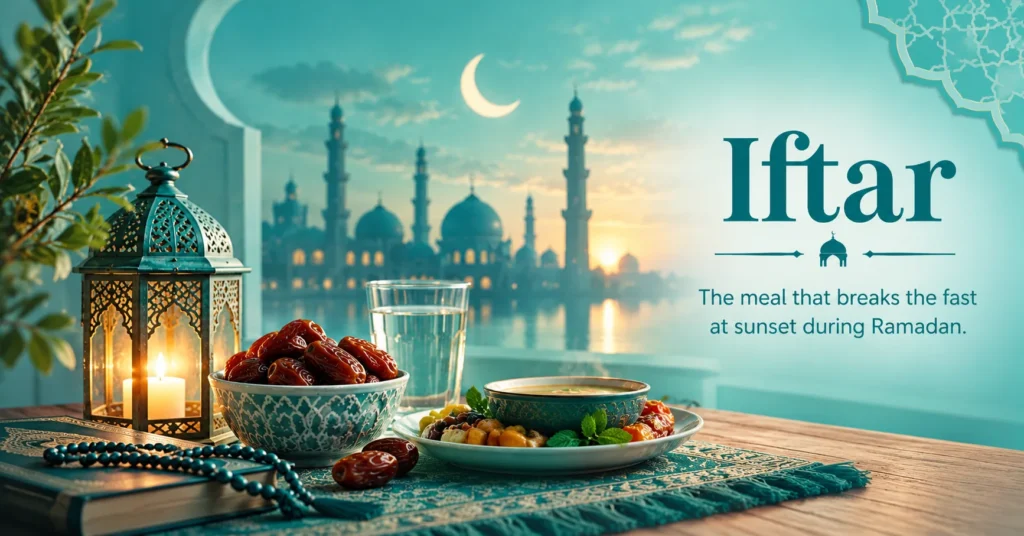
Common choices include dates, water, fruit, soup, rice, vegetables, bread, meat, lentils, yogurt, salads, and other familiar foods. Some families begin with a very small amount and then eat a larger dinner later. Others serve one substantial meal immediately after prayer. Islamic Relief recommends balanced nutrition and hydration rather than relying heavily on rich or salty foods.
| Iftar element | Common role |
| Dates | Traditional first food |
| Water | Hydration after fasting |
| Fruit | Hydration and nourishment |
| Soup | Light, warm starter |
| Rice or bread | Source of carbohydrates |
| Vegetables | Fiber and nutrients |
| Protein | Supports a balanced meal |
| Yogurt | Common accompaniment in many cultures |
The important point is that Iftar is not defined by a particular recipe. Its defining feature is its connection to breaking the Ramadan fast.
Meaning of Iftar
The simplest meaning of Iftar is breaking the fast. In everyday English, however, the word usually refers to the evening meal with which Muslims end their Ramadan fast. This distinction explains why someone might say, “We are having Iftar at the mosque,” meaning both the act of breaking the fast and the communal meal surrounding it.
The word belongs to Arabic religious vocabulary and has entered English as a commonly recognized term. English dictionaries and reference works generally define it as the evening meal that breaks the daily Ramadan fast. The broader context includes Ramadan, sunset, fasting, Maghrib, dates, prayer, family, and community.
Iftar Meaning in Islam
Within an Islamic context, Iftar is more than eating after hunger. It is the completion of the day’s fasting period and an opportunity to demonstrate gratitude, moderation, hospitality, and remembrance of Allah. The experience can be private, shared with family, or expanded into a mosque or community gathering.
This is especially meaningful during Ramadan because fasting is intended to develop spiritual awareness and self-control. The meal that ends the fast can therefore become a reminder that food and water are blessings rather than things to take for granted.
Iftar Meaning in English
In English, Iftar generally means the evening meal or occasion when Muslims break their daily Ramadan fast. It is often explained as “breaking the fast.” The term is now widely used in English-language reporting, educational material, restaurants, community organizations, and American Muslim communities.
An English speaker might hear phrases such as “Ramadan Iftar,” “community Iftar,” “Iftar dinner,” or “Iftar meal.” These expressions all point toward the same central idea: Muslims gathering or eating at sunset after completing the day’s fast.
Iftar Meaning in Arabic
In Arabic, Iftar is written إفطار. The term is related to the Arabic root associated with breaking or ending the fast. In Ramadan context, it specifically refers to breaking the daily fast at sunset and the meal associated with that act.
The pronunciation may be rendered approximately as if-TAR, although pronunciation varies somewhat by language and accent. Alternative spellings such as Iftaar, Iftari, Eftari, Iftor, and Ftoor can appear across languages and regions. UNESCO recognizes several of these forms when describing the broader cultural tradition.
Suhoor and Iftar Meaning
Suhoor and Iftar are the two meals that frame the daily Ramadan fast. Suhoor is eaten before dawn, while Iftar occurs at sunset after the day’s fast has ended. One prepares the person for fasting; the other marks the completion of that fast.
| Term | Meaning | Timing | Purpose |
| Suhoor | Pre-dawn meal | Before Fajr/dawn | Prepare for fasting |
| Iftar | Fast-breaking meal | At sunset | End the daily fast |
Understanding this distinction solves one of the most common questions people new to Ramadan have. If someone says, “I am preparing Suhoor,” they are preparing for the coming day of fasting. If they say, “We are preparing Iftar,” they are preparing for sunset and the end of that day’s fast.
The two meals also create a natural rhythm: Suhoor → daylight fasting → Iftar → evening worship → next Suhoor. During Ramadan, this cycle repeats throughout the month, although exact meal times change with local sunrise and sunset.
What is the Meaning of Iftar Food?
Iftar food means the dishes and drinks served when Muslims break their Ramadan fast. There is no single food that defines Iftar worldwide. Dates and water are strongly associated with the tradition, while the larger meal reflects local cuisine and family preferences.
In the United States, Iftar tables can be remarkably diverse. A mosque may host a community dinner featuring dishes contributed by families from different backgrounds, while an individual household might serve soup, rice, chicken, vegetables, fruit, or traditional foods from its family’s country of origin. This diversity is part of Iftar’s cultural richness.
UNESCO’s description of Iftar emphasizes that traditional knowledge is transmitted through families, with food preparation, participation, and shared meals helping younger generations learn the social and cultural meaning of the practice.
Why is Iftar Important?
Iftar is important because it brings together the physical, spiritual, and social dimensions of Ramadan. Physically, it ends a period without food and drink. Spiritually, it marks the completion of another day of fasting. Socially, it can create a powerful opportunity for families, friends, neighbors, and communities to sit together.
The experience can be especially meaningful for someone who has spent the day working, studying, caring for children, or simply practicing patience while fasting. The sound of the Maghrib call, the first date, the first drink of water, and a table shared with loved ones can turn an ordinary evening into a memorable Ramadan moment.
Iftar also has a strong charitable dimension. Communities may invite people who are alone, distribute meals to people experiencing poverty, or organize large mosque dinners. UNESCO specifically recognizes Iftar’s association with charity, solidarity, family relationships, and social exchange.
For American readers who are unfamiliar with Ramadan, the easiest way to understand Iftar is this: it is not simply Muslim dinner. It is the daily moment when a Ramadan fast ends, accompanied by gratitude, worship, nourishment, and often community.
Conclusion
Iftar meaning is simple at its core: it is the breaking of the daily fast at sunset during Ramadan. But understanding Iftar fully requires looking beyond the dictionary definition. It brings together fasting, Maghrib, Sunnah, gratitude, dua, nourishment, family, charity, and community.
For Muslims, that first moment after sunset can carry a deep emotional weight. For people learning about Ramadan, understanding Iftar offers a window into one of Islam’s most visible and meaningful traditions. Whether it takes place around a family table, inside a mosque, at an American community center, or at a large public gathering, Iftar is ultimately about ending a day of fasting with gratitude and connection.
FAQs
Author

Ethan Carter is an SEO blogger specializing in internet slang, text abbreviations, and social media meanings. He creates clear, accurate, and reader-friendly content backed by thorough research. His goal is to help readers understand modern online language with reliable, easy-to-read guides.