Bushido Meaning: 25+ Powerful Lessons, Ancient Virtues & Samurai Traditions
Bushido meaning is “the way of the warrior,” referring to ethical ideals associated with Japan’s samurai and warrior class. The phrase connects samurai code, warrior ethics, honor, loyalty, and discipline with a broader Japanese tradition of conduct. Yet there is an important catch: bushido was not one timeless rulebook followed identically by every warrior. Its meaning changed across Japanese history.
If you have encountered bushido in Japanese culture, martial arts, samurai stories, anime, history, or philosophy, the simplified “warrior code” description can leave you wanting more. This guide separates historical tradition from later romantic images, explains the Japanese kanji, samurai values, virtues, and warrior philosophy, and shows why the word still carries emotional weight today.
Bushido meaning: What Does Bushido Mean?
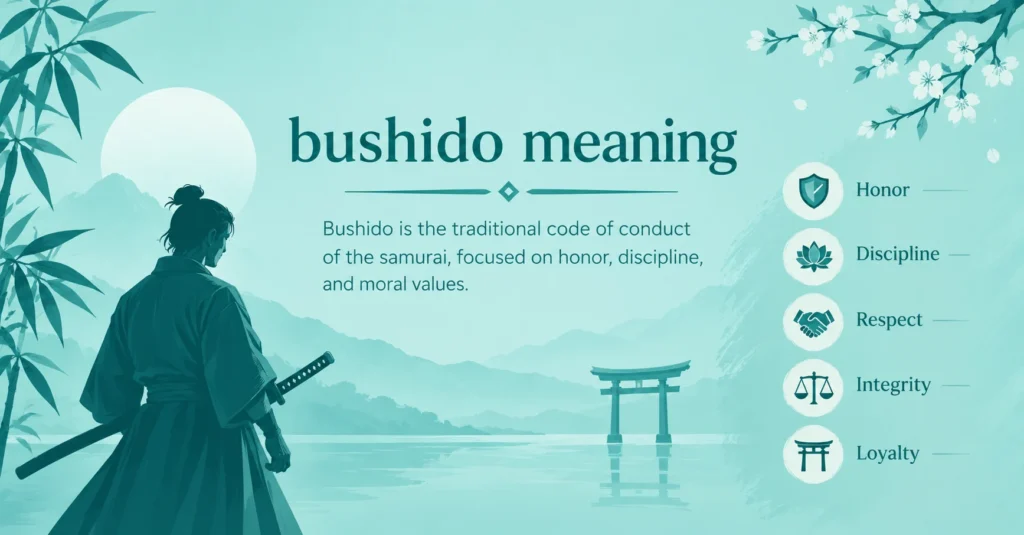
The simplest bushido meaning is “the way of the warrior.” In English, it is often described as the samurai code, warrior ethics, or a moral way of life associated with Japan’s warrior class. The concept involves qualities such as courage, loyalty, honor, sincerity, proper conduct, and self-control rather than fighting skill alone.
Imagine a warrior facing a difficult decision when fear, personal interest, family loyalty, and duty pull in different directions. Bushido is concerned with the character behind that decision. That is why terms such as duty, discipline, honor, courage, and responsibility appear repeatedly in discussions of the tradition. The ideal warrior was expected to govern himself as well as his actions.
Bushido meaning: Bushido Kanji: Why 武士道 Means “The Way of the Warrior”
The Japanese word 武士道 (bushidō) contains the ideas of a warrior and a way or path. 武士 (bushi) refers to a warrior or member of Japan’s warrior class, while 道 (dō) means way, path, road, or disciplined course of life. Together, the characters create the familiar translation “the way of the warrior.”
The final dō is especially meaningful because it appears in words such as jūdō, kendō, and sadō. It suggests more than a technique: it can describe a disciplined path of practice and self-cultivation. That helps explain why bushido is better understood as warrior ethics or a warrior’s way of life than as a simple list of commands.
Bushido meaning: What Is the Bushido Code?
The phrase “bushido code” is convenient, but it can create a misleading picture. There was no single universal ancient handbook that every samurai memorized and followed word for word. Warrior ideals developed through different periods, families, domains, texts, religious influences, military traditions, and relationships between warriors and their lords.
Historical Japanese warrior conduct therefore contained both ideals and practical rules. Some expectations concerned loyalty, honor, military ability, family reputation, service, and proper behavior, while specific governments or warrior houses could impose enforceable regulations. The distinction matters because a moral ideal and a legal rule are not necessarily the same thing.
Bushido Ideals vs Enforceable Samurai Laws
A warrior house could issue instructions governing conduct, property, marriage, military responsibilities, or relationships with political authorities. Those were enforceable rules within a particular system. Bushido, by contrast, is commonly used to describe broader ethical ideals, virtues, expectations, and concepts of warrior conduct that varied over time.
Bushido meaning: The 8 Virtues of Bushido
Modern explanations often present eight virtues: rectitude, courage, benevolence, courtesy, sincerity, honor, loyalty, and self-control. They provide a useful framework for understanding the values commonly associated with bushido, but they should not be mistaken for an ancient official checklist issued to every samurai.
The exact number and wording vary among modern sources. Some discussions emphasize seven virtues, while others include self-control as an eighth. The famous virtue-based presentation owes much to modern interpretations, particularly the work of Nitobe Inazō, while older warrior traditions contained overlapping but not identical ideas.
1. 義 (Gi): Rectitude or Justice
Gi refers to rectitude, justice, or moral correctness. In the context of bushido, it can be understood as choosing what is right rather than whatever is easiest or most personally profitable. The ideal creates tension when duty, loyalty, family interests, and personal judgment point in different directions.
2. 勇 (Yū): Courage
Yū means courage or bravery. Bushido does not make courage identical with reckless behavior; the ideal is closer to acting despite danger or fear. A courageous warrior was expected to face difficult circumstances with composure rather than allowing fear to determine every decision.
3. 仁 (Jin): Benevolence or Compassion
Jin represents benevolence, humanity, or compassion. This virtue complicates the modern stereotype that bushido was only about warfare and death. Warrior ethics could also concern responsibility, leadership, restraint, education, and the treatment of people over whom a powerful individual held authority.
4. 礼 (Rei): Courtesy or Respect
Rei means courtesy, respect, or proper manners. Respect was not simply decorative politeness; it expressed the expectation that conduct should remain controlled even when a person possessed strength or social power. Its influence can still be recognized in the etiquette surrounding Japanese martial arts.
5. 誠 (Makoto / Sei): Sincerity and Honesty
Makoto conveys sincerity, truthfulness, and honesty. The basic ideal is that words and actions should agree. In a modern example, someone who promises to complete an important responsibility and follows through demonstrates the kind of consistency that makes sincerity meaningful rather than merely verbal.
6. 名誉 (Meiyo): Honor
Meiyo means honor, reputation, or good name. In warrior society, honor could extend beyond an individual because personal behavior could affect a family, house, or lord. This helps explain why reputation and public conduct appear so strongly in traditional accounts of samurai life.
7. 忠義 (Chūgi): Loyalty
Chūgi refers to loyalty or faithfulness to duty and relationships, especially loyalty to a lord in historical warrior contexts. Yet loyalty was not always simple. Samurai could face competing obligations involving family, political authority, reputation, religious belief, allies, and survival.
8. 自制 (Jisei): Self-Control
Jisei means self-control or restraint. It represents the ability to govern fear, anger, desire, and careless behavior. Modern lists sometimes include this as an eighth virtue, while other presentations speak of seven virtues. Either way, disciplined conduct is an important part of the popular modern image of bushido.
| Virtue | Japanese | Core idea |
| Rectitude | 義 Gi | Doing what is right |
| Courage | 勇 Yū | Facing fear and difficulty |
| Benevolence | 仁 Jin | Compassion and humanity |
| Courtesy | 礼 Rei | Respectful conduct |
| Sincerity | 誠 Makoto | Truthfulness |
| Honor | 名誉 Meiyo | Dignity and reputation |
| Loyalty | 忠義 Chūgi | Faithfulness to duty |
| Self-control | 自制 Jisei | Restraint and discipline |
Bushido meaning: When Did Bushido Begin?
There is no single date when bushido suddenly appeared. Warrior customs and ethical expectations developed over centuries as Japan’s warrior class became politically and socially important. Early traditions emphasized military service, loyalty, reputation, courage, family interests, and conduct in battle, while later periods gave greater attention to moral and philosophical interpretation.
The word bushidō itself is not simply an ancient label that existed unchanged throughout samurai history. Historical sources indicate that the term became established later, while earlier writers discussed warrior conduct using other expressions and through house rules, military traditions, and moral teachings. This is why historians distinguish older warrior ethics from the unified modern image of bushido.
Bushido meaning: Nitobe Inazō and Bushido: The Soul of Japan
One of the most influential figures in the modern history of bushido is Nitobe Inazō, whose Bushido: The Soul of Japan was published in English in 1900. Nitobe was writing for an international audience and explained Japanese moral ideals partly through comparisons with European chivalry and Western ethical traditions.
His book helped give English-speaking readers a recognizable framework involving rectitude, courage, benevolence, politeness, sincerity, honor, loyalty, and self-control. That does not mean Nitobe invented every warrior value from nothing. Older Japanese traditions contained many related ideas. His importance lies in how he organized and presented them for a modern international audience.
The distinction is important because the bushido familiar from modern books, movies, posters, games, and motivational writing is partly a later interpretation. Historical warrior conduct was more diverse, and different periods or groups could place different weight on loyalty, military skill, duty, religion, family, reputation, or moral restraint.
Bushido meaning: Is Bushido the Same as Hagakure?
No. Hagakure is a particular early eighteenth-century work associated with Yamamoto Tsunetomo and the former Saga domain, while bushido is a much broader term. Hagakure contains reflections on warrior service, loyalty, discipline, and death, but it should not be treated as the single official handbook of all samurai.
The famous association between bushido and death comes partly from the dramatic language surrounding warrior readiness to die. That image became powerful in later popular culture, but it does not capture the entire tradition. Bushido discussions also involve service, judgment, courtesy, responsibility, sincerity, self-control, and leadership.
This distinction helps avoid one of the most common mistakes in modern explanations: treating a memorable statement from one historical work as though it were the complete definition of bushido.
Bushido meaning: Bushido vs Budo: What Is the Difference?
Bushido and budo are related Japanese terms, but they are not interchangeable. Bushido refers broadly to warrior ethics and ideals associated with the warrior class, whereas budo refers to Japanese martial ways or disciplines. Judo, kendo, and other martial arts can teach values that overlap with bushido without being identical to it.
A person practicing karate or judo is therefore not automatically “practicing bushido.” A dojo may emphasize discipline, courtesy, perseverance, courage, respect, and self-control, which resemble popular bushido values. But the martial discipline itself is a different concept. Understanding this difference prevents two related Japanese terms from being treated as synonyms.
Bushido meaning: Is Bushido Still Followed in Japan Today?
Japan no longer has a legal samurai class, and modern Japanese people do not follow one official bushido code. Nevertheless, the word remains recognizable and can appear in discussions of martial arts, sportsmanship, perseverance, leadership, business, historical identity, popular culture, film, manga, and games.
Modern usage is often more metaphorical than literal. Someone may describe a person’s dedication, discipline, fair play, or determination as reflecting a “bushido spirit.” In sports and martial arts contexts, the term can suggest endurance, respect for opponents, disciplined effort, and composure.
That modern use should not be confused with an uninterrupted ancient tradition. Contemporary Japan contains many different social values and lifestyles, and bushido cannot be used as a universal explanation for how Japanese people behave.
Bushido meaning: Common Misunderstandings About Bushido
Misunderstanding 1: Bushido Was One Ancient Book
Bushido was not the title of one universal medieval rulebook. Warrior ethics developed through many texts, practices, house traditions, and historical circumstances. Later writers organized these themes differently, which is why no single document should be treated as the complete bushido code.
Misunderstanding 2: Every Samurai Followed the Same Code
Samurai lived in different centuries, domains, families, and political environments. Their behavior did not always match later ideals. Historical warrior conduct included loyalty and courage, but it also involved practical politics, competition, violence, retreat, negotiation, and conflicting obligations.
Misunderstanding 3: Bushido Was Only About Dying
Death and readiness for death appear in some warrior traditions, but bushido is broader than that. Its associated ideas include duty, service, courage, sincerity, courtesy, compassion, discipline, judgment, and honor. Reducing the concept to death creates an incomplete picture.
Misunderstanding 4: The Eight Virtues Were an Official Samurai Checklist
The popular eight-virtue framework is useful for learning, but it should not be presented as a single ancient checklist that every samurai received. The number, wording, order, and interpretation of virtues vary among later explanations.
Misunderstanding 5: Bushido and Martial Arts Mean the Same Thing
They do not. Bushidō concerns warrior ethics and ideals, while budō describes Japanese martial ways and disciplines. A martial arts school may teach values associated with bushido, but practicing a martial art does not automatically mean following a historical samurai code.
Misunderstanding 6: Bushido Explains All Japanese Culture
Bushido is one important historical and cultural concept, not a complete explanation of Japanese society. Japan’s culture has also been shaped by Shinto, Buddhism, Confucianism, modern institutions, literature, art, regional traditions, technology, and countless individual experiences.
Conclusion
Bushido is more than a historical code associated with Japan’s samurai; it represents a set of values centered on honor, loyalty, courage, discipline, and responsibility. While its meaning and practice changed across different periods, the idea continues to influence how people understand character and personal conduct. Today, bushido is often discussed in connection with Japanese history, martial arts, leadership, and self-discipline.
It is also important to view it within its historical context rather than treating it as a single, unchanging set of rules. Understanding bushido can offer a deeper appreciation of Japanese culture and the enduring importance of living with integrity, purpose, and respect for others.
FAQs
Author

Ethan Carter is an SEO blogger specializing in internet slang, text abbreviations, and social media meanings. He creates clear, accurate, and reader-friendly content backed by thorough research. His goal is to help readers understand modern online language with reliable, easy-to-read guides.