
Trident Meaning: Symbolism, History & Spiritual Significance
Trident meaning is most commonly connected with power, authority, the sea, protection, and control over natural forces. But this three-pronged symbol carries different meanings across Greek mythology, Roman culture, Hindu traditions, heraldry, tattoos, and modern art. If you have ever wondered why Poseidon carries a trident or why the same shape appears beside Shiva, you are looking at a symbol whose history is much deeper than its striking design.
Over years of researching symbols and their cultural context, one thing becomes clear: the meaning of a symbol depends on where you encounter it. A trident can represent maritime power, divine authority, transformation, balance, strength, or spiritual symbolism. Understanding those connections helps you interpret the symbol without reducing every culture to one definition.
The Symbolism & Meaning of Trident
At its simplest, a trident meaning is a three-pronged spear, but trident meaning extends far beyond its physical form. The three points rising from one shaft naturally create associations with unity, balance, power, authority, and controlled force. Its shape also connects it strongly with water, fishing, mythology, and the idea of mastering forces that humans cannot easily control.
The symbol becomes especially powerful because one central shaft holds several directions together. In symbolic interpretations, this can suggest creation and destruction, past and future, strength and responsibility, or multiple forces operating as one. These interpretations are not universal rules, however. Different religious and cultural traditions give the three points their own meanings.
What the Trident Represents
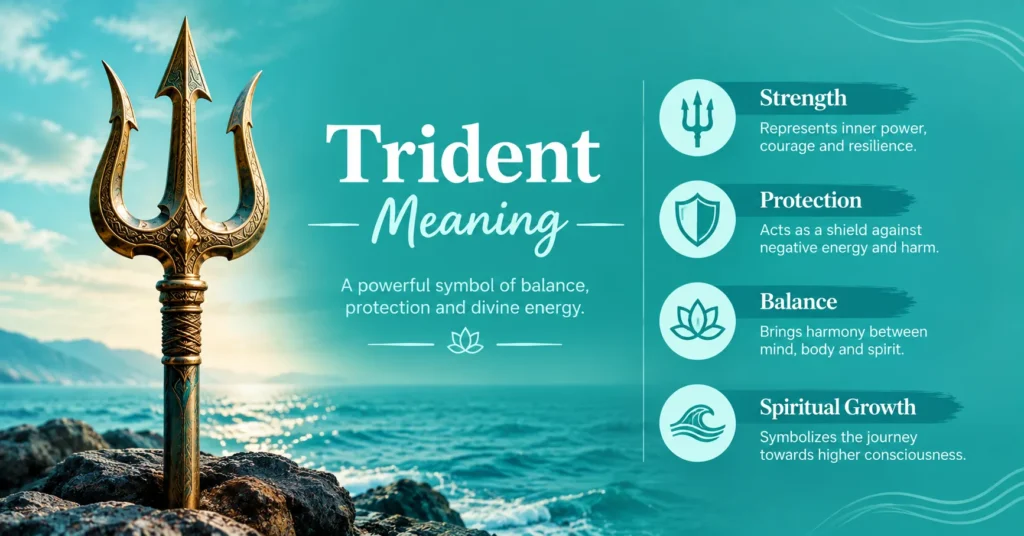
The trident meaning commonly represents power, sovereignty, protection, strength, and authority over natural forces. Its most famous association is with the sea, largely because Poseidon and Neptune are traditionally depicted carrying it. The connection with water also explains why tridents appear in maritime imagery, fishing traditions, naval symbolism, and coastal art.
The three prongs can also encourage ideas of balance and interconnected forces. In some interpretations, three represents different stages or dimensions existing together. In Hindu symbolism, Shiva’s trishula has its own religious meanings, including associations with creation, preservation, destruction, time, and the gunas. It is important not to treat those interpretations as identical to the Greek trident.
| Symbolic association | Common context |
| Power | Mythology and personal symbolism |
| Authority | Gods, rulers, heraldry |
| Sea | Poseidon, Neptune, maritime imagery |
| Protection | Religious and military symbolism |
| Balance | Three-part symbolic systems |
| Transformation | Spiritual and mythological interpretation |
| Strength | Tattoos, art, modern design |
The physical object also has a practical history. Three-pronged fishing spears could be useful in shallow water, which helps explain why a practical marine tool became such an effective mythological image. Over time, the ordinary fishing instrument was transformed in stories into an emblem of extraordinary power.
Historical Origins
The word trident meaning ultimately comes from Latin tridēns, associated with the ideas of “three” and “tooth.” Dictionaries describe the object as a three-pronged spear or weapon, while historical and mythological sources connect it with fishing, sea deities, warfare, and symbolism. Its physical design therefore existed as a practical form before becoming one of mythology’s most recognizable attributes.
In ancient Mediterranean culture, the trident meaning association with the sea became especially strong. Greek mythology made Poseidon’s weapon famous, while Roman tradition connected the same visual form with Neptune. Later European art, heraldry, military insignia, and popular culture continued to reuse the recognizable three-pointed design.
Parallels in Other Ancient Cultures
The Greek and Roman traditions are not the only places where three-pronged imagery appears. Hindu tradition has the trishula, associated especially with Shiva. Although the trishula resembles a trident, it belongs to a different religious history and should not automatically be treated as the same symbol.
The distinction matters because symbols can look similar while carrying different theological meanings. A Poseidon trident primarily belongs to the mythology of the sea and divine power, while Shiva’s trishula is embedded in Hindu philosophical and devotional traditions. Similar shapes create visual connections, but context determines meaning.
The Trident in Ancient Ritual and Cult Practice
The trident meaning also appeared in religious imagery and ritual contexts connected with sea deities. In Greek culture, Poseidon was worshiped at coastal locations, harbors, and sanctuaries, where sailors sought divine protection and favorable conditions at sea.
This gives the trident meaning an important emotional dimension. It was not simply an impressive weapon. For people whose livelihood or survival depended on the ocean, the symbol could represent both danger and protection. The sea could provide food and transportation while also bringing storms, shipwrecks, and uncertainty.
The Mythological Significance of the Trident in Greek Tradition
In Greek mythology, Poseidon’s trident is one of the clearest symbols of divine authority. Poseidon was associated with the sea, earthquakes, and horses, and the trident represented his ability to command forces far beyond ordinary human control. Stories describe him using it to raise storms, shake the earth, and produce springs from rock.
One famous story involves the contest between Poseidon and Athena over Athens. Poseidon struck the ground with his trident and produced a saltwater spring, while Athena offered the olive tree. The story captures an important aspect of trident meaning: immense power can be impressive without necessarily being the gift people choose.
The weapon’s mythology also explains why the trident became more than a simple spear. It came to represent the authority of a deity who could affect the sea and the land. That combination of power, unpredictability, protection, and destruction continues to influence how the symbol is interpreted today.
Cultural Variations
Trident meaning changes significantly depending on cultural context. In Greek and Roman mythology, it is closely associated with the sea. In Hinduism, the related trishula belongs to Shiva and carries philosophical and religious associations. In British heraldry, the trident became connected with maritime power and sovereignty.
This variation is important when interpreting a trident tattoo, necklace, logo, flag, or piece of artwork. A symbol cannot always be decoded from its shape alone. The surrounding imagery, cultural reference, religious tradition, and personal intention may completely change what it communicates.
Greek and Roman
For Greeks, the trident is most strongly associated with Poseidon, ruler of the sea and a deity also connected with earthquakes and horses. The Romans adopted much of this imagery through Neptune, giving the trident a continuing association with maritime authority.
In classical art, Poseidon or Neptune holding a trident immediately communicates power over water. The symbol therefore became shorthand for oceans, storms, navigation, and divine strength. Even today, an isolated trident can make viewers think of the sea before they know anything else about the design.
Hindu (Shaiva)
In Hindu tradition, Shiva’s trishula is one of the most recognizable sacred attributes associated with the deity. Interpretations of its three points vary across texts and devotional traditions, but they can include creation, preservation, and destruction, as well as the three gunas or dimensions of time.
This is why calling every trident simply a “symbol of the sea” misses an important part of its cultural meaning. The trishula can express a much broader philosophical idea involving transformation, cosmic order, spiritual discipline, and the relationship between different forces.
British Imperial and Heraldic
The trident also became an important image in British maritime symbolism, especially through Britannia, who is traditionally shown with a trident. Here the symbol communicates naval power, maritime identity, and sovereignty rather than the personal mythology of Poseidon.
Similar imagery appears in heraldry, flags, military insignia, and coastal identities. In these contexts, the three-pronged shape can communicate a relationship with the sea without necessarily carrying a religious meaning.
Cultural Legacy: From Ancient to Modern Times
The trident survived because its shape is immediately recognizable. Ancient mythology gave it a powerful narrative foundation, while later artists, governments, military organizations, designers, and entertainment creators repeatedly adapted it for new contexts.
Today, someone in the United States might encounter a trident on a tattoo, in a fantasy movie, on military insignia, in jewelry, or in an ocean-themed logo. The underlying association with strength and maritime power often remains recognizable, even when the original mythology is not understood.
The Trident in National Symbols
Trident-like imagery appears in national and regional symbols, including the well-known Barbados trident and Ukraine’s tryzub. These symbols should not automatically be treated as interchangeable versions of Poseidon’s weapon because each has its own historical development and cultural context.
The broader pattern is nevertheless interesting: the three-pointed form can communicate sovereignty, identity, independence, maritime heritage, or authority. That makes the trident particularly effective as a visual emblem because a relatively simple shape can carry substantial historical meaning.
The Trident in Military and Naval Insignias
Modern military symbolism preserves the trident’s association with maritime mastery. One of the most recognizable examples is the U.S. Navy SEAL Trident, which incorporates an anchor, trident, and pistol. Its imagery connects sea, air, and land capabilities with the identity of the SEAL community.
This modern usage shows how ancient symbolism can survive without remaining purely mythological. The trident’s visual language of strength, precision, and maritime capability remains understandable even to people who have never read a Greek myth.
The Trident in Popular Culture
Movies, comics, television, games, and fantasy literature have given the trident a new generation of audiences. Aquaman, Percy Jackson, God of War, and other fictional worlds use tridents to communicate supernatural power, oceanic identity, or heroic status.
Popular culture sometimes changes the mythology for storytelling purposes. A fictional trident may have magical abilities that are not found in ancient sources. It is therefore useful to distinguish the historical meaning of the symbol from the rules invented for a particular movie, game, or story.
The Trident as a Tattoo
A trident tattoo can represent many things depending on the wearer. Someone may choose it because of a connection to the ocean, fishing, Greek mythology, Poseidon, Shiva, strength, protection, transformation, or simply the striking geometry of three points joined to one shaft.
The emotional meaning can be just as important as the historical meaning. For one person, a trident may symbolize surviving a difficult period and becoming stronger. For another, it may honor family heritage, spirituality, a love of the sea, or an interest in mythology. There is no single universal tattoo definition.
A Poseidon-inspired design may emphasize ocean power and mythology, while a Shiva-inspired trishula should be understood within its Hindu religious context. If the tattoo is intended as a religious symbol, learning the tradition behind it is more respectful than treating the design as merely decorative.
Trident: Positive & Negative Meanings
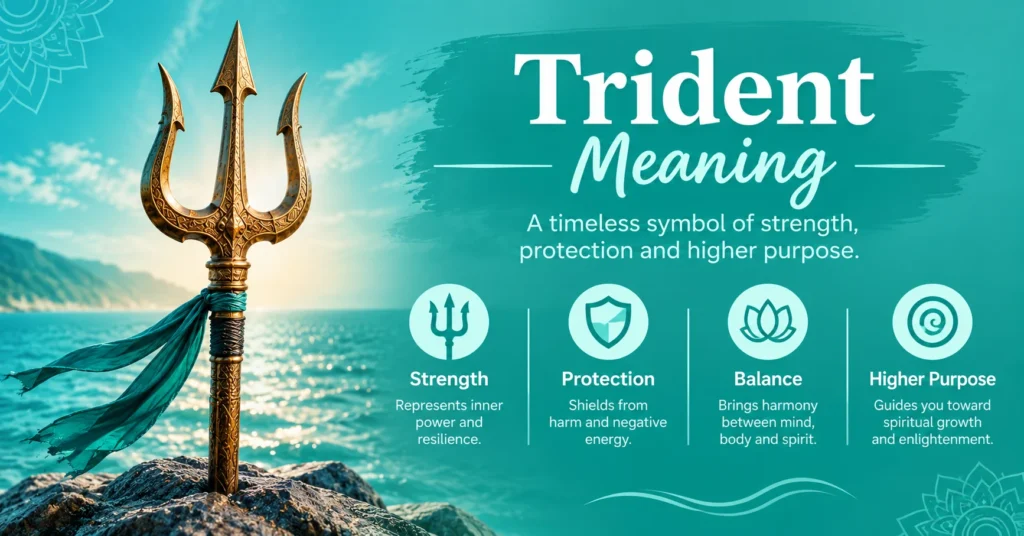
Positive interpretations of the trident commonly include strength, authority, protection, balance, resilience, transformation, and confidence. These meanings work especially well in modern personal symbolism because the three points can represent several challenges or forces being held together by one central foundation.
Negative interpretations can include aggression, excessive control, danger, domination, conflict, or destructive power. These associations are not inherent to every trident; they depend heavily on the culture, imagery, and context. A weapon can represent protection in one setting and threat in another.
| Positive association | Possible darker association |
| Strength | Aggression |
| Protection | Threat |
| Authority | Domination |
| Balance | Conflict |
| Transformation | Destruction |
| Confidence | Excessive control |
| Maritime identity | Danger |
This duality is actually one reason the symbol remains compelling. The sea itself has always carried two sides: it can provide food, travel, beauty, and discovery, yet it can also be unpredictable and dangerous. The trident captures that tension unusually well.
When someone asks for the trident meaning, the most accurate answer is therefore not a single word. It is a family of connected ideas: power, authority, water, protection, transformation, balance, and control of powerful forces. The exact interpretation depends on whether you are looking at Poseidon’s weapon, Shiva’s trishula, a naval emblem, a tattoo, or a modern artistic symbol.
The symbol has endured because three simple points can tell a surprisingly large story. It connects practical tools with mythology, ancient religion with modern design, and personal identity with centuries of cultural memory.
Conclusion
A trident is more than a three-pronged weapon; it is a symbol with deep roots in mythology, religion, history, and popular culture. It is strongly associated with power, authority, protection, and the forces of nature, especially through its connection with figures such as Poseidon and Shiva. Depending on the context, a trident can also represent balance, strength, and the ability to overcome challenges.
Today, its meaning may appear in tattoos, artwork, logos, jewelry, and fictional stories, where its symbolism can take on a personal meaning. Understanding the history behind the trident makes its familiar shape much more meaningful and shows why this ancient symbol continues to attract attention.
FAQs
Author

Ethan Carter is an SEO blogger specializing in internet slang, text abbreviations, and social media meanings. He creates clear, accurate, and reader-friendly content backed by thorough research. His goal is to help readers understand modern online language with reliable, easy-to-read guides.