Obtuse Meaning: 15+ Surprising Insights, Definitions, Examples & Everyday Uses
Obtuse meaning is usually “slow or unwilling to understand,” but the word also describes an angle greater than 90° and less than 180°. In everyday American English, it can describe someone who misses an obvious point, seems insensitive, or appears deliberately difficult. In geometry, however, the term is completely neutral. Cambridge and Oxford both distinguish these meanings clearly, which helps explain why the word can feel confusing when you first encounter it.
If you have ever heard someone say, “Don’t be obtuse,” and wondered whether it meant stupid, confused, stubborn, or simply unaware, context is the key. This guide explains the word through language, mathematics, pronunciation, synonyms, examples, tone, and real-life communication so you can recognize its meaning without accidentally using it too harshly.
What Is the Definition of Obtuse? obtuse meaning
The obtuse meaning depends on context. When describing a person, it commonly means slow to understand, lacking perception, or unwilling to grasp something obvious. Related ideas include dullness, insensitivity, imperceptiveness, and lack of discernment. Oxford classifies this personal sense as formal and disapproving, so it can sound stronger than “confused.”
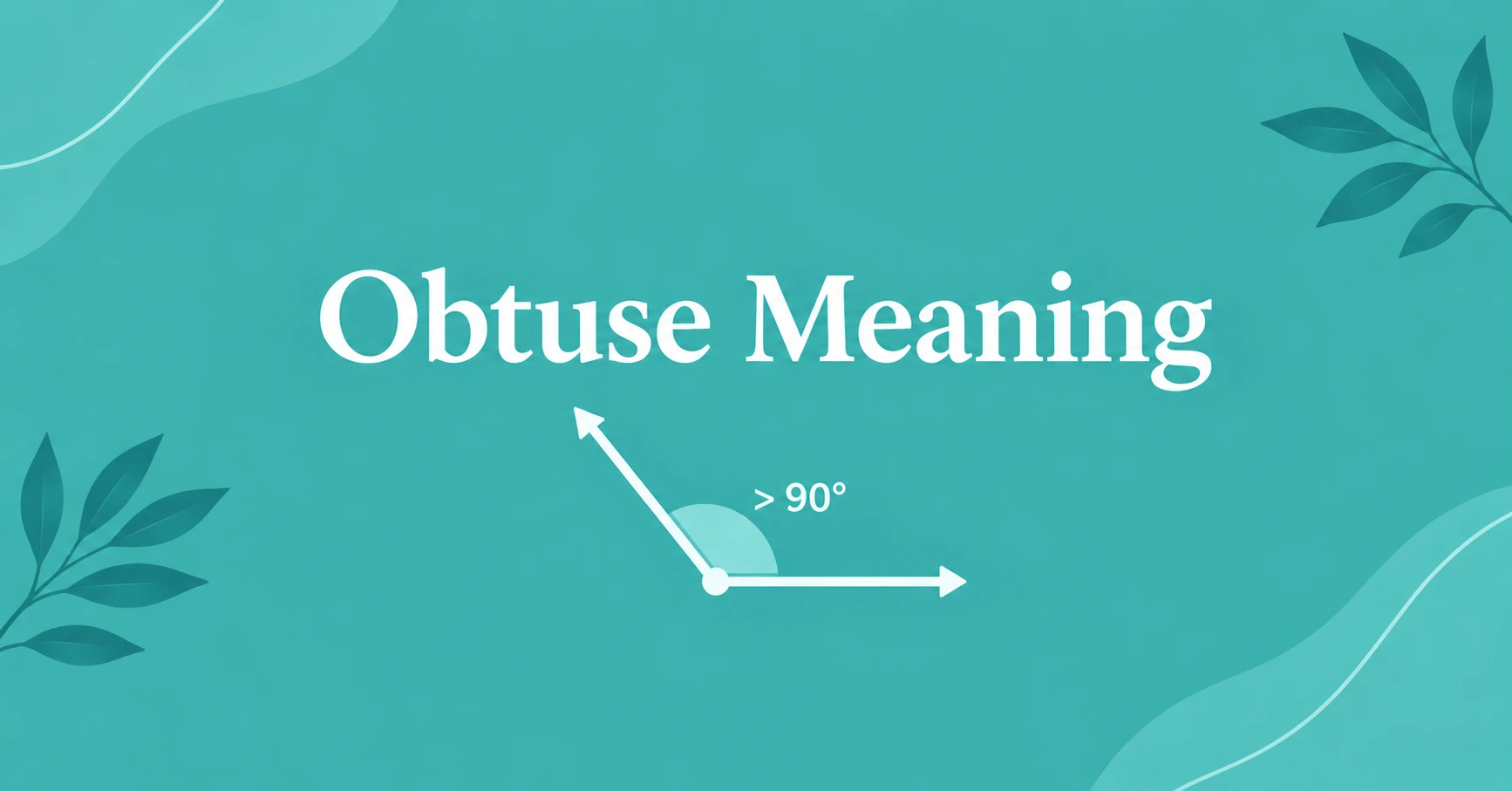
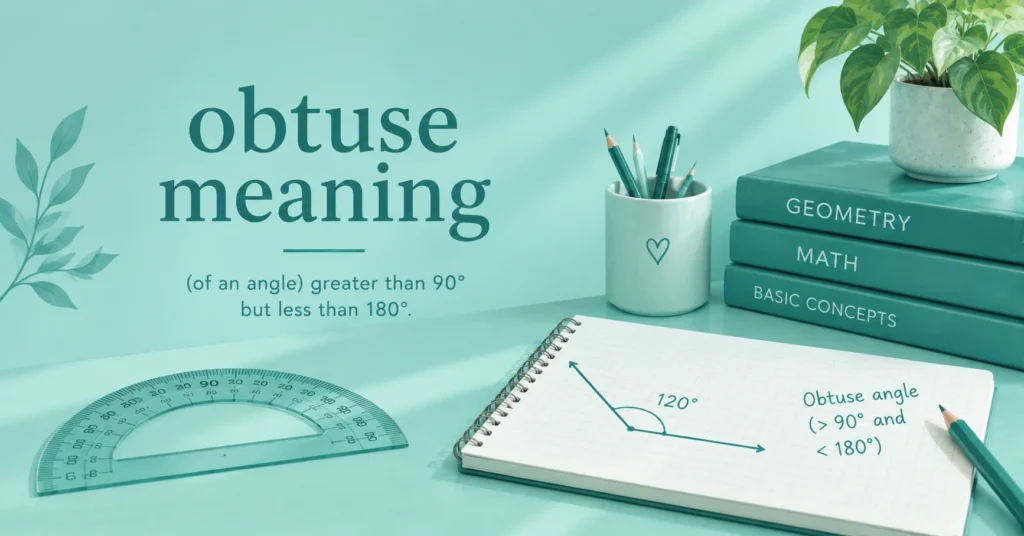
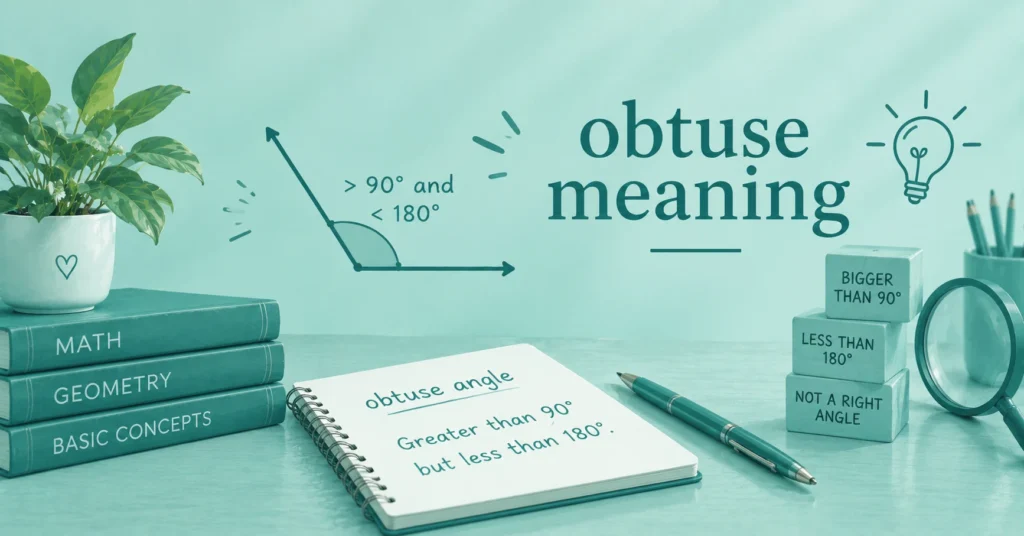
In mathematics, an obtuse angle has a precise definition: it measures more than 90 degrees but less than 180 degrees. An obtuse triangle contains one such interior angle. This mathematical sense has no insulting implication; it simply identifies a geometric relationship. Cambridge and Collins both make this distinction.
What does obtuse mean?
In plain English, obtuse can mean someone is not understanding something quickly or is failing to recognize an obvious point. It can also describe an angle wider than a right angle. The intended meaning becomes clear from the surrounding words: conversation usually signals the figurative sense, while geometry signals the mathematical one.
What Does Obtuse Mean in Simple English? obtuse meaning
The simplest obtuse meaning is “slow to understand.” Imagine explaining an obvious situation several times, yet the other person continues missing the point. Calling that person obtuse suggests a lack of awareness or understanding. Other related descriptions include clueless, dull, unobservant, imperceptive, and slow on the uptake.
However, obtuse does not automatically mean unintelligent. Someone can be highly intelligent yet act obtuse in a particular situation because they misunderstand the context, refuse to acknowledge an implication, or deliberately avoid recognizing what another person is saying. That distinction is important in everyday communication.
How does obtuse differ from simply being confused?
Being confused usually means a person genuinely does not understand something. Being obtuse can suggest something stronger: the person is slow or unwilling to understand, especially when the answer seems obvious. Context therefore determines whether the word describes temporary confusion, poor perception, stubbornness, or deliberate resistance.
The Two Main Meanings of Obtuse obtuse meaning
The two central obtuse meaning categories are figurative language and geometry. Figuratively, it can describe a person who has difficulty understanding or perceiving something. Geometrically, it describes an angle between 90 and 180 degrees. Collins also records broader senses involving bluntness, dull perception, and rounded forms.
These meanings actually share an underlying idea: lack of sharpness. A sharp angle forms a narrow point, whereas an obtuse angle is wider. Figuratively, someone described as obtuse is perceived as lacking mental or perceptual sharpness. The historical connection comes from Latin obtusus, associated with being blunt or dulled.
Social/Conversation Meaning
In conversation, obtuse often describes someone who misses an obvious implication, fails to pick up a hint, or appears unwilling to acknowledge what another person means. The tone may be frustrated or sarcastic. “Are you being obtuse?” therefore asks more than whether someone is confused; it can imply that understanding should already be possible.
Math Meaning of Obtuse
In geometry, an obtuse angle is greater than 90° and less than 180°. A triangle can contain exactly one obtuse angle because the three interior angles must total 180°. An obtuse triangle is therefore different from an acute triangle, whose three interior angles are all less than 90°.
Why People Use the Word “Obtuse” in Conversations obtuse meaning
The conversational obtuse meaning is useful when ordinary words such as “confused” or “unaware” do not capture the speaker’s frustration. Someone might say, “I have explained this three times; you are being obtuse.” Here the speaker is emphasizing the apparent failure to grasp something that seems straightforward.
The word also carries a more formal flavor than “clueless” or “slow.” That can make it useful in essays, criticism, debates, and serious conversations, but it can also make the statement sound condescending. A dictionary definition tells you what a word means; tone tells you how that meaning lands.
Relationship Context
In a relationship, calling someone obtuse may suggest that they are missing obvious emotional signals or refusing to acknowledge what their partner is communicating. For example, someone might describe a person as obtuse after repeated hints have gone unnoticed. The phrase can communicate frustration rather than a judgment about intelligence.
Workplace Context
At work, obtuse may describe behavior during a disagreement, meeting, or negotiation when someone appears unable or unwilling to understand a straightforward point. Because the word can sound insulting, alternatives such as “unclear,” “unresponsive,” or “not seeing the issue” may be safer in professional communication.
Online Argument
Online, context becomes especially important because text removes facial expression and vocal tone. Calling someone obtuse may be playful among friends but hostile during a disagreement. The phrase “deliberately obtuse” is particularly strong because it suggests the person understands the point but is choosing to act as though they do not.
Is “Obtuse” an Insult? obtuse meaning
The obtuse meaning can become insulting when it is applied to a person. Cambridge labels the personal definition as formal and associates it with being stupid or slow to understand, while Oxford describes it as formal and disapproving. That means “you are being obtuse” can carry genuine criticism rather than neutral description.
Still, the word is not automatically an insult. Friends may use it jokingly, and writers can use it descriptively. The emotional effect depends on the relationship, subject, tone, and whether the person truly misunderstood something. A gentle “I may be being obtuse, but could you explain that?” is very different from an accusation.
Mild/Playful Example
A friend might say, “You’re being obtuse on purpose,” while laughing during a harmless conversation. Here, the word can function as teasing rather than serious criticism. The surrounding relationship softens the expression, although someone unfamiliar with the speaker could still interpret it negatively.
Harsh Example
“He is too obtuse to understand basic communication” is considerably harsher. It directly attacks the person’s ability to understand and may sound contemptuous. In professional, academic, or emotionally sensitive situations, a more precise description is usually preferable.
Obtuse Meaning in Tone & Emotion
Tone can completely change the obtuse meaning a listener receives. A playful speaker may mean “you are slow to catch the joke,” while an angry speaker may mean “you are refusing to understand something obvious.” Other possibilities include sarcasm, criticism, frustration, or emotional impatience.
| Tone | Likely meaning | Emotional effect |
| Playful | Slow to catch on | Light teasing |
| Frustrated | Not understanding something obvious | Annoyance |
| Sarcastic | Pretending not to understand | Critical |
| Formal | Lacking perception or discernment | Disapproving |
| Academic | Referring to geometry | Neutral |
This is why the same word can feel harmless in one conversation and deeply insulting in another. The dictionary definition stays stable, but the pragmatic meaning changes according to context.
What does “intentionally obtuse” mean?
“Intentionally obtuse” means someone appears to understand the point but is choosing to behave as though they do not understand it. The phrase often appears in arguments, debates, and discussions where one person believes the other is avoiding an obvious conclusion rather than genuinely being confused.
What Are Synonyms and Antonyms of Obtuse? obtuse meaning
Common synonyms associated with the figurative obtuse meaning include dull, slow, dense, imperceptive, insensitive, unobservant, and slow-witted. These words are not interchangeable in every situation, however. “Insensitive,” for example, emphasizes emotional awareness, while “dense” is more informal and often more insulting.
For geometric contexts, the most important contrast is acute. An acute angle measures less than 90 degrees, while an obtuse angle measures more than 90 and less than 180 degrees. In figurative language, sharp, perceptive, astute, clever, and discerning can provide useful contrasts.
Obtuse vs Similar Words obtuse meaning
Understanding the obtuse meaning becomes easier when it is compared with nearby words. “Clueless” usually suggests lack of awareness, “ignorant” means lacking knowledge, and “stubborn” emphasizes unwillingness to change. Obtuse can overlap with all three, but its distinctive idea is failure or unwillingness to grasp something that should be understandable.
| Word | Core meaning | Typical tone |
| Obtuse | Slow or unwilling to understand | Formal/critical |
| Dense | Slow to understand | Informal/insulting |
| Clueless | Unaware or uninformed | Casual |
| Ignorant | Lacking knowledge | Critical |
| Stubborn | Unwilling to change | Negative |
| Abstruse | Difficult to understand | Neutral/academic |
Obtuse vs abstruse
This distinction is particularly important. Obtuse can describe a person who is slow or unwilling to understand; abstruse normally describes an idea, subject, or explanation that is difficult to understand. The words look and sound similar, but their meanings are different. The American Heritage Dictionary specifically notes this usage distinction.
Obtuse vs acute
In geometry, these are direct contrasts. An acute angle is greater than 0° and less than 90°, while an obtuse angle is greater than 90° and less than 180°. Figuratively, “acute” can also suggest sharp perception, which creates a useful conceptual contrast with obtuse.
When to Use the Word “Obtuse” obtuse meaning
Use the word when you need to describe someone who seems slow to understand, unaware of an obvious implication, or unwilling to recognize a point. It works particularly naturally in literary criticism, formal discussion, analytical writing, and situations where a more precise word is preferable to simply calling someone stupid.
For example, “The character remained obtuse to the clues around him” focuses on a failure of perception. “The negotiator was deliberately obtuse” suggests intentional resistance. “The triangle contains an obtuse angle” is purely mathematical and carries no negative judgment.
Real-Life Examples of Obtuse
Consider these natural examples:
- Conversation: “I’m not trying to be obtuse, but I don’t understand your point.”
- Literature: “The character was obtuse to the warning signs.”
- Work: “His response seemed obtuse rather than constructive.”
- Debate: “She accused him of being deliberately obtuse.”
- Geometry: “The triangle contains one obtuse angle.”
These examples show why context is essential. The same adjective can describe a person’s perception, a character’s behavior, or a geometric angle.
When NOT to Use It obtuse meaning
Avoid using obtuse when you simply mean someone is unfamiliar with a subject. A person can be knowledgeable and intelligent yet misunderstand a single explanation. Calling them obtuse may unfairly imply dullness or unwillingness to understand. Precision matters, especially when discussing someone’s abilities or character.
It is also worth avoiding the word when emotions are already high. In texting, sarcasm and criticism are particularly easy to misread. If your actual meaning is “I don’t think we understood each other,” saying exactly that may resolve the problem without adding an unnecessary insult.
What It Feels Like When Someone Calls You Obtuse
Being called obtuse can feel like being told, “You should understand this already.” That implication explains why people may react defensively. The word can criticize perception rather than intelligence, but the listener may still hear it as a judgment about their mental ability or awareness.
Conclusion
The word “obtuse” can describe more than just an angle in geometry. In everyday language, it often refers to someone who is slow to understand an idea or who seems insensitive to what others are trying to communicate. The meaning depends on the context, so recognizing how the word is being used can help avoid confusion.
Whether you encounter “obtuse” in a math lesson, a book, or a conversation, its surrounding words usually make the intended meaning clear. Understanding both its literal and figurative uses can also improve your vocabulary and reading comprehension. With a little context, “obtuse” is a straightforward word to recognize and use correctly.
FAQs
Author

Ethan Carter is an SEO blogger specializing in internet slang, text abbreviations, and social media meanings. He creates clear, accurate, and reader-friendly content backed by thorough research. His goal is to help readers understand modern online language with reliable, easy-to-read guides.