
7 Powerful TTYS Meaning in Text: The Positive Truth You Need to Know
Ttys meaning in text “talk to you soon.” It’s a casual sign-off people drop at the end of a text or chat when they’re stepping away but plan on picking the conversation back up not a full goodbye, more like a conversational pause button.
If you just got a text that ended in “ttys” and stared at it for a second, you’re not behind. Texting slang moves fast, and half the fun of group chats is half-guessing your way through them. This one’s easy once you know it, and knowing it means you’ll never have to send that slightly awkward “wait what does that mean” follow-up again.
TTYS Meaning in Text: The Quick Answer
TTYS stands for “talk to you soon.” It’s used to close out a conversation while signaling that you’ll be back later today, tomorrow, whenever, but soon. Think of it as the texting equivalent of a wave goodbye rather than a closed door.
It’s informal by nature. You’ll see it between friends, partners, classmates, and coworkers who already text casually not in a client email or a first message to someone you don’t know well. The tone is warm, not distant: it says “this isn’t over,” which is the opposite of a flat “bye.”
Where TTYS Came From
Ttys meaning in text traces back to the early instant-messaging and chatroom era of the late 1990s and early 2000s AIM, MSN Messenger, and early flip-phone texting, where every keystroke cost you time (and, on some phones, literally cost you money per character). Abbreviating common phrases wasn’t just a style choice; it was practical.
“Talk to you soon” got shortened for the same reason “be right back” became BRB and “laughing out loud” became LOL. What’s interesting is that TTYS survived while a lot of that era’s slang didn’t probably because it still does a job nothing else quite does: it’s warmer than “bye” and shorter than typing out the whole phrase.
How People Actually Use TTYS in Conversations
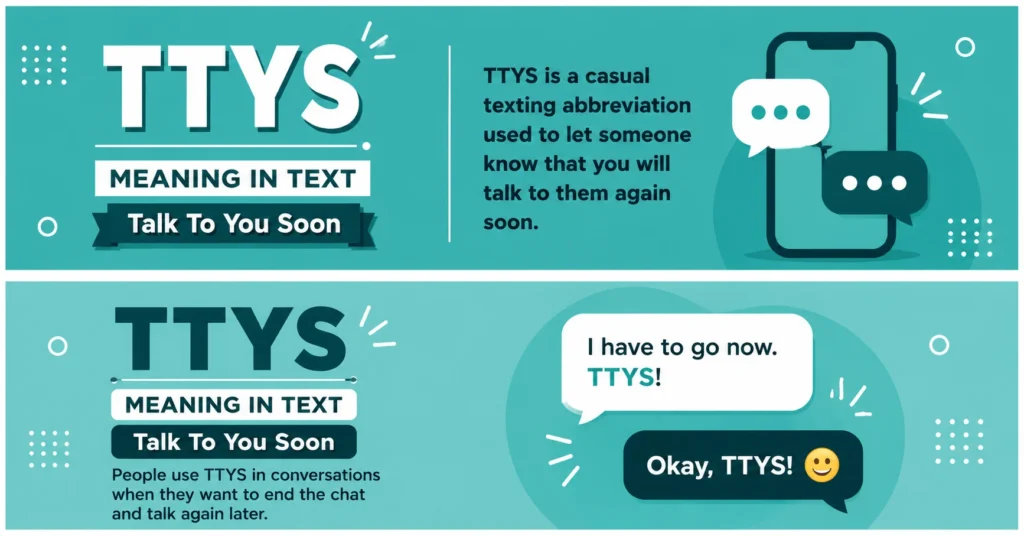
In practice, ttys meaning in text shows up right at the tail end of a message, often as its own line. A typical exchange looks like: “Gotta run, meeting starts in 5 ttys!” or “Had a great time last night, let’s do it again soon. ttys.” It’s rarely the opener; it’s almost always the close.
You’ll also see it used proactively someone might send “ttys” mid-conversation to signal they need to step away but aren’t ending things for good, similar to putting a bookmark in a book. Common replies include “ttys,” “sounds good, talk soon,” or just an emoji nothing that requires more effort than the message itself demanded.
TTYS vs. TTYL: What’s the Real Difference
TTYL (“talk to you later”) is the more common, more general cousin of TTYS. The practical difference is the implied timeframe: TTYS tends to signal a shorter gap later today, or very soon while TTYL is looser and could mean tomorrow, next week, or “whenever.”
| TTYS | TTYL | |
| Full phrase | Talk to you soon | Talk to you later |
| Implied timeframe | Short hours, same day | Open-ended |
| Common context | Ongoing back-and-forth chats, partners, close friends | General texting, any relationship |
| Frequency of use | Less common | More common |
Neither is more “correct” TTYL is just the more frequently used of the two, so TTYS can read as slightly more personal or specific about timing.
When TTYS Fits and When to Skip It
TTYS works well in personal texts, group chats, and casual social media replies. It fits naturally between people who already text informally friends wrapping up a late-night chat, a couple checking in throughout the day, coworkers in a relaxed Slack-style thread.
It’s a poor fit for formal emails, first-time professional contact, or any message where the tone needs to stay buttoned-up. There’s nothing wrong with the phrase itself, but “talk to you soon” written out (or a plain “thanks, speak soon”) reads more appropriately in those settings than the abbreviation does.
Does TTYS Mean Anything Else?
Outside of texting, “TTY” (without the S) has entirely different, well-established meanings: it’s short for teleprinter/teletypewriter, it refers to a virtual console/terminal in Unix-based operating systems, and it’s another name for a telecommunications device for the deaf (TDD). None of these overlap meaningfully with the texting slang context makes it obvious which one you’re dealing with.
You won’t find “TTYS” itself carrying a serious alternate meaning in medicine, aviation, or other technical fields; if it shows up there, it’s almost always someone using the casual texting shorthand informally, not an established industry acronym.
Conclusion
Understanding TTYS meaning in text makes online conversations much easier to follow, especially when someone uses casual texting slang. TTYS usually means “Talk to You Soon” and is commonly used as a friendly way to end a conversation while suggesting that you will chat again later. You may see it in texts, social media messages, or everyday online conversations.
The exact tone can depend on the person and the context, but it is generally warm and informal. Once you know what TTYS means, you can recognize it without overthinking the message. When texting, understanding these small abbreviations can help you communicate naturally and keep conversations flowing.
FAQs
Author

Ethan Carter is an SEO blogger specializing in internet slang, text abbreviations, and social media meanings. He creates clear, accurate, and reader-friendly content backed by thorough research. His goal is to help readers understand modern online language with reliable, easy-to-read guides.
One Comment