Silhouette Meaning: 10 Essential & Fascinating Facts About Its History, Uses & Symbolism
Silhouette meaning is the dark, solid shape or outline of a person, animal, object, or scene seen against a lighter background. You may recognize it in a sunset photograph, a profile portrait, a fashion design, or the outline of a building. Terms such as shadow, outline, profile, shape, and backlit figure all connect to the idea, but a silhouette usually removes interior detail so the edge becomes the main visual clue. Drawing on established dictionary and art-history references, this guide explains the word clearly while addressing its origin, photography, fashion, artistic use, and everyday meaning.
The word can feel more mysterious than it really is. When someone says they saw a silhouette, they usually mean they could recognize the shape, outline, profile, or figure without seeing its details. That distinction matters because an outline is normally just a boundary line, while a silhouette is generally a filled shape. Whether you encountered the word in photography, art, clothing, design, or conversation, the explanation below gives you the context needed to use it naturally.
Silhouette Meaning: What Does Silhouette Mean?
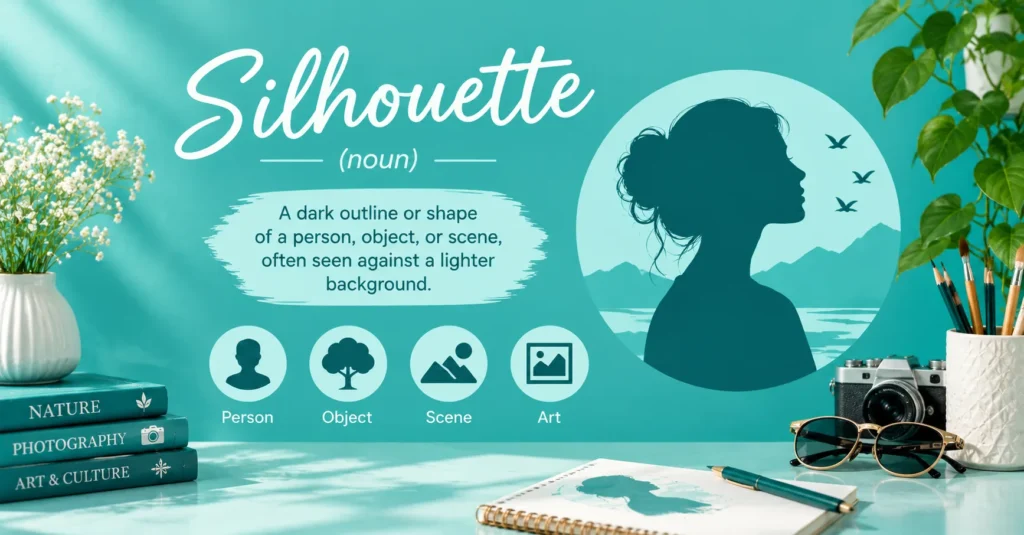
A silhouette is a solid representation of a person, animal, object, or scene in which the interior details are hidden or removed. Traditionally, it is shown as a dark or black shape against a lighter background. Imagine a person standing in front of a bright sunset: you may not see their face, clothing, or expression, but their recognizable outer shape remains visible. That is the basic silhouette meaning.
The word can also describe an object’s overall form or outline, especially in fashion. A designer may discuss the silhouette of a dress, while a photographer may capture the silhouette of a tree. In both cases, the focus is on shape rather than interior detail. This broader usage explains why silhouette appears naturally in conversations about clothing, architecture, illustration, photography, and visual storytelling.
| Context | Meaning of silhouette |
| Everyday language | A recognizable dark shape or outline |
| Art | A simplified solid figure or profile |
| Photography | A subject rendered dark against a brighter background |
| Fashion | The overall shape created by clothing on the body |
| Graphic design | A simplified solid shape used for recognition |
| Film and media | A dramatic or recognizable figure shown mainly by its outline |
Silhouette Meaning: Where the Word Comes From
The word silhouette has an unusual history because it comes from a person’s name: Étienne de Silhouette, a French finance minister who served in 1759. His name became associated with austerity and economy, and simple profile portraits became linked with the expression à la Silhouette. The exact details behind the naming story have been debated, but the connection with his name is well established.
Before photography, a simple profile portrait could provide an inexpensive record of someone’s appearance. Black paper or card could be cut or filled to reproduce the outline of a face. The technique itself was older than the word, with profile and shadow imagery appearing in earlier artistic traditions. Over time, silhouette moved beyond portraiture and became an ordinary English word for a dark outline, shadow-like figure, or overall form.

Silhouette Meaning: History
The history of silhouette art stretches far beyond the period when the English word became popular. Earlier cultures used profile imagery, shadows, and simplified figures in visual art. Wikipedia’s historical account connects silhouette-like practices with ancient Greek traditions, including black-figure pottery, while later profile portraiture developed into a recognizable European art form.
During the eighteenth and nineteenth centuries, silhouette portraits became particularly popular because they were comparatively inexpensive and could be produced quickly. In the United States, the form was especially popular from roughly 1790 to 1840. The arrival and eventual spread of photography changed portraiture dramatically, but the silhouette survived as an artistic and decorative technique rather than disappearing completely.
Greek origins
Ancient Greek visual traditions included strong profile shapes and black-figure imagery. These examples are important because they show that the basic artistic idea using a simplified dark figure whose identity depends heavily on its contour predates the modern word. The later European silhouette tradition therefore developed from a much older visual instinct: recognizing people and objects through shape.
Profile portraits
Profile portraits became particularly effective for silhouette work because features such as the forehead, nose, lips, and chin create a distinctive contour. A skilled artist could cut a person’s likeness from black paper by following that profile. The resulting portrait contained little internal information, yet the outline could still make the individual recognizable.
Nineteenth-century popularity and development
Silhouette portraiture flourished during the nineteenth century, when specialist artists produced profile portraits for customers at fairs, markets, studios, and other public settings. Some artists worked freehand, while mechanical devices also helped reproduce profiles. The growing availability of photography eventually reduced the silhouette’s role as an inexpensive alternative to painted portraiture.
Maintaining the tradition
The technique did not disappear when photography became widespread. Silhouette artists continued working at fairs and public events, and the form later gained renewed appeal as a nostalgic way to preserve a person’s profile. Today, silhouette art can still appear at weddings, celebrations, exhibitions, craft events, and personalized-art businesses.
Silhouette Meaning: In Art, Media and Illustrations
In art and illustration, a silhouette can simplify a complicated subject into one immediately recognizable visual shape. Removing facial features, colors, textures, and other details can make the contour more important and sometimes more emotionally powerful. Paper cutting, book illustration, posters, advertising, and contemporary artwork have all used silhouette techniques to communicate an idea quickly.
Silhouettes also work particularly well when an artist wants mystery or visual distance. A face hidden inside a dark shape leaves the viewer with fewer details to interpret, while a distinctive outline can still communicate identity. This is one reason silhouette imagery continues to appear in visual storytelling, graphic design, film, advertising, and illustration.
Shadow theatre
Shadow theatre demonstrates how silhouettes can become moving characters rather than static pictures. In traditional shadow-play forms, figures are placed between a light source and a surface, allowing audiences to see their shapes rather than their detailed surfaces. Asian traditions, including Indonesian wayang, contributed to the long history of shadow-based performance.
Movies
Film directors have long used silhouettes for atmosphere, suspense, symbolism, and recognition. Alfred Hitchcock’s distinctive profile is one memorable example, while silhouette sequences also appear in films, title sequences, posters, and music videos. A figure reduced to a dark outline can suggest danger, distance, mystery, movement, or simply create a striking composition.
Architecture
Architecture can create silhouettes both intentionally and naturally. A skyline at sunset, a building framed against the sky, or decorative forms casting strong shadows can all produce recognizable silhouette effects. Here, the important visual information often comes from the building’s contour, roofline, towers, arches, or other structural features rather than its surface detail.
Graphic design
Graphic designers use silhouettes because simplified shapes can remain recognizable even when reproduced at small sizes. Logos, posters, signs, icons, and advertisements may use a person’s figure, an animal, a landmark, or an object as a solid shape. Removing unnecessary details can make the central visual easier to identify and reproduce.
Silhouette Meaning: Silhouette in Art and Photography
In photography, the silhouette meaning becomes especially clear when a subject stands between the viewer and a strong light source. A bright sky, sunset, doorway, window, or studio light can illuminate the background while leaving the subject comparatively dark. The result is a photograph in which the outline carries most of the visual information.
A successful silhouette photograph does not necessarily require a completely black subject, but strong contrast usually makes the effect easier to recognize. The pose also matters. Separate arms, legs, hair, hats, objects, or other distinctive features can make the subject readable, while overlapping shapes may merge into an unclear mass. This is why profile views are often effective.
Photography
Photographers often create silhouettes through backlighting, sometimes called contre-jour. The background is exposed brightly enough that the subject loses most of its visible surface detail. Natural scenes such as sunsets, mist, open skies, and doorways can provide the necessary contrast, while controlled studio lighting can produce the same effect deliberately.
Photographic silhouettes
A photographic silhouette can feature almost anything: people, animals, trees, buildings, mountains, or everyday objects. What makes the image work is not simply darkness but recognition. If viewers can understand the subject from its boundary alone, the silhouette communicates successfully. This principle is also useful in visual design, where recognizable shapes often need to work at small sizes.
Silhouette Meaning: How to Make a Silhouette From a Photo
Creating a silhouette from a photograph begins with choosing an image where the subject has a clear, recognizable contour. Side-facing poses often work particularly well because facial features, hair, shoulders, and body proportions create a distinctive profile. Good separation between limbs and objects is also useful because overlapping elements can turn into one confusing shape.
For a traditional photographic effect, place a stronger light source behind the subject and expose for the brighter background. For digital artwork, an editor can isolate the subject, remove or hide the background, and fill the subject with a single flat color. The result should remain recognizable without relying on interior texture, shading, or facial detail.
Silhouette Meaning: Other Uses
The word has expanded well beyond traditional portrait art. In fashion, silhouette describes the overall outline created by clothing, while in fitness it can describe the visible form of the body. In design, silhouettes can represent objects or people quickly. In journalism, they can obscure identity; in computer vision, silhouettes can provide information about an object’s shape.
This broad range explains why context matters when someone asks for the silhouette meaning. A photographer may mean a backlit image, a fashion editor may mean the shape of an outfit, and a designer may mean a simplified icon. The underlying idea stays consistent: the outer form carries important information even when internal details are reduced or hidden.
Fashion and fitness
In fashion, silhouette refers to the overall shape or outline produced by a garment or complete outfit. Designers and historians may compare silhouettes from different periods, such as fitted, oversized, A-line, or other distinctive forms. In this context, the word does not mean a black shadow; it means the visible shape of the clothing.
Icons
Silhouettes are useful for icons because people can often recognize a familiar object from its shape alone. Traffic signs, maps, landmarks, animals, plants, and human figures can all be simplified into recognizable silhouettes. The fewer details an icon requires, the more important its outer contour becomes for fast visual identification.
Journalism
In journalism and documentary media, a person may be shown in silhouette when protecting their identity is important. The dark figure hides recognizable facial features while still communicating that a person is present. This is a practical use of visual concealment rather than an artistic silhouette portrait, although both rely on removing identifying interior detail.
Computer modelling
Computer vision and 3D modeling can also use silhouettes as information about shape. A computer can analyze a visible contour from one or more viewpoints and use it to help reconstruct or reason about an object’s form. Here, silhouette becomes a technical representation rather than simply an artistic effect.
Silhouette Meaning: Modern Use
Today, silhouette is an ordinary English word used across photography, fashion, design, art, architecture, entertainment, and everyday conversation. You might describe the silhouette of a mountain at sunset, the silhouette of a dancer, or the silhouette of a dress. The original connection to Étienne de Silhouette is rarely relevant when people use the word today.
Modern usage also demonstrates how the word shifted from a specific artistic technique into a broader description of form. A silhouette can be a literal dark image, an outline emphasized by lighting, or simply the overall shape of something. That flexibility is why the term appears naturally in both visual arts and ordinary descriptions of appearance.
Conclusion
Some of the most memorable silhouettes work because viewers recognize them almost instantly. A familiar skyline, animal, person, landmark, or character can remain identifiable even after its internal details disappear. In visual communication, that makes silhouettes powerful: they simplify information without necessarily eliminating identity.
Historic paper portraits provide one example, while modern advertising, movies, music videos, logos, and photography provide others. The iPod advertising campaigns famously used dancing silhouettes, while cinema has repeatedly used dark profiles and figures to create distinctive visual moments. These examples show how the same basic principle can move from portraiture to mass communication.
FAQs
Author

Ethan Carter is an SEO blogger specializing in internet slang, text abbreviations, and social media meanings. He creates clear, accurate, and reader-friendly content backed by thorough research. His goal is to help readers understand modern online language with reliable, easy-to-read guides.