

Lucifer Meaning: 7 Powerful & Surprising Facts About the Light-Bearer, Satan & Bible
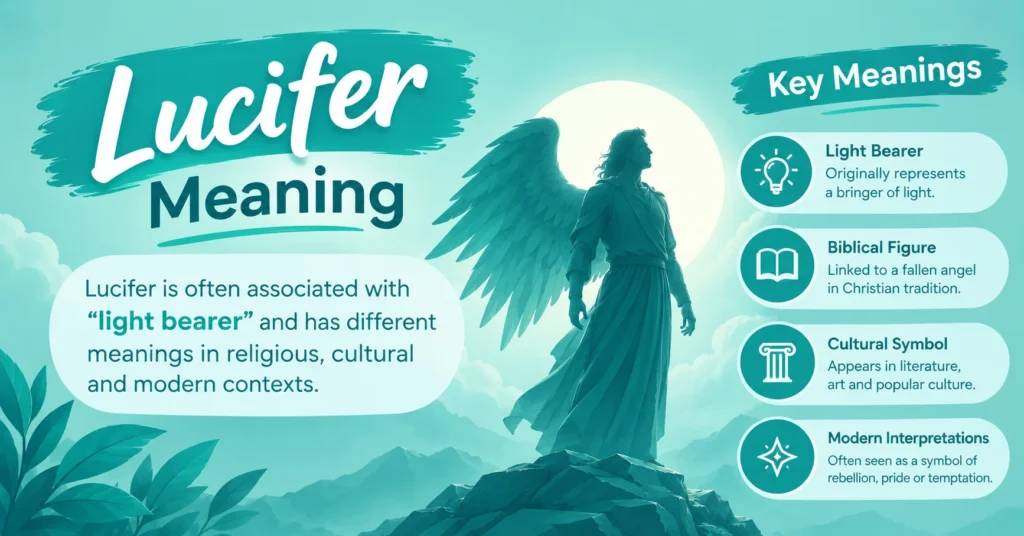
Lucifer meaning is most literally connected with “light-bearer” or “morning star,” from the Latin lucifer. The word originally referred to the planet Venus when visible before sunrise, but Christian tradition later connected Lucifer with Satan, the Devil, a fallen angel, pride, rebellion, and the fall from heaven. That difference matters because many readers encounter the word first through theology rather than its older linguistic meaning. After researching biblical dictionaries, historical usage, and the Isaiah tradition, this guide separates the Latin word, biblical context, Christian interpretation, and later cultural symbolism so you can understand exactly why one name carries such different meanings.
Lucifer meaning: Roman folklore and etymology
The original Lucifer meaning is closely tied to light, dawn, Venus, and the morning star. The Latin word combines lux or lucis, meaning light, with ferre, meaning to carry or bear. In Roman usage, Lucifer referred to Venus when it appeared in the eastern sky before sunrise, making “light-bearer” a literal image rather than an inherently evil name.
Roman and Greek traditions connected the morning star, dawn, celestial brightness, and personification. Greek terms such as Phosphoros and Eosphoros carried closely related ideas of bringing or announcing dawn. This is important because the earliest sense of Lucifer was astronomical and poetic. The later association with Satan developed through biblical interpretation and Christian tradition rather than being the word’s original Latin definition.
A simple way to understand the linguistic progression is:
| Term | Meaning or association |
| lux | light |
| ferre | to carry or bear |
| Lucifer | light-bearer |
| Morning star | Venus before sunrise |
| Helel | shining one |
| Helel ben Shahar | shining one, son of dawn |
| Later Christian usage | Satan/Devil |
Oxford and other major dictionaries retain both sides of this history: Lucifer can mean the Devil in modern English while tracing the word’s origin to Latin “light-bringing, morning star.”
Lucifer meaning: In the Bible
The biblical question is more complicated than the common definition “Lucifer means Satan.” In Isaiah 14:12, the King James Version famously uses Lucifer, while many modern English translations use expressions such as “morning star,” “day star,” or “shining one.” The underlying Hebrew expression is Helel ben Shahar, commonly understood as “shining one, son of dawn.”
The immediate literary setting is also important. Isaiah 14:4 introduces the passage as a taunt against the king of Babylon, and the surrounding verses describe an arrogant ruler whose attempt to rise above others ends in humiliation. The image of the morning star falling from the sky therefore functions within a poem about downfall. Bible dictionaries likewise connect the passage directly with Babylon’s king and the imagery of a brilliant star.
Christian interpretations
Christian interpretation eventually connected Isaiah’s fallen “morning star” with Satan’s fall from heaven. This connection was strengthened when early Christian readers compared Isaiah with New Testament passages such as Luke 10:18 and Revelation 12, which describe Satan’s defeat or expulsion from heaven. The association became deeply established in Christian literature and theology.
That does not mean every Christian tradition reads Isaiah 14:12 in exactly the same way. A historical reading focuses on the king of Babylon, while a theological or typological reading may see the passage as also illuminating Satan’s rebellion and fall. The distinction is useful because it separates what the verse directly addresses from how later Christian tradition interpreted its imagery.
The translation history helps explain the confusion. The Septuagint rendered the Hebrew expression with the Greek Heosphoros, associated with the dawn or morning star. Jerome’s Latin Vulgate used Lucifer. Later English readers, especially through the King James tradition, encountered “Lucifer” as a capitalized name, helping turn a Latin descriptive term into what sounded like a personal name.
Modern English Bibles generally translate the imagery rather than preserving “Lucifer” as a proper name in Isaiah 14:12. Wikipedia’s current reference page notes that modern translations commonly use forms such as morning star, daystar, Day Star, shining one, or shining star.
This is why saying “lucifer meaning is literally the biblical name of Satan” is too simple. The better explanation is that Lucifer became a traditional Christian name for Satan through interpretation of Isaiah and related passages. Encyclopedia sources similarly describe the transition from a Latin term for the morning star to its later identification with Satan.
Lucifer meaning: Comparative religion
Comparative religion shows why the morning-star image, celestial ascent, pride, and downfall became powerful symbols. Venus appears prominently in ancient cultures because its bright appearance shortly before sunrise is striking. Stories about luminous beings attempting to reach a higher position can therefore be connected with the visual experience of a brilliant star appearing and then disappearing as daylight arrives.
The important point is not that every ancient culture told the same lucifer meaning story. They did not. Instead, different traditions developed their own celestial myths and symbols. Comparing them helps explain why later writers could connect the morning star, ambition, descent, light, darkness, and rebellion into a larger symbolic narrative.
Sumerian folklore and origins of the Biblical tale
Comparative sources discuss earlier Near Eastern motifs involving a heavenly figure seeking an elevated position and then being brought down. Wikipedia connects this broader motif with Venus and discusses parallels in Babylonian and Canaanite traditions, including stories involving celestial ambition and descent.
One frequently discussed parallel involves Athtar, a morning-star figure in Canaanite tradition, who attempts to occupy the throne of Baal but ultimately descends. These comparisons should be treated carefully: they are examples of related mythological motifs, not proof that every later account of Lucifer was copied directly from one earlier story.
Arabian legends
Arabian traditions contain their own stories involving stars, transformation, rebellion, and descent. Wikipedia discusses legends surrounding Suhail, identified with Canopus, as a figure who was cast down from a higher position. It also records a tradition involving Venus as a transformed figure associated with angels.
These stories demonstrate that celestial imagery was not limited to Christian theology. Across cultures, stars could represent beauty, status, transformation, punishment, divine order, or rebellion. The similarities can illuminate cultural history, but they should not be treated as if they all describe the same theological character.
Lucifer meaning: Influence of the conception of Lucifer as the Devil
Once Lucifer became associated with the Devil, the name acquired a much darker theological meaning. The central themes became pride, rebellion, temptation, fall, evil, and opposition to God. Over centuries, writers, theologians, artists, poets, and religious movements expanded the character far beyond the original Latin meaning of a light-bearing morning star.
This development also influenced Western literature. Dante’s Divine Comedy and John Milton’s Paradise Lost helped shape popular images of Lucifer and Satan, while later art and entertainment frequently presented Lucifer as a dramatic fallen angel. Encyclopedia sources note the importance of this literary development in shaping the familiar Western portrait of the rebellious figure.
Satanism
Lucifer has not had one universally shared meaning in Satanist or Luciferian traditions. Some Luciferian systems treat Lucifer symbolically as a figure representing knowledge, illumination, independence, or intellectual freedom, rather than simply equating him with the Christian Devil.
Wikipedia distinguishes these modern interpretations from mainstream Christian theology and notes that Luciferian beliefs can interpret the figure differently from traditional Christian understandings. These are religious or philosophical positions held by particular groups, not the original Latin definition of the word.
Anthroposophy
In Rudolf Steiner’s Anthroposophy, Lucifer has a distinctive philosophical meaning that differs from ordinary Christian demonology. Steiner presented Lucifer and Ahriman as opposing spiritual tendencies, with Christ occupying a mediating position within his framework.
This illustrates an important semantic point: the word Lucifer can function differently depending on the belief system being discussed. In one context it means the morning star; in another it represents Satan; in another philosophical system it can represent a particular spiritual tendency.
Theosophy
Theosophical interpretations also depart from the traditional Christian definition. In the writings associated with Helena Blavatsky, Lucifer could symbolize intellectual illumination, consciousness, freedom of thought, and the development of human intelligence rather than simply representing an evil personal being.
This interpretation deliberately draws attention back toward the older “light-bearer” symbolism. It is therefore another example of how the same name can accumulate different meanings as it moves through religion, philosophy, literature, and modern spiritual movements.
Freemasonry
Claims connecting Freemasonry with Lucifer worship have a complicated history and include the famous Taxil hoax. Léo Taxil promoted sensational claims about alleged Luciferian worship among Freemasons and later publicly admitted that his accusations were fraudulent.
Some Masonic writers have nevertheless used “Lucifer” symbolically in discussions of light, knowledge, or illumination. Those symbolic references should not automatically be interpreted as evidence that Freemasonry as an organization worships Lucifer. The historical record is considerably more complicated than that popular claim suggests.
Charles Godfrey Leland
Charles Godfrey Leland’s Aradia, or the Gospel of the Witches presents another distinctive version of Lucifer. In Leland’s account, Lucifer appears within an Italian witch-cult mythology connected with Diana, light, celestial movement, and folklore.
Leland’s work is important for understanding later folklore but should not be confused with biblical Christianity. It combines classical, folkloric, and Christian elements in ways that reflect its own literary and cultural setting. Wikipedia specifically connects Leland’s Lucifer with the classical personification of Venus while noting the incorporation of Christian motifs.
Lucifer meaning: Modern popular culture
Modern popular culture has transformed Lucifer into one of the most recognizable supernatural characters in Western storytelling. Television, comics, novels, film, music, and visual art frequently portray him as charismatic, intelligent, rebellious, witty, conflicted, or sympathetic, rather than presenting only the traditional image of an embodiment of evil.
The television series Lucifer, DC Comics’ interpretation, Neil Gaiman’s work, and other modern portrayals demonstrate how far the character has moved from the original astronomical meaning of the Latin word. In these stories, Lucifer often becomes a vehicle for exploring free will, identity, authority, morality, rebellion, responsibility, and redemption.
This modern portrayal can create confusion when someone searches for the literal Lucifer meaning. A fictional character called Lucifer may be inspired by Christian mythology without representing the biblical or historical meaning of the term. Wikipedia specifically notes that modern popular culture frequently presents Lucifer as a complex or sympathetic character rather than simply an evil figure.
The safest way to understand the word is therefore to identify the context first:
| Context | Lucifer meaning |
| Latin | Light-bearer / light-bringer |
| Roman astronomy | Morning appearance of Venus |
| Isaiah 14 tradition | Shining one / morning star imagery |
| King James Bible | “Lucifer” in Isaiah 14:12 |
| Christian tradition | Traditional name associated with Satan |
| Comparative mythology | Celestial or morning-star figure |
| Luciferian traditions | May symbolize illumination or independence |
| Popular culture | Often a fictionalized fallen-angel character |
The word’s history is therefore a story of translation, interpretation, theology, literature, and cultural change. The earliest sense was not “evil.” It described brightness and the morning star. The Satan association developed later and became so influential that modern dictionaries now commonly list the Devil as a principal English meaning.
Topical Bible Verses
Several biblical passages help explain why readers connect Lucifer with the Devil. Isaiah 14:12 is the central passage because it contains the “morning star” imagery. Luke 10:18 describes Satan falling from heaven, while Revelation 12 describes the dragon identified as the Devil and Satan being cast down.
Another interesting comparison is 2 Peter 1:19, where the morning-star image appears without meaning “Satan.” This reinforces an important linguistic point: “morning star” imagery itself is not inherently evil. The theological meaning depends on the person, passage, and context in which the image is used.
Conclusion
The meaning of Lucifer is more complex than the name’s modern association with evil. Historically, lucifer is a Latin word connected with “light-bringer” or the morning star, while later Christian traditions associated the name with Satan before his fall. Because of these different religious, linguistic, and cultural interpretations, Lucifer can carry very different meanings depending on the context.
For some people, it represents pride and rebellion; for others, it suggests light, transformation, or independence. Understanding the background behind the name helps separate its original meaning from later interpretations. Whether you encounter Lucifer in the Bible, literature, popular culture, or as a personal name, context is key to understanding what it represents.
FAQs
Author

Ethan Carter is an SEO blogger specializing in internet slang, text abbreviations, and social media meanings. He creates clear, accurate, and reader-friendly content backed by thorough research. His goal is to help readers understand modern online language with reliable, easy-to-read guides.






One Comment