
Hotep Meaning: 7 Essential Facts About Its Origins & Use
Hotep meaning depends heavily on context: the ancient Egyptian word ḥtp is associated with peace, satisfaction, contentment, rest, and offerings, while modern usage can refer to an Afrocentric greeting or a critical internet label. The word appears in ancient Egyptian names such as Imhotep and Amenhotep, connecting language, history, and cultural identity.
If you encountered hotep meaning on social media and felt unsure whether it was respectful, humorous, or insulting, you’re not alone. Its modern history involves Afrocentrism, Black cultural identity, online slang, and cultural debate. Understanding both the historical meaning and contemporary usage helps you read the word accurately without confusing cultural pride with a modern stereotype.
What Does “Hotep” Mean?
In its ancient Egyptian context, hotep meaning comes from the Egyptian form ḥtp, whose semantic range includes ideas such as being satisfied, content, peaceful, or at rest. In religious contexts, related usage can also refer to an offering. Therefore, translating it simply as “peace” is convenient but incomplete.
In modern Afrocentric settings, hotep can function as a greeting expressing peace, respect, or cultural connection. In internet slang, however, a hotep may be a critical label for someone perceived as promoting exaggerated Afrocentric claims, pseudo-history, conspiracy theories, or socially conservative views. The second meaning is contextual rather than a definition of Afrocentrism itself.
How to Pronounce “Hotep”
The commonly given English pronunciation is HOH-tep, with the stress on the first syllable. English-language sources represent it as /ˈhoʊ.tɛp/. The spelling hotep is a modern romanization of an ancient Egyptian form, so readers should not assume that an English pronunciation perfectly reproduces an ancient pronunciation.
Pronunciation becomes particularly useful when the word appears in conversations about Ancient Egypt, Kemetic traditions, African heritage, or online culture. Saying it correctly helps, but understanding the context matters even more. A historical discussion and a social-media argument may use the same word while communicating very different ideas.
Origin and Evolution of “Hotep”
The Egyptian root ḥtp has a long history and appears in names and religious contexts. Examples include Imhotep, a famous ancient Egyptian official associated with the Third Dynasty, and Amenhotep, a royal name containing the same linguistic element. Harvard’s Digital Giza records Hotep/Hetep as an alternate form connected with ancient Egyptian names.
The modern cultural meaning developed much later. Dictionary.com reports that hotep was used as a greeting among some Afrocentrists by at least the 1970s, while later internet culture transformed the word into a more contested label. Academic research similarly describes Hotep as a contemporary cultural trope connected with Black pride, ancient Egyptian imagery, identity, and debates over gender and historical claims.

Hotep Meaning, Origin and Usage
Key Takeaways
There are essentially three contexts to keep in mind. Historically, ḥtp carries a broad Egyptian semantic field involving peace, satisfaction, contentment, rest, and offerings. In some modern Afrocentric communities, hotep can be a positive greeting. In online criticism, a hotep can refer to a particular stereotype rather than to anyone interested in African history.
This distinction matters because the modern slang label is sometimes applied too broadly. Being interested in Ancient Egypt, supporting Black history, studying Afrocentrism, or celebrating African heritage does not automatically make someone a “hotep” in the critical slang sense. Context, speaker intent, and the surrounding conversation determine the meaning.
Origin of Hotep
The ancient Egyptian word is conventionally transliterated as ḥtp or rendered as hotep/hetep. Its meanings extend beyond a single English equivalent. Historical evidence associates the word with ideas of satisfaction, contentment, peacefulness, rest, and offerings. Ancient Egyptian texts and names demonstrate that its meaning depended partly on grammatical and cultural context.
The same linguistic element appears in important names. Imhotep contains the element, as does Amenhotep. That historical connection explains why the word became meaningful in later conversations about Ancient Egypt and African heritage. It should not, however, be assumed that every modern use has exactly the same meaning as an ancient Egyptian usage.
Usage of Hotep
Modern usage generally falls into two broad categories: respectful or cultural use and critical slang. Someone may use hotep as a greeting associated with peace and African heritage, while another speaker may describe a person as “a hotep” in a discussion about historical claims, gender politics, or online cultural commentary.
To Critique Over-the-Top Afrocentrism
One common slang use is to criticize claims viewed as excessively Afrocentric or historically unsupported. For example, online commenters may use hotep when someone presents an extraordinary claim about Ancient Egypt without credible evidence. This usage is a cultural criticism, not a neutral synonym for African-centered scholarship.
To Highlight Performative Activism
The label can also be used when someone appears to express strong public support for Black empowerment while, according to critics, behaving inconsistently with those stated principles. 7ESL identifies this as one modern usage of the term.
To Call Out Problematic Views
Some users apply hotep to people they associate with sexism, homophobia, rigid gender roles, or conspiracy thinking. Academic discussions of the contemporary Hotep trope also examine associations with heteropatriarchy, essentialism, and debates about Black cultural identity. These are descriptions of how the label is used, not characteristics of Afrocentrism as a whole.
Playfully Teasing a Friend
Not every use is hostile. Among friends, hotep can be used jokingly when someone becomes intensely enthusiastic about Ancient Egypt, pyramids, African history, or related cultural subjects. Tone is crucial: the same word can sound affectionate between friends and insulting when directed at a stranger.
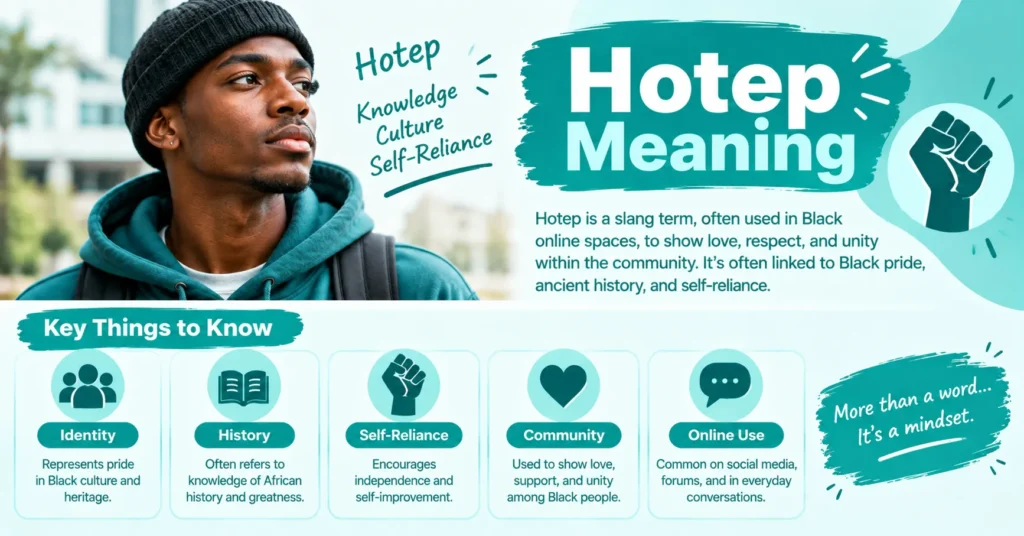
Commenting on Pseudo-Scholarly Claims
Another frequent online use involves claims presented with confidence but lacking reliable historical evidence. Reddit discussions demonstrate that people interested in Ancient Egyptian history sometimes encounter debates about whether specific claims associated with “Hotep” culture align with established historical scholarship.
Other Meanings
The safest way to understand hotep is not to search for one universal definition. Its ancient meaning, modern greeting usage, and contemporary slang sense overlap historically but are not interchangeable. In an Egyptology context, the ancient linguistic meaning is relevant; in a cultural greeting, the modern positive meaning may be intended; online criticism can invoke an entirely different sense.
How “Hotep” Is Used
Who Uses “Hotep”?
Some Afrocentric and Pan-African communities use hotep positively as a greeting or expression of peace and cultural connection. Historians and Egyptology students may encounter ḥtp while studying Egyptian language, names, religious texts, and offering formulas. Online commentators may instead use “a hotep” as a critical or humorous label.
The term therefore does not belong exclusively to one community or one register of English. Its meaning is socially situated. If you see someone write “hotep” by itself, the surrounding message may reveal whether it means a greeting. If someone says “he is a hotep,” the grammatical construction strongly suggests the modern slang label.
Common Situations
| Context | Likely meaning | Tone |
| Ancient Egyptian studies | ḥtp and its historical meanings | Academic |
| Afrocentric greeting | Peace, respect, cultural connection | Respectful |
| Social-media criticism | A particular cultural stereotype | Critical |
| Meme or comedy | Exaggerated Hotep persona | Humorous |
| Discussion of ancient names | Egyptian linguistic element | Historical |
This context-based approach is more reliable than treating every appearance of hotep as slang. English Study Online similarly emphasizes that tone may range from respectful to humorous, mocking, or offensive depending on who says the word and why.
Examples in Conversations
Greeting:
“Hotep, my brother. How have you been?”
Here, the word functions as a greeting connected with peace or cultural identity.
Online discussion:
“Why are people calling him a hotep?”
In this example, the speaker is asking about the critical slang label rather than using the ancient meaning.
Historical discussion:
“The name Amenhotep contains the Egyptian element ḥtp.”
Here, hotep is being discussed linguistically and historically rather than as internet slang.
Examples in Texts and Social Media
On X, Reddit, podcasts, and other social platforms, hotep frequently appears in conversations about African history, Black identity, Ancient Egypt, cultural politics, and controversial historical claims. Dictionary.com documented its association with Black Twitter, while recent Reddit discussions show both historical questions about ḥtp and contemporary debates about the modern label.
A useful clue is the surrounding vocabulary. Words such as “pyramids,” “Kemet,” “history,” or “Egypt” may point toward cultural or historical discussion, while phrases involving “Hotep Twitter,” conspiracy claims, or criticism of someone’s worldview may indicate the modern slang sense.
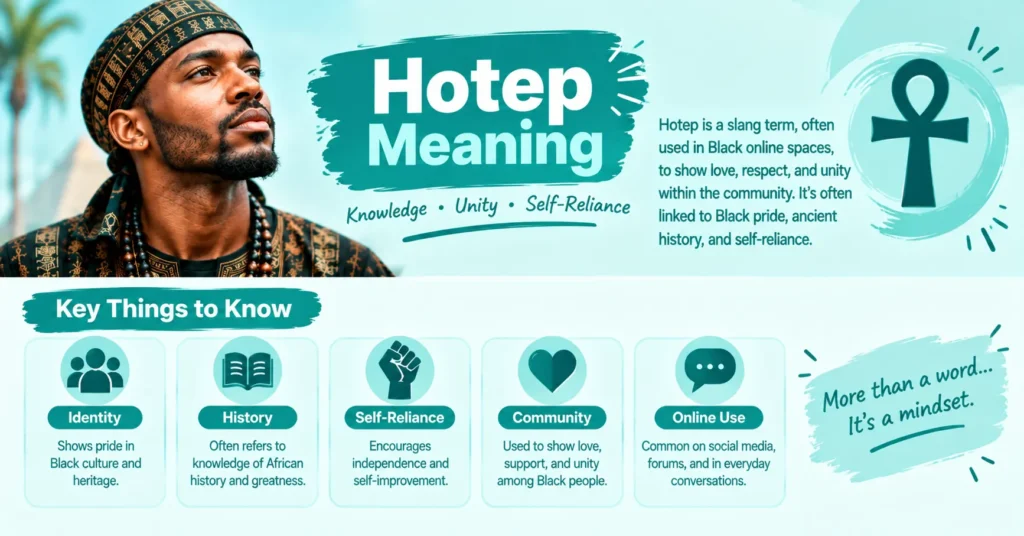
Tone and Cultural Sensitivity
The modern slang meaning can be sensitive. Some people embrace hotep as part of an Afrocentric identity, while others regard the label as mocking or derogatory. Recent Reddit discussion shows that some users object strongly to its use as an insult, particularly when they believe it reduces disagreement with an individual to a racialized stereotype.
For that reason, casually labeling another person a “hotep” can create unnecessary conflict. A more precise approach is to identify the specific claim or behavior being discussed. Instead of relying on a broad label, explain whether the issue concerns historical accuracy, gender politics, cultural interpretation, or another concrete disagreement.
Related Terms to Hotep
Several terms frequently appear in discussions surrounding hotep. Afrocentrism broadly refers to approaches that center African peoples, histories, experiences, and contributions. Pan-Africanism concerns solidarity and political or cultural connections among African peoples and the African diaspora. Neither term is simply interchangeable with the modern slang label “hotep.”
Other related expressions include Black pride, Kemetic, African heritage, Black cultural identity, and Hotep Twitter. These terms overlap in some conversations but describe different concepts. Academic research, for example, treats Hotep culture as one particular register within broader Black cultural memory rather than as a synonym for all Afrocentric thought.
Alternatives to “Hotep”
If you mean the greeting, “peace” or “peace be with you” may communicate a similar idea in ordinary English, although neither is a complete translation of every historical use of ḥtp. If you mean the critical slang label, however, there may be no single neutral substitute because the term bundles several criticisms together.
When precision matters, describe the specific behavior instead. For example, saying “unsupported historical claim,” “Afrocentric interpretation,” or “socially conservative argument” is clearer than applying a broad label when the audience may interpret hotep differently.
Common Mistakes When Using “Hotep”
One common mistake is assuming that hotep only means “peace.” That translation captures an important part of the word’s modern presentation but does not cover its broader ancient semantic range, including satisfaction, contentment, rest, and offerings in particular contexts.
Another mistake is assuming that every person interested in African history or Ancient Egypt is a “hotep.” The modern critical usage describes a narrower stereotype. English Study Online specifically warns against treating every Afrocentrist, activist, or African-history student as a hotep.
It is also misleading to treat hotep as simply another word for “too woke.” Contemporary usage is more specific and can involve ideas about Afrocentrism, historical claims, gender, cultural identity, and online persona.
Finally, remember that context changes tone. A respectful greeting, an ancient Egyptian name, and an insult on social media can all involve the same spelling while carrying very different meanings.
Examples of Hotep
Here are several natural examples showing the major senses:
| Example | Meaning |
| “Hotep, my brother.” | A modern peace-oriented greeting |
| “The name Imhotep contains ḥtp.” | Historical/language reference |
| “People online called his claims hotep.” | Critical slang |
| “She studies ancient Egyptian ḥtp.” | Academic context |
| “That meme is making fun of Hotep culture.” | Internet/cultural commentary |
The important lesson is that the surrounding sentence determines the intended sense. Dictionary.com documents both greeting usage and the later derogatory use, while 7ESL emphasizes examples involving exaggerated Afrocentric claims and cultural commentary.
The historical meaning also has stronger documentation than many internet explanations suggest. Egyptian museum records and Harvard’s Digital Giza project show Hotep/Hetep in ancient Egyptian names and inscriptions, while Reddit discussions from Egyptology-focused communities provide additional examples of how the linguistic element is interpreted in context.
Conclusion
The simplest way to remember hotep meaning is to separate its three major contexts. Historically, ḥtp is an Ancient Egyptian term associated with peace, satisfaction, contentment, rest, and offerings. In some modern Afrocentric settings, hotep can be a positive greeting. In internet slang, “a hotep” can be a critical label for a particular cultural stereotype.
The word’s history is therefore much richer than a single dictionary definition. Understanding that distinction helps prevent a common mistake: assuming that a historical Egyptian term, a modern cultural greeting, and a contemporary internet insult are all identical uses. They are related, but context determines what the speaker actually means.
FAQs
Author

Ethan Carter is an SEO blogger specializing in internet slang, text abbreviations, and social media meanings. He creates clear, accurate, and reader-friendly content backed by thorough research. His goal is to help readers understand modern online language with reliable, easy-to-read guides.