
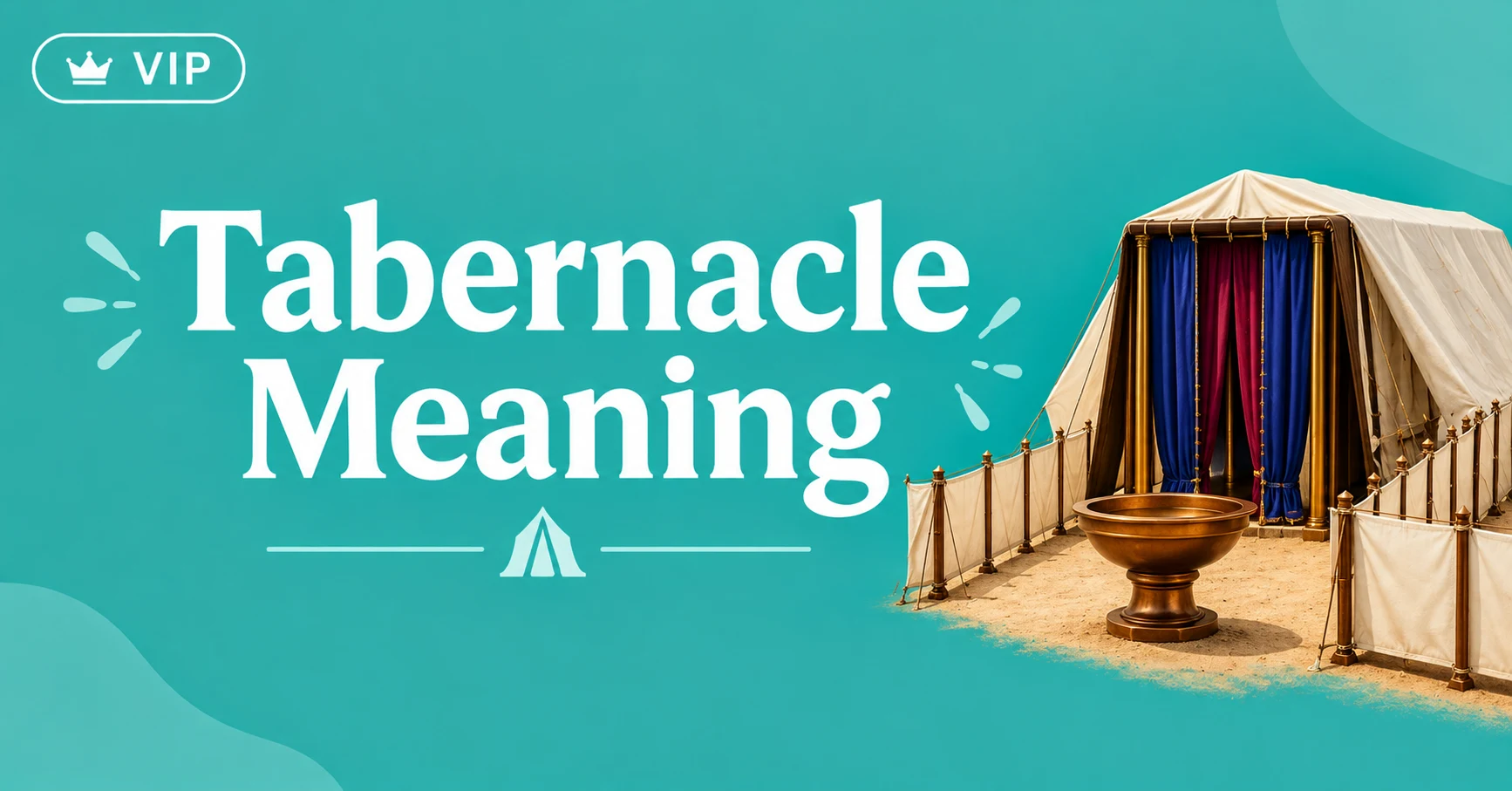
Tabernacle Meaning: 9 Powerful Biblical Facts, Symbolism & Sacred Significance
The tabernacle meaning is essentially “dwelling place,” referring in the Bible to the portable sanctuary where God’s presence was understood to dwell among Israel. The terms Mishkan, Tent of Meeting, sanctuary, Holy Place, and Holy of Holies help explain its role. After studying biblical terminology and historical references, it becomes clear that the Tabernacle was more than a tent: it represented worship, divine presence, covenant, and closeness to God.
For someone encountering the word in Exodus, a church service, or a discussion of Sukkot, the terminology can initially feel confusing. The wilderness sanctuary, Ark of the Covenant, priesthood, sacrifices, and Temple all connect to its story. This guide brings those pieces together so you can understand the biblical meaning without getting lost in technical details or competing interpretations.
The Tabernacle Meaning and Purpose
The Hebrew word mishkan is associated with dwelling or residence. In biblical context, the Tabernacle was a sacred dwelling associated with God’s presence among the Israelites. It was also called the ohel moed, or Tent of Meeting, emphasizing that it was a place of encounter, revelation, worship, and communication.
Its purpose was therefore both physical and religious. Israel carried this portable sanctuary through the wilderness, and its carefully organized spaces separated ordinary areas from increasingly holy ones. The arrangement included the courtyard, Holy Place, and Holy of Holies, creating a structured setting for priestly service and worship.
The Mishkan and “Dwelling Place”
Mishkan is especially important when understanding tabernacle meaning because it points toward dwelling rather than simply describing a tent. Bible Gateway identifies the Hebrew term as “dwelling place” and connects it with the root meaning “to dwell.” That linguistic connection explains why divine presence is central to the concept.
The Tent of Meeting
The expression Tent of Meeting emphasizes relationship and encounter. Bible Gateway explains that this designation described a place where God met with Moses and Israel and communicated revelation. Thus, the tabernacle meaning was associated not merely with religious ceremony but with divine communication and covenant relationship.
What Is the Tabernacle?
The tabernacle meaning was a portable sanctuary used by the Israelites during their wilderness journey and later in the land before Solomon’s Temple became the permanent central sanctuary. It functioned as a center of worship and as the sacred setting associated with God’s presence among Israel.
Unlike a permanent stone temple, the tabernacle meaning could be dismantled, transported, and reconstructed. Biblical descriptions explain how Levites were assigned responsibilities for carrying its components and sacred furnishings. This portability made the sanctuary closely connected with Israel’s journey through the wilderness.
A Portable Sanctuary
The portable design was practical, but it also carried theological significance. Israel’s worship center traveled with the community rather than remaining permanently attached to one building. The cloud associated with the Tabernacle signaled when the Israelites were to remain or journey, according to Exodus and Numbers.
God’s Presence Among Israel
The tabernacle meaning represented God’s presence among the Israelites. The International Fellowship of Christians and Jews describes it as the intersection of divine and earthly realms, while biblical passages connect its construction with God’s desire to dwell among His people.
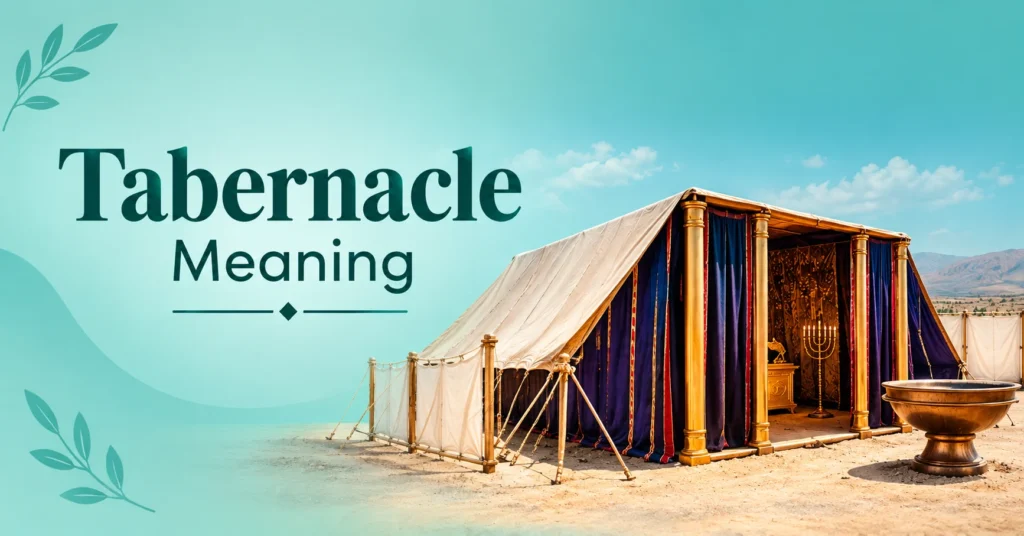
What is the Tabernacle in the Bible?
The primary biblical instructions concerning the Tabernacle appear in Exodus 25–31, while Exodus 35–40 describes its construction and completion. Numbers provides additional information about its arrangement, transportation, priestly responsibilities, and place within Israel’s camp.
The biblical account connects the Tabernacle with worship, sacrifice, priestly service, revelation, and holiness. Its central objects included the Ark of the Covenant, lampstand, table of showbread, altar of incense, and other furnishings used in the sanctuary.
Exodus 25–31
Exodus gives unusually detailed instructions for the sanctuary. The text describes materials, dimensions, furnishings, coverings, priestly garments, and procedures. The detailed instructions show that the Tabernacle was not presented as an improvised tent but as a carefully ordered sanctuary built according to the biblical narrative’s prescribed pattern.
The Wilderness Journey
During Israel’s wilderness years, the Tabernacle moved with the community. When the cloud lifted, the Israelites traveled; when it remained over the dwelling, they stayed. Levites had designated responsibilities for dismantling, carrying, protecting, and reassembling its parts.
The Tabernacle’s Significance
The significance of the Tabernacle extends beyond its physical structure. It represented a place where the sacred and ordinary worlds met, with increasing levels of holiness moving inward toward the Holy of Holies. Jewish interpretation has connected its design with divine presence, sacred space, and humanity’s relationship with God.
Christian interpretation adds another layer because the New Testament refers to the Tabernacle and uses dwelling imagery in discussing Christ. Hebrews contrasts the earthly sanctuary with heavenly realities, while John 1:14 uses language associated with “dwelling” or “pitching a tent” when describing the Word becoming flesh.
Holy Space and Divine Presence
The Tabernacle’s arrangement created a movement from the outer court toward increasingly restricted sacred areas. The outer court contained the sacrificial altar and laver, while the sanctuary itself contained the Holy Place and innermost Holy of Holies. This physical arrangement expressed distinctions of holiness and access.
The Holy of Holies
The Holy of Holies was the innermost chamber of the sanctuary. It housed the Ark of the Covenant and was separated from the Holy Place by a veil. According to Leviticus 16, the high priest entered this innermost sacred space on the Day of Atonement under the prescribed ritual system.
What the Tabernacle Looked Like
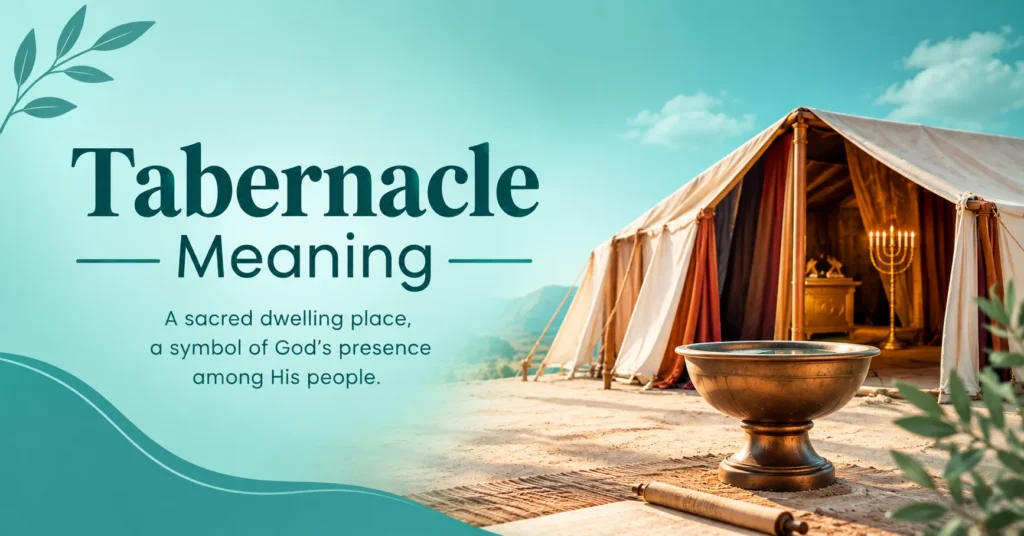
The Tabernacle consisted of an enclosed courtyard surrounding a tent-like sanctuary. Descriptions include curtains, wooden boards, precious metals, acacia wood, colored fabrics, coverings, poles, and sacred furnishings. The structure was designed to be assembled and disassembled as Israel traveled.
Inside, the sanctuary was divided into the Holy Place and Holy of Holies. The Holy Place contained the table of showbread, lampstand, and altar of incense, while the innermost room contained the Ark. The courtyard included the altar of burnt offering and bronze laver.
The Outer Court
The outer court surrounded the central sanctuary and contained the altar of burnt offering and laver. Bible Gateway describes the court as a rectangular enclosure with curtains and an eastern entrance. The altar was associated with sacrifices, while the laver served priestly washing.
The Holy Place
The Holy Place was the outer compartment inside the sanctuary. Its principal furnishings included the table of showbread, golden lampstand, and golden altar of incense. These objects formed part of the ritual environment through which priests carried out their assigned service.
The Tabernacle vs. the Temple
The clearest distinction is portability versus permanence. The Tabernacle traveled with Israel, while Solomon’s Temple in Jerusalem became a permanent sanctuary. The Temple incorporated important features associated with the earlier Tabernacle, creating a historical and theological relationship between the two institutions.
The Tabernacle did not simply disappear from biblical history without a connection to later worship. Biblical references place it at locations including Shiloh, Nob, and Gibeon before the Temple era. The Temple eventually became the permanent Jerusalem sanctuary under Solomon.
Portable and Permanent Worship
The difference between the two structures helps explain why the Tabernacle is often associated with Israel’s journey. Its mobility reflected a people who had not yet reached the permanent center represented by Jerusalem. The Temple later provided a fixed sanctuary while retaining important elements of the earlier worship system.
What Is the Tabernacle Meaning Today?
Today, tabernacle meaning depends partly on religious context. In Jewish discussion, the biblical Tabernacle remains an important part of the Torah’s account of worship, divine presence, priesthood, and Israel’s wilderness journey. It is also closely related historically and symbolically to the Festival of Tabernacles, or Sukkot.
In Christianity, the word can carry additional meanings. Some traditions use “tabernacle” for a sacred container associated with the Eucharist, while Christian biblical interpretation can also understand the ancient sanctuary as pointing toward themes of God’s presence and access to God through Christ.
Jewish Religious Context
Jewish interpretation has explored the Tabernacle’s spiritual meaning in different ways. My Jewish Learning notes interpretations from figures such as Maimonides and the Zohar, while also discussing the idea that sacred space can symbolize the human heart as a place prepared for divine presence.
Christian Interpretations
Christian readers often connect the Tabernacle with the New Testament’s language of God’s dwelling among humanity. Hebrews discusses the earthly sanctuary alongside a heavenly reality, while John 1:14 uses Greek language associated with dwelling or “pitching a tent” among people. These are theological interpretations rather than a replacement for the original historical context.
Plan of the Tabernacle
The basic plan moved from the outer courtyard toward the sanctuary and then into the Holy of Holies. The arrangement included an altar and laver in the courtyard, followed by the Holy Place with its furnishings, and finally the innermost chamber containing the Ark of the Covenant.
The materials were also carefully specified. Biblical descriptions mention gold, silver, bronze, acacia wood, linen, colored yarns, animal skins, oil, spices, and precious stones. These materials were assembled into a structure designed for sacred service rather than ordinary domestic use.
Framework and Coverings
The framework included wooden boards overlaid with gold, while multiple coverings protected the sanctuary. Bible Gateway describes linen curtains, goat-hair curtains, and outer coverings made from animal skins. The layered construction protected the sacred interior while allowing the entire sanctuary to be transported.
Furniture and Sacred Objects
Among the best-known objects were the Ark of the Covenant, table of showbread, menorah or lampstand, altar of incense, bronze altar, and laver. Each occupied a designated place within the sanctuary arrangement. The Ark was located in the Holy of Holies, behind the veil.
What Does “Tabernacle” Mean in Simple Terms?
In simple terms, tabernacle meaning is “dwelling place” or “tent-like sanctuary.” In the Bible, it most often refers to the sacred portable sanctuary associated with God’s presence among the Israelites before Solomon’s Temple was established.
The English word comes through Latin tabernaculum, meaning a tent or hut, while the biblical Hebrew mishkan carries the sense of dwelling or residence. That distinction is useful because it shows why “tabernacle” describes both a physical structure and its theological function.
Why Was the Tabernacle Important?
The Tabernacle was important because it provided Israel with a central sanctuary for worship and represented God’s presence among the people. It also established an organized system of priestly service, sacrifices, sacred objects, boundaries of holiness, and ritual access.
Its story connects the Exodus, wilderness journey, covenant, priesthood, Ark of the Covenant, and later Temple tradition. Understanding these connections makes the word much easier to recognize when reading Exodus, Leviticus, Numbers, Hebrews, or related biblical passages.
Key Tabernacle Facts at a Glance
| Question | Answer |
| Hebrew term | Mishkan |
| Basic meaning | Dwelling place / residence |
| Other biblical name | Tent of Meeting |
| Main biblical source | Exodus |
| Primary setting | Wilderness and early Israel |
| Main function | Sanctuary and center of worship |
| Innermost chamber | Holy of Holies |
| Sacred object in the Holy of Holies | Ark of the Covenant |
| Main priestly figure | High Priest |
| Later permanent sanctuary | Solomon’s Temple |
| Related Jewish festival | Sukkot / Festival of Tabernacles |
The terminology and major structural details are supported by the biblical reference material examined above.
Conclusion
The tabernacle meaning becomes much clearer when the word is understood through its biblical setting. It was a portable sanctuary, a dwelling associated with God’s presence, a place of worship, and a center of priestly service. The Hebrew mishkan emphasizes dwelling, while “Tent of Meeting” emphasizes encounter and revelation.
From the wilderness sanctuary to Solomon’s Temple, the Tabernacle occupies an important place in biblical history. Its courtyard, Holy Place, Holy of Holies, Ark, altar, and priesthood created a carefully ordered sacred environment. For modern readers, understanding that background turns a complicated biblical term into a vivid picture of worship, holiness, presence, and relationship.
FAQs
Author

Ethan Carter is an SEO blogger specializing in internet slang, text abbreviations, and social media meanings. He creates clear, accurate, and reader-friendly content backed by thorough research. His goal is to help readers understand modern online language with reliable, easy-to-read guides.