
Phallic Meaning: 7 Powerful Meanings, Uses & Examples
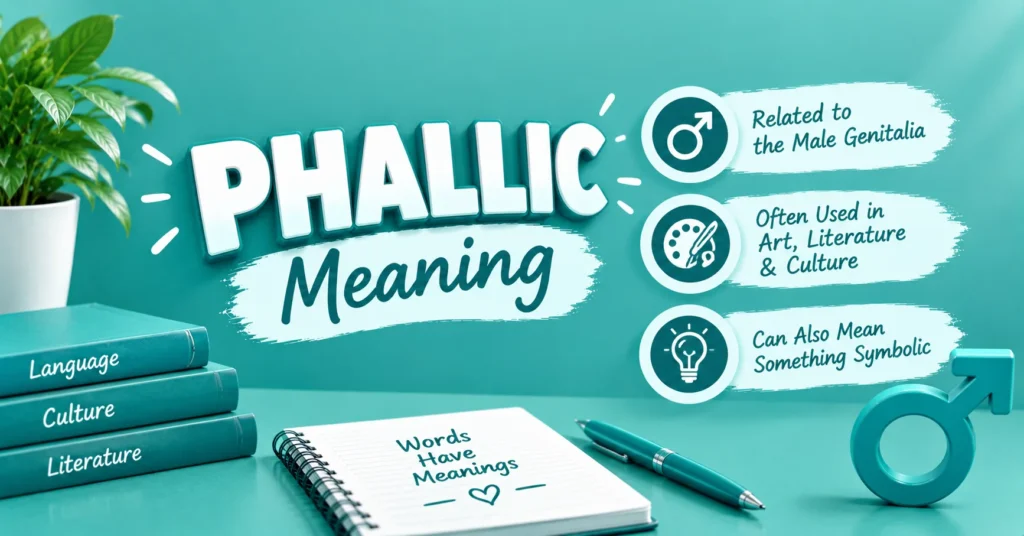
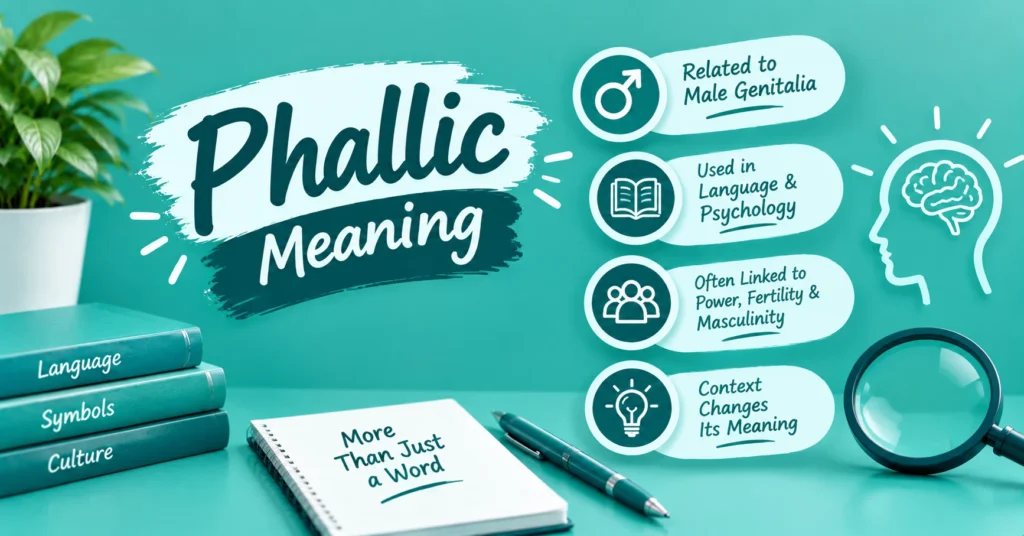
Phallic meaning refers to something that resembles, represents, or relates to a phallus, usually the penis. The word appears in anatomy, art, psychology, symbolism, architecture, literature, and everyday conversation. It can describe a phallic shape, phallic symbol, sexual imagery, or masculine symbolism without necessarily being vulgar.
If you have seen “phallic” in a text, meme, art discussion, or social-media comment and wondered whether it is slang, the answer is no. It is a formal English adjective whose tone changes with context. Understanding its definition, symbolism, psychology, and modern usage makes the word much easier to interpret accurately.
Phallic Meaning Explanation
At its simplest, phallic meaning describes something resembling or representing the male sexual organ. The term can refer to physical shape, symbolic imagery, masculine power, fertility, or sexual symbolism. A person might call a sculpture, building, object, or design phallic because of its appearance or cultural interpretation.
The word is not automatically obscene. In art criticism, psychology, literature, and cultural studies, “phallic” can be a neutral analytical description. In casual conversation, however, it is often used humorously when an object looks suggestive. The surrounding sentence, audience, and tone determine how the observation should be understood.
Is “Phallic” Slang or an Acronym?
Phallic is not an acronym, abbreviation, or modern texting shortcut. It is an adjective derived from the concept of the phallus and is used in formal subjects such as psychology and art as well as informal online conversations. Calling something “phallic” usually describes resemblance or symbolism rather than creating a secret code.
Anatomical Reference
In an anatomical context, phallic relates directly to the phallus or male genital organ. Dictionaries distinguish this adjective from phallus, the noun referring to the organ or an image representing it. The adjective therefore modifies another noun, as in “phallic structure,” “phallic imagery,” or “phallic symbol.”
Symbolic Usage
A phallic symbol goes beyond physical resemblance. It can represent masculinity, fertility, generative power, sexuality, authority, or dominance depending on the cultural setting. Importantly, an elongated object is not automatically a phallic symbol; interpretation depends on context, intention, convention, and how viewers understand the imagery.
Phallic Across Different Platforms
Online, phallic meaning usually remains the same, but its tone can change dramatically. A TikTok comment may use the word for a joke about an unusual shape, while an Instagram art discussion may use it analytically. In a private message, the same adjective may sound playful, suggestive, or awkward.
This difference matters because digital communication removes facial expression and vocal tone. Someone saying that a building, logo, food, or sculpture looks phallic may simply be making an observation. Reading the entire conversation rather than one word helps reveal whether the speaker is joking, criticizing, flirting, or discussing symbolism.
Phallic Meaning on Snapchat
On Snapchat, “phallic” may appear in casual reactions to objects with an unmistakably suggestive shape. A message such as “That building looks phallic” usually comments on visual resemblance rather than using a special Snapchat definition. The platform changes the tone, not the basic dictionary meaning.
Phallic Meaning on TikTok
On TikTok, phallic can appear in comments about unusual architecture, food, sculptures, logos, plants, or other visually suggestive objects. The usage is often humorous because viewers collectively notice a resemblance. Still, the term can also appear in educational or artistic discussions where the tone is more analytical.
Phallic Meaning on Instagram
Instagram usage varies with the content. Under an architecture post, “phallic” may describe a visual design or symbolic interpretation. Under a meme, it may simply be a joke. Art, photography, fashion, and cultural-analysis accounts can also use the adjective in a more formal sense.
Phallic Meaning on WhatsApp
On WhatsApp, context is especially important because private conversations can be intimate, sarcastic, professional, or playful. If someone calls an object phallic, they may be commenting on its appearance. If the conversation is romantic or sexual, the same word may carry a more suggestive tone.
Phallic Meaning: Tone & Context Variations
Phallic meaning does not change completely with tone, but the implication can. In a classroom, it may be an academic term. In a meme, it may be a joke. In art criticism, it can identify symbolism. In casual conversation, it can sound cheeky or suggestive. Context prevents overinterpretation.
A useful rule is to ask what the speaker is actually describing. If they mention a sculpture, tower, logo, cactus, or piece of architecture, the word probably refers to visual resemblance or symbolism. If the surrounding conversation is explicitly sexual, the adjective may carry a more direct sexual implication.
Funny Tone
A humorous use often happens when someone notices an unexpected resemblance. For example, “I can’t unsee how phallic that sculpture looks” is likely observational humor. The speaker is not necessarily making a serious psychological claim. The joke comes from recognizing a shape that resembles male anatomy.
Academic Tone
In academic writing, phallic can be completely neutral. Art historians, literary critics, psychologists, and cultural researchers may use terms such as phallic symbolism or phallic imagery when analyzing representations of sexuality, masculinity, fertility, or power. The context makes the terminology analytical rather than insulting.
Sarcastic Tone
Sarcasm can turn a neutral description into a joke or criticism. Someone might say, “Very subtle definitely not phallic,” while looking at an obviously suggestive design. The literal vocabulary remains the same, but irony changes the intended message. Recognizing sarcasm is therefore essential when interpreting online conversations.
Phallic Meaning: Grammar & Language Role
From a grammar perspective, phallic is an adjective. It describes a noun rather than functioning as the name of the object itself. Common combinations include phallic symbol, phallic imagery, phallic shape, phallic representation, and phallic symbolism. The noun phallus has a different grammatical role.
Knowing this distinction makes the word easier to use naturally. Saying “The sculpture is phallic” describes its perceived quality, while “The sculpture represents a phallus” makes a more direct statement about representation. The first focuses on an adjective; the second uses a noun and a verb.
Part of Speech
Phallic is an adjective meaning related to, resembling, or representing a phallus. It commonly appears before nouns, as in “phallic imagery” or “phallic structure.” It can also follow linking verbs, as in “The design looks phallic.” Its grammatical role remains descriptive.
Sentence Role
The adjective modifies or describes another concept. For example, “The artist used phallic imagery” identifies the type of imagery, while “The sculpture appears phallic” describes its perceived form. This makes phallic especially useful in analytical writing where shape, symbolism, and interpretation need to be described precisely.
Formal vs Informal Usage
The word works in both formal and informal settings, but the surrounding language should match the audience. Academic writing may discuss phallic symbolism, psychoanalysis, or cultural representation. Casual users may simply say something “looks phallic.” In professional environments, context determines whether the word is appropriate.
Phallic Meaning: Origin & Internet Culture
The word phallic has an old linguistic history rather than being an invention of social media. Oxford traces it to the Greek phallikos, from phallos. The related noun phallus entered English much earlier. Over time, the adjective developed uses in anatomy, symbolism, psychology, art, and cultural criticism.
Internet culture has made the word more visible in everyday conversation. Memes and comment sections frequently use “phallic” when people notice suggestive shapes in architecture, food, logos, sculptures, or objects. That casual usage can make a formal academic term look like slang, even though its underlying meaning has not changed.
Phallic Meaning: Historical Context and Antiquity
Historically, phallic meaning was not limited to humor or sexual suggestion. In several ancient cultures, representations of the phallus could be connected with fertility, protection, reproduction, vitality, or religious practice. Archaeological evidence shows that phallic imagery could have positive or protective meanings rather than simply representing erotic behavior.
Roman examples are especially useful for understanding this distinction. Museum scholarship documents phallic-shaped amulets and related imagery used as protective symbols against the evil eye, while other ancient artworks connect phallic imagery with fertility and divine or generative themes.
Common Manifestations and Imagery
Phallic symbolism has been discussed in connection with architecture, tools, weapons, plants, animals, monuments, and artistic forms. However, calling an object phallic is an interpretation, not proof that its creator intended a sexual message. A tall structure can have practical architectural purposes while later viewers perceive symbolic resemblance.
The distinction is important because symbolic analysis can become overly broad. Not every tower, column, tree, or elongated object is intentionally phallic. Strong interpretations require attention to historical context, artistic conventions, cultural evidence, and the object’s actual function.
Phallic Meaning: The Freudian Framework and Psychoanalysis
In psychology, phallic meaning has a specialized history through Freud’s theory of psychosexual development. The American Psychological Association describes Freud’s classical model as involving oral, anal, phallic, latency, and genital stages. The phallic stage is associated with early childhood and the Oedipal phase.
It is important to describe this as Freudian theory, not as an established modern scientific fact. Contemporary psychology does not simply treat every phallic image as evidence of unconscious sexual desire. The historical theory remains influential in psychoanalytic and cultural discussions, while many of its specific claims have been questioned or revised.
The Concept of Phallic Stage and Identity
Freud’s phallic stage occupies a particular place in his psychosexual-development theory. The APA describes the Oedipal phase as occurring during the later portion of this stage, generally around ages three to five. Modern readers should understand these ideas historically and theoretically rather than treating Freud’s original claims as universally accepted psychological findings.
Cultural and Cross-Cultural Significance
A phallic symbol can mean different things in different cultures. One society may associate a representation with fertility or protection, while another may interpret a similar shape through sexuality, authority, or humor. Museum collections demonstrate that historical phallic imagery sometimes carried religious, protective, or fertility-related meanings.
Critiques and Modern Reinterpretations
Modern scholarship often questions interpretations that automatically reduce every elongated object to male sexuality or unconscious desire. Cultural context matters. Feminist and other critical approaches have also challenged older theories that treated male anatomy as the universal center of symbolic power. Therefore, phallic analysis is strongest when evidence and context accompany the interpretation.
Phallic Meaning: Common Mistakes & Misunderstandings
One common mistake is assuming phallic meaning always means something explicitly sexual. The word can describe physical resemblance, artistic symbolism, psychological theory, cultural imagery, or casual humor. Another mistake is treating “phallic” as slang. It is a standard adjective that happens to have both academic and informal uses.
A second mistake is assuming that anything tall, narrow, or cylindrical must be a phallic symbol. Shape can inspire an interpretation, but symbolism depends on context. A careful explanation distinguishes between something that merely resembles a penis and something deliberately used as a phallic symbol.
| Term | Basic meaning | Typical context |
| Phallic | Related to, resembling, or representing a phallus | Art, psychology, everyday description |
| Phallus | Penis or representation of a penis | Anatomy, symbolism, cultural studies |
| Phallic symbol | Object interpreted as representing a phallus | Art, literature, culture |
| Phallic stage | Freudian psychosexual-development concept | Psychoanalysis |
| Yonic | Relating symbolically to female genitalia or reproductive imagery | Symbolism, art, cultural studies |
The key takeaway is simple: phallic meaning depends on context. In everyday online conversation, it often describes a suggestive shape. In academic writing, it can refer to symbolism, psychoanalysis, fertility, masculinity, or cultural representations. Understanding the setting prevents both underreading and overreading the word.
If you encountered “phallic” in a text message, comment, meme, artwork description, or psychology lesson, you can usually understand it by asking one question: Is the speaker describing a shape, discussing symbolism, or talking about sexuality? That distinction usually reveals the intended meaning.
Conclusion
Understanding the phallic meaning becomes easier when you look at how the term is used in different contexts. It generally describes something associated with the shape, symbolism, or representation of the penis, and it can appear in psychology, art, literature, culture, and everyday conversation. The meaning may be literal in some situations or symbolic in others, depending on the subject being discussed.
Freud’s use of the term also gave it a specific place in psychoanalytic theory, particularly when discussing childhood development. Because the word can carry different meanings, context is important when interpreting it. Knowing that context helps you understand the term accurately without assuming that every use has the same meaning.
FAQs
Author

Ethan Carter is an SEO blogger specializing in internet slang, text abbreviations, and social media meanings. He creates clear, accurate, and reader-friendly content backed by thorough research. His goal is to help readers understand modern online language with reliable, easy-to-read guides.




One Comment