
Insufferable Meaning: Definition, Examples & Easy Guide
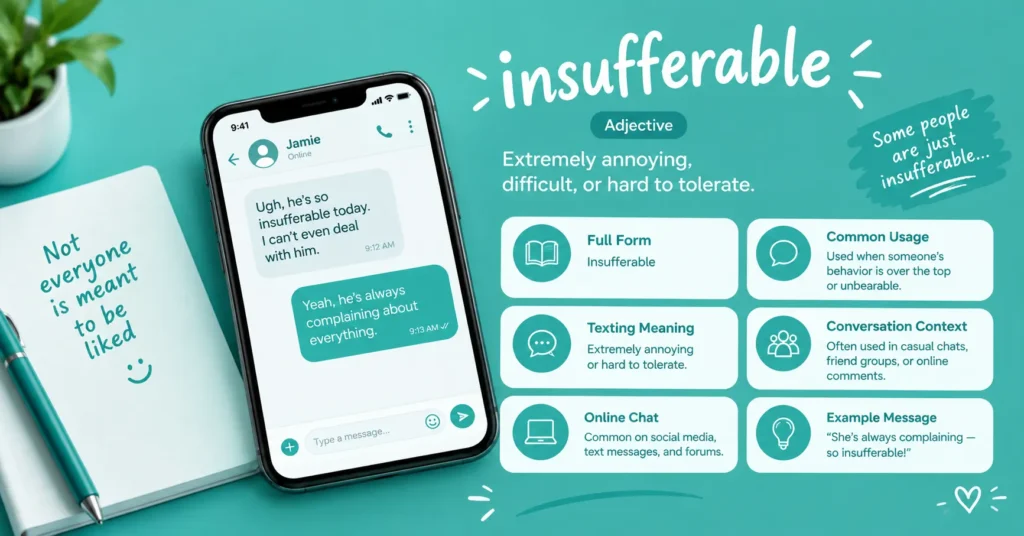
Insufferable meaning is “extremely unpleasant, annoying, or difficult to tolerate or endure.” The word can describe a person, behavior, experience, condition, or situation that feels beyond ordinary annoyance. Common related terms include unbearable, intolerable, unendurable, annoying, arrogant, and unpleasant. Dictionaries also commonly connect it with expressions such as an insufferable bore or insufferable heat.
If you have ever wondered whether calling someone “insufferable” means merely annoying or something much stronger, the distinction matters. As someone who regularly studies how English words work in real communication, I find this word especially useful because its emotional force depends on context. This guide explains the definition, American usage, word origin, related forms, and natural examples so you can use it confidently.
Meaning of insufferable in English
The simplest insufferable meaning is something that is too unpleasant, irritating, uncomfortable, or difficult to bear. It can describe a person who is exhausting to be around, but it can also describe heat, noise, pain, conditions, behavior, or another experience that has become extremely difficult to tolerate.
For example, saying “The summer heat was insufferable” means the heat was more than merely uncomfortable. Likewise, “He became insufferable during the meeting” suggests that his behavior was so irritating or unpleasant that tolerating it became difficult. The word therefore expresses a high degree of annoyance or intolerance, rather than an ordinary complaint.
In everyday English, insufferable meaning often carries a strong emotional reaction. Someone might be called insufferable because they constantly brag, interrupt, act superior, or refuse to listen. A situation can also become insufferable when repeated frustration pushes someone beyond their normal patience.
The word is an adjective, so it modifies a person, thing, behavior, condition, or experience. You can say “an insufferable person,” “insufferable behavior,” “insufferable noise,” or “an insufferable situation.” Its flexibility is one reason it appears in both conversational and formal writing.
Insufferable in American English
In American English, the insufferable meaning centers on something that is not to be endured, intolerable, or unbearable. Dictionary.com gives the American pronunciation as approximately /ɪnˈsʌfərəbəl/, while Collins also identifies an American English form.
Americans may use the word for both people and situations. For instance, “Her constant bragging is insufferable” focuses on behavior, while “The traffic was insufferable this morning” focuses on an unpleasant experience. The surrounding noun or situation tells the reader exactly what has crossed the speaker’s tolerance threshold.
The tone is usually strong and negative. Calling someone annoying can describe a relatively minor irritation; calling that person insufferable suggests the irritation has become much harder to tolerate. This difference is especially important in workplace, friendship, and family conversations, where word choice can affect how harsh a statement sounds.
In casual American conversation, the word can also be used humorously or dramatically. A friend might complain about “insufferable humidity” during a hot day without making a serious accusation. Context determines whether the word sounds genuinely hostile, exaggerated, playful, or simply descriptive.
Definition of insufferable
The dictionary definition of insufferable meaning describes something or someone as extremely unpleasant or annoying and therefore difficult to bear. Collins similarly explains the word through the ideas of being very unpleasant or annoying, while its American definition connects it with being intolerable or unbearable.
A useful way to understand the word is to imagine a limit of tolerance. Something mildly annoying remains below that limit. Something insufferable has crossed it. That is why the word feels stronger than ordinary descriptions such as irritating, bothersome, or inconvenient.
The word can describe physical experiences as well. Extreme heat, unbearable noise, unpleasant conditions, or persistent discomfort may all be described as insufferable when the speaker considers them exceptionally difficult to endure. Cambridge provides examples involving heat and uncomfortable conditions.
It can also describe personality or conduct. Expressions such as insufferable bore, insufferable arrogance, and insufferable insolence show how naturally the adjective connects with behavior that others perceive as excessively unpleasant, self-important, tedious, or disrespectful.
Insufferable and unbearable
Unbearable and insufferable meaning overlap significantly, but their tone can differ. Unbearable often describes an experience, condition, pain, or emotional burden that is extremely difficult to endure. Insufferable frequently carries an additional sense of strong irritation, especially when describing a person’s behavior or personality.
For example, “The pain was unbearable” sounds natural because the focus is physical suffering. “His arrogance was insufferable” focuses more on the speaker’s reaction to someone’s conduct. The two words can sometimes replace each other, but the context determines which sounds more precise.
Derived Forms of Insufferable
The word insufferable meaning has related grammatical forms that help expand its use. Collins lists insufferableness as a noun and insufferably as an adverb.
| Form | Part of speech | Example |
| insufferable | adjective | His attitude is insufferable. |
| insufferably | adverb | She was insufferably rude. |
| insufferableness | noun | The insufferableness of the situation was obvious. |
The most useful form in everyday writing is insufferable itself. The adverb insufferably describes the manner in which something happens: “He was insufferably arrogant.” Here, the word modifies arrogant and emphasizes the extreme degree of the behavior. Cambridge gives similar examples involving dullness, confidence, and rudeness.
The noun insufferableness is much less common in ordinary conversation. If you’re writing naturally for a general U.S. audience, it will usually be clearer to use the adjective or adverb instead of forcing the noun form into a sentence.

Word Origin of Insufferable
The insufferable meaning becomes easier to remember when you understand its origin. Collins dates the word to approximately 1525–1535 and analyzes it as in- + sufferable. Dictionary.com similarly records the first appearance in the 1525–35 period.
The deeper linguistic connection is with the idea of suffering, bearing, or enduring. Oxford traces the word through French to the Latin sufferre, meaning to endure or bear. In other words, the basic concept behind the word is something that cannot comfortably be endured.
This history explains why the modern word works in several contexts. If something cannot be endured because it is physically uncomfortable, emotionally exhausting, or intensely irritating, insufferable can communicate that extreme reaction.
Understanding the root also makes related words easier to remember. Suffer, sufferable, insufferable, unbearable, and unendurable all revolve around the broader concept of experiencing or tolerating something. The modern adjective simply emphasizes the point at which tolerance has effectively run out.
Explanation of Insufferable
A practical explanation of the insufferable meaning is: so unpleasant, irritating, arrogant, or uncomfortable that you feel you cannot tolerate it anymore. That is why the word works for both people and situations. Vocabulary.com similarly explains it through things that are unacceptable or too much to handle.
Imagine a coworker who constantly interrupts everyone, takes credit for other people’s work, and refuses to listen. You might describe that behavior as annoying. But if the pattern becomes persistent and exhausting, insufferable communicates a much stronger reaction.
Now imagine a different situation: you’re sitting in a room with broken air conditioning during an unusually hot afternoon. Saying “It’s warm” is mild. Saying “The heat is insufferable” communicates that the discomfort has reached an extreme level.
This distinction helps explain why the word can feel powerful. Insufferable does not simply identify something you dislike; it emphasizes the degree to which you believe it cannot be tolerated.
It is also worth remembering that the word expresses the speaker’s judgment or reaction. Calling someone insufferable is not an objective diagnosis of their personality. It tells the listener how strongly the speaker experiences that person’s behavior.
Insufferable vs. annoying
The difference between insufferable and annoying is mainly one of intensity and context. Something annoying bothers you, while something insufferable feels exceptionally difficult to tolerate. A noisy notification can be annoying; repeated arrogance, condescension, or unbearable behavior may lead someone to call a person insufferable.
That does not mean every annoying person is insufferable. The stronger adjective should be reserved for situations where the level of irritation, unpleasantness, or difficulty has genuinely become extreme. Using the stronger word carefully makes your communication more accurate and less exaggerated.
Examples of Insufferable
Real examples make the insufferable meaning much easier to recognize. Cambridge’s examples include uses involving unpleasant conditions, problems, behavior, and intense discomfort, demonstrating that the adjective isn’t restricted to describing people.
Describing a person
- “My new coworker is becoming insufferable.”
- “His constant bragging was insufferable.”
- “She can be insufferable when she refuses to listen.”
- “Everyone found his smug attitude insufferable.”
These examples suggest more than simple annoyance. The speaker feels that the person’s behavior has become extremely difficult to tolerate.
Describing behavior
- “Her insufferable arrogance made the conversation uncomfortable.”
- “His insufferable attitude ruined an otherwise pleasant meeting.”
- “The constant interruptions became insufferable.”
Here, the adjective focuses on conduct rather than the person’s entire identity. That can sometimes make the sentence more precise because it identifies the particular behavior causing the frustration.
Describing situations or conditions
- “The heat became insufferable by late afternoon.”
- “The noise was almost insufferable.”
- “The traffic was insufferable after the accident.”
- “Working in those conditions became insufferable.”
Collins and Cambridge both demonstrate that the word can naturally describe heat, conditions, problems, and other experiences, not only people.
Describing something humorous or exaggerated
In informal conversation, someone might jokingly say:
“This humidity is absolutely insufferable.”
The speaker may genuinely dislike the humidity, but the dramatic adjective can also add humor. English speakers often use strong adjectives this way, especially when complaining about everyday inconveniences.
Example Sentences for Insufferable
The best way to understand insufferable meaning is to see how the word behaves in complete sentences. Current dictionary examples show uses involving people, conditions, attitudes, and experiences, confirming that its semantic range is broader than a simple synonym for “annoying.”
Here are original examples written for everyday U.S. English:
| Context | Example sentence | Meaning |
| Person | “He became insufferable after winning the argument.” | His behavior became extremely irritating. |
| Personality | “Her constant need to be right is insufferable.” | Her behavior is very difficult to tolerate. |
| Heat | “The heat inside the car was insufferable.” | The temperature was extremely uncomfortable. |
| Noise | “The construction noise became insufferable.” | The noise was almost impossible to tolerate. |
| Workplace | “His condescending attitude made him insufferable to work with.” | His behavior was extremely unpleasant. |
| Experience | “The wait became insufferable after three hours.” | The delay became extremely difficult to endure. |
| Humor | “This humidity is insufferable.” | The speaker is strongly complaining about the humidity. |
| Writing | “The character was intentionally written as insufferable.” | The character was designed to be extremely irritating. |
Current published examples collected by Dictionary.com also show the adjective being used for people, entertainment, experiences, and behavior, illustrating its continuing use in contemporary English.
Quick vocabulary comparison
| Word | Typical strength/context |
| Irritating | Causes annoyance |
| Annoying | Bothers or frustrates you |
| Unpleasant | Not enjoyable or agreeable |
| Obnoxious | Extremely unpleasant or offensive |
| Intolerable | Cannot reasonably be tolerated |
| Unbearable | Extremely difficult to endure |
| Insufferable | Extremely unpleasant, irritating, or difficult to tolerate |
The words overlap, but insufferable is particularly useful when you want to communicate a strong sense of personal frustration or intolerance. Cambridge lists impossible, intolerable, unbearable, and unendurable among its synonyms.
Conclusion
The word “insufferable” describes someone or something that is extremely difficult to tolerate, often because of annoying, unpleasant, or frustrating behavior. It can refer to a person’s attitude, constant complaining, arrogance, or even a situation that feels unbearable. While the word is usually negative, its meaning depends on the context and tone in which it is used.
Understanding “insufferable” can help you recognize whether someone is simply being irritating or whether the situation has genuinely become hard to endure. When using the word yourself, consider your tone carefully, as it can sound quite harsh. Choosing clearer, more specific words can often communicate your feelings without unnecessarily offending someone.
FAQs
Author

Ethan Carter is an SEO blogger specializing in internet slang, text abbreviations, and social media meanings. He creates clear, accurate, and reader-friendly content backed by thorough research. His goal is to help readers understand modern online language with reliable, easy-to-read guides.