
20+ Powerful & Amazing Undulating Kiss Meaning: The Surprising Truth You Need to Know
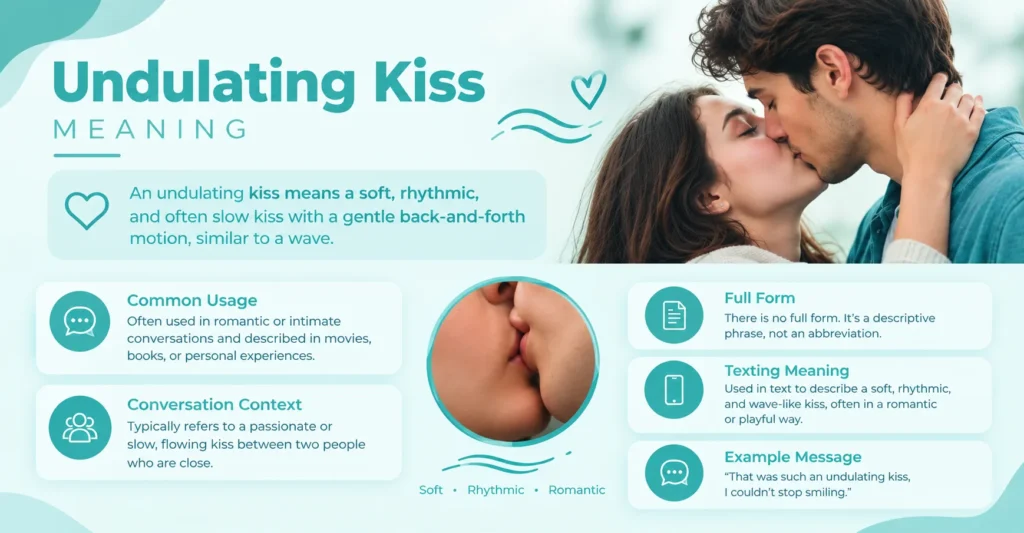
If you searched this because you saw “undulating kiss meaning” in a caption, a story, or a TikTok comment and had no idea what it meant you’re not imagining things. It’s not in any dictionary as a fixed term, and it isn’t a technique with an official name in relationship psychology. It’s an informal, descriptive phrase: a kiss where the lips move in a slow, wave-like rhythm instead of staying still, and it’s caught on because it’s a vivid way to describe a very real, very common kissing style.
Here’s the short answer, then the full picture: an undulating kiss meaning describes a slow, flowing kiss where the lips press, release, and press again in a soft rhythm like a gentle wave rather than one static motion. It’s descriptive language borrowed from poetry and nature writing, not a clinical or historical term, and understanding where it actually comes from makes the whole concept much less confusing.
Where the Word “Undulating” Actually Comes From
“Undulate” comes from the Latin undulatus, meaning wave-like, from unda (“wave”). It entered English in the 1600s to describe anything that rises and falls smoothly ocean swells, rolling hills, sound waves, even fabric moving in the wind. It has nothing to do with romance on its own; it’s a physics-and-nature word first.
What happened with “undulating kiss” is a much more recent, informal pairing. Someone applied that pre-existing descriptive word to kissing because the rhythm genuinely resembles a wave a rise, a fall, a repeat. The phrase then spread online in two overlapping waves: first through romance and fan-fiction writing, where authors reach for evocative, sensory language to describe intimacy without being clinical, and later through TikTok relationship content, where AI-generated video summaries and caption tools have repeated variations of the phrase across dozens of unrelated clips until it started to feel like an established term everyone already knew.
Worth knowing if you’re trying to actually understand it, not just search for it: you won’t find “undulating kiss” in a dictionary, a sex-education resource, or academic writing on kissing (the scientific term for kissing behavior is “osculation,” and even that doesn’t have wave-based subcategories). That doesn’t make the phrase meaningless it just means it’s slang-adjacent and descriptive, not clinical or historical.
Why Describing Kisses This Way Isn’t New
Reaching for movement-based, nature-inspired language to describe physical intimacy is actually a very old writing habit, even if this specific phrase isn’t. Romance literature has long borrowed words from water, weather, and motion “swept up,” “melted into,” “waves of feeling” because plain physical description (lips touching lips) doesn’t capture the emotional experience people are actually trying to communicate.
“Undulating” fits neatly into that same tradition: it’s a word that describes motion and rhythm, which is exactly what’s hard to put into words about a slow, responsive kiss. So while “undulating kiss” as an exact phrase is a recent, internet-driven coinage, the impulse behind it using wave imagery to describe tenderness has literary roots that go back much further than any single viral post.
What It Actually Feels Like
Strip away the poetic framing and it’s a specific, learnable rhythm rather than a mysterious concept:
- The lips stay soft rather than firm, pursed, or rigid
- Contact isn’t constant, even pressure it’s a cycle of gentle press, slight release, and press again
- The pace is slow and deliberate, never rushed
- It typically stays lip-to-lip rather than open-mouthed
- Both people are actively responding to each other’s movement, not just one person leading and the other following passively
The sensation people describe is closeness and unhurried intimacy. It reads as tender rather than urgent or passionate in the high-intensity sense, which is part of why it consistently gets described in soft, romantic language instead of intense language. It’s also why people say it “feels different” from other kisses the variation in pressure keeps the nervous system more engaged than a single static press would, since lips are one of the most nerve-dense, sensation-rich parts of the body.
The Physical Side: Why the Rhythm Feels More Intense
There’s a simple physiological reason a wave-like rhythm feels more noticeable than a static kiss. Lips have an unusually high concentration of nerve endings and blood vessels compared to most skin, which is why they’re so sensitive to pressure, temperature, and texture changes. A kiss held at one constant pressure gives the brain a single, steady signal that fades from attention fairly quickly this is basic sensory adaptation, the same reason you stop noticing a ring on your finger after a while.
Varying the pressure and motion, the way an undulating kiss does, keeps re-triggering that sensory response instead of letting it fade, which is part of why people describe it as feeling more sustained, more noticeable, and more emotionally present than a kiss that doesn’t change.
Undulating Kiss vs. Other Common Kiss Styles
| Kiss Type | Pace | Mouth Position | What It Signals |
| Peck | Fast, brief | Closed lips | Casual affection, greeting |
| Undulating kiss | Slow, rhythmic | Closed or barely parted | Tenderness, unhurried intimacy |
| French kiss | Faster, more open | Open-mouthed, tongue involved | Passion, heightened intensity |
| Lingering kiss | Slow, static | Closed, held in place | Emotional pause, reassurance |
| Forehead kiss | Slow, brief | N/A (lips to forehead) | Comfort, protectiveness |
The main distinction people ask about is undulating vs. French kissing: a French kiss is defined by open-mouth tongue contact and a generally faster pace, while an undulating kiss is defined by motion the wave-like press-and-release and doesn’t require tongue involvement at all. The two aren’t mutually exclusive; some couples blend the rhythm of an undulating kiss into a slower, more open kiss, but the “undulating” part specifically describes the rhythm, not the mouth position.
How People Describe Doing It
If you’re trying to understand the mechanics rather than just the definition, here’s the pattern people consistently describe across relationship writing and social content:
- Start slow. Let the first contact be light rather than firm the whole style loses its point if it starts intense.
- Let the lower lip lead slightly, with the upper lip following a beat behind. This small offset is what actually creates the “wave” sensation, rather than a flat, uniform press.
- Ease off the pressure instead of holding it static, then press again. The release is just as important as the press it’s the alternation that reads as rhythmic rather than just soft.
- Pay attention to whether your partner is matching the rhythm. This only reads as intimate when it’s mutual; one person doing a deliberate technique while the other isn’t engaged just feels mismatched.
- Keep checking in, especially the first time. A quick pause, a smile, or simply slowing down together is a normal and healthy part of any physical intimacy comfort and mutual interest matter far more than getting a specific “technique” right.
- Keep it slow throughout. Rushing the rhythm collapses it back into an ordinary kiss; the pacing is the entire point of the style.
A Few Common Mistakes
Because the phrase is often described in vague, poetic terms, people trying it out sometimes overcorrect in ways that undercut the effect:
- Too much pressure throughout. If the “press” never fully releases, it just becomes a firm, static kiss rather than a rhythmic one.
- Moving too fast. The wave motion needs space to actually register; rushed lip movement reads as normal kissing, not something distinct.
- Ignoring the other person’s response. The rhythm is meant to be built together. If one partner is doing all the “work,” it stops feeling mutual and starts feeling performative.
- Treating it like a rigid formula. It’s a descriptive style, not a script the goal is a relaxed, responsive rhythm, not hitting specific steps in order.
Why the Phrase Is Suddenly Everywhere
Search interest in this exact phrase tracks almost entirely with TikTok, where AI-generated video summaries and caption tools have been repeating variations of “undulating kiss meaning” across dozens of unrelated clips, including multi-language versions in Urdu and Tagalog that don’t appear connected to any single original video. This is useful context if you landed here confused: the phrase isn’t from a specific movie, song, or long-standing cultural tradition.
Its recent spike in visibility is largely an artifact of AI-generated social content recirculating the same descriptive phrase, which then fed a wave of near-identical “meaning” blog posts trying to capture that search traffic. That’s not a knock on the concept itself wave-like, rhythmic kissing is a real, describable, and pleasant experience it’s just useful to understand why the phrase suddenly feels like something everyone else already knew about.
Conclusion
Understanding the undulating kiss meaning can help explain a kissing style that feels gentle, rhythmic, and expressive rather than simply being about the kiss itself. The word “undulating” suggests a smooth, wave-like movement, so the term is often used to describe a kiss with a flowing or changing rhythm. Like many kiss-related expressions, its meaning can vary depending on the context and the people involved.
What matters most is that any form of affection should feel comfortable, mutual, and respectful. If you come across the phrase online, consider the surrounding conversation before assuming one fixed definition. Clear communication and personal boundaries always make intimate moments more meaningful.
FAQs
Author

Ethan Carter is an SEO blogger specializing in internet slang, text abbreviations, and social media meanings. He creates clear, accurate, and reader-friendly content backed by thorough research. His goal is to help readers understand modern online language with reliable, easy-to-read guides.

One Comment