
What Does TYSM Mean? TYSM Full Form Explained
The TYSM full form is “Thank You So Much” a texting abbreviation you’ve probably seen in a DM, a comment, or a group chat and had to pause and Google. If you just typed “tysm full form” into search because someone sent it to you and you didn’t want to ask, you’re not alone, and you’re about to get a straight answer.
I’ve spent years writing about digital communication and casual internet abbreviations, and TYSM is one of the friendliest ones out there no hidden meaning, no sarcasm by default, just gratitude with a little extra warmth baked in. This guide covers exactly what it means, where it’s appropriate, and what to say instead when a text message needs to sound more professional.
What Does TYSM Mean?
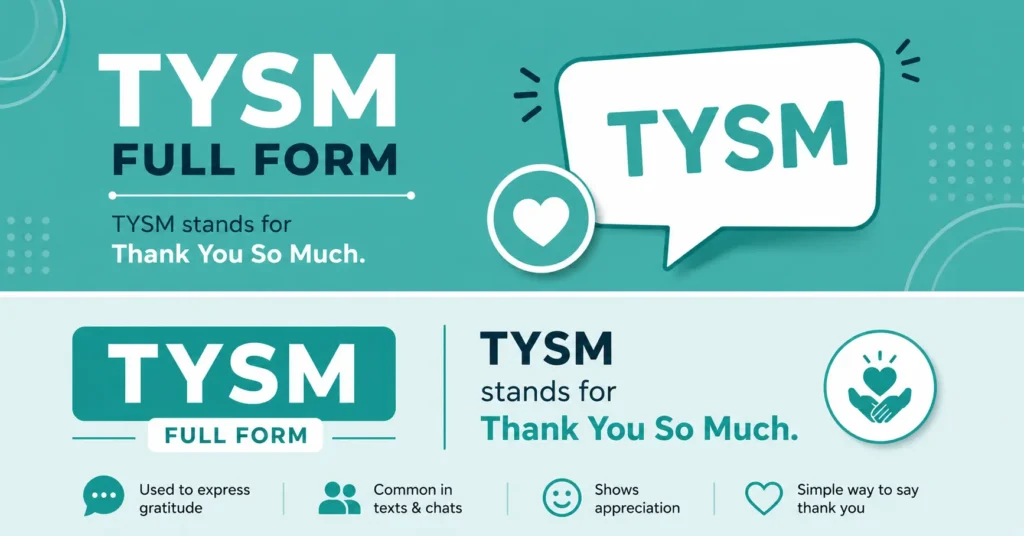
TYSM stands for “Thank You So Much.” It’s a texting abbreviation and internet abbreviation used across nearly every messaging app and social media platform to express gratitude quickly, without typing the full phrase out every time. Unlike some slang terms, TYSM doesn’t have alternate or hidden meanings the full form is fixed and universally understood.
You’ll see it written as TYSM, tysm, or even tysmmm for extra emphasis. It sits in the same family as TY (“thank you”) and TYVM (“thank you very much”), but tysm full form carries more warmth and enthusiasm than either. In digital communication, that small difference in tone matters more than people expect.
Where Is TYSM Commonly Used?
tysm full form shows up almost everywhere casual conversation happens online. It’s common in text messages, Instagram comments, TikTok replies, WhatsApp chats, Snapchat responses, Discord servers, and Facebook posts basically any platform where quick, informal social media exchanges are the norm.
Gamers use it in Discord and in-game chat after a teammate helps out; creators use it on TikTok and Instagram to thank followers; friends use it in WhatsApp threads after a favor. The chat slang travels well because the meaning never changes from platform to platform only the tone around it does.
Is TYSM Polite?
Yes, tysm full form is considered polite and friendly in nearly every casual context. It’s often seen as warmer and more enthusiastic than a plain “thanks,” which is exactly why it spread so fast among younger texters and social media users who wanted their gratitude expression to feel a little more genuine.
That said, politeness in texting slang is context-dependent. Pair TYSM with an eye-roll emoji or send it after something clearly annoying, and the tone flips toward sarcasm. Without that signal, though, TYSM reads as sincere, casual, and appreciative never rude on its own.
When Should You Use TYSM?
Tysm full form works well in casual conversation: thanking a friend for a favor, replying to a compliment on social media, appreciating a gift, or acknowledging a teammate’s help in a group chat. It’s built for speed and warmth, not formality, and that’s exactly where it shines.
Good moments to use it include birthday message replies, thanking followers for support, responding to advice from a friend, or wrapping up a casual text exchange. If the relationship is informal and the setting is digital, TYSM almost always lands well.
When Should You Avoid TYSM?
Skip TYSM in formal settings: job applications, business emails, academic writing, legal documents, or professional customer communication. In these contexts, an abbreviation reads as too casual, even if the sentiment behind it is genuine professional communication has different formality expectations than a text message.
Instead, use the full phrase: “Thank you so much,” “Thank you for your assistance,” or “I sincerely appreciate your help.” These sound identical in meaning to TYSM but match the tone a formal email or workplace conversation requires.
Examples of TYSM In A Sentence
Seeing TYSM in real exchanges makes the tone easier to read than a definition alone. Here’s a friend helping another after a problem: “I don’t have the exact answer, but here’s a link that helped me.” Response: “Oh, TYSM!” That’s a textbook casual conversation use quick, warm, sincere.
Another common pattern: “I picked up your package while you were out.” Reply: “TYSM! I owe you one.” Or after receiving birthday wishes on social media: “TYSM everyone, this made my day 💖.” In every case, TYSM replaces a longer thank-you without losing any warmth.
TYSM vs Thank You: Which Sounds Better?
Context decides the winner here, not one being objectively “better.” TYSM fits texting and social media, where fast, informal replies dominate it feels natural among friends, followers, and casual online communities, especially with Gen Z and younger millennials.
“Thank you” or “Thank you so much” written out in full suits emails, professional communication, and any setting where a text message would feel out of place. Neither wins universally; matching the abbreviation (or its full form) to the setting is what actually signals good texting etiquette.
11 Excellent Alternatives to TYSM
Relying on TYSM in every message can start to feel repetitive. These alternatives cover the same gratitude expression with different levels of formality and emotional tone.
Thank You So Much
The full, spelled-out version always appropriate, and slightly more sincere-sounding in writing than the abbreviation, especially in a first message to someone new.
I Truly Appreciate It
A warmer, more formal option for professional communication. Works well in a work email or when replying to a colleague who went out of their way to help.
Thanks a Ton
Casual and upbeat a good fit for friends or relaxed workplace chat slang without sounding stiff or overly formal.
Many Thanks
Sits between formal and casual. Common in professional thank-you messages and customer service replies where brevity still matters.
I’m Grateful
Adds emotional depth beyond a quick thanks better suited to moments that genuinely moved you, not routine exchanges.
Much Appreciated
Efficient and respectful, a favorite in workplace email and messaging tone where you want warmth without excess formality.
Appreciate It / Appreciate You
Modern, laid-back, and sincere increasingly common in American casual conversation and social media replies.
TYSM In Other Languages
Gratitude expressions exist in every language, even if the internet abbreviation itself is specific to English texting slang. Knowing a few equivalents adds useful context for anyone communicating across cultures or curious about how “thank you so much” translates elsewhere.
Spanish uses “Gracias,” French uses “Merci,” and Italian uses “Grazie.” Japanese speakers say “Arigato” (or the more formal “Domo Arigato”), Chinese speakers say “Duō xiè,” German uses “Danke sehr,” and Thai uses “Khop Khun Mak Kha.” None of these have a texting-abbreviation shorthand quite like TYSM that clipped, emphatic style is largely an English-language digital communication habit.
Conclusion
Understanding the TYSM full form makes texting and online conversations much easier. TYSM simply means “Thank You So Much,” and it is commonly used to express genuine appreciation in a quick, casual way. You may see it in texts, social media comments, chats, and other online conversations. While it has a friendly and informal tone, the meaning is straightforward and positive.
Knowing common abbreviations like TYSM can help you understand messages without confusion and respond naturally. Whether someone uses TYSM after a small favor or to show heartfelt gratitude, the message is usually warm and appreciative. So, the next time you see TYSM, you’ll know it’s simply a quick way of saying thanks.
FAQs
Author

Ethan Carter is an SEO blogger specializing in internet slang, text abbreviations, and social media meanings. He creates clear, accurate, and reader-friendly content backed by thorough research. His goal is to help readers understand modern online language with reliable, easy-to-read guides.




2 Comments