
OTP Meaning: What Does OTP Stand For? (2026 Guide)
You get a text with a six-digit code and no idea why. Or a friend says “they’re my OTP” and you’re lost. Same three letters, completely different meaning and which one applies depends entirely on where you saw it.
This guide covers every common meaning of OTP, how to tell them apart in seconds, and because OTP scams are a real and growing problem in 2026 how to keep your codes from ending up in the wrong hands.
The Short Answer
OTP most often means One-Time Password: a temporary code used to verify your identity when logging in, paying, or recovering an account.
The second most common meaning, especially in fandom spaces and casual texting, is One True Pairing a fictional (or sometimes real) couple someone strongly supports.
A few other meanings show up occasionally: “On the Phone” in casual texts, and “Off-Topic” in forums and comment threads.
The context tells you which one is meant here’s how to read it.
How to Tell Which OTP Someone Means
Look at the surrounding words, not the acronym itself.
| If the conversation mentions… | OTP likely means |
| Login, verification, code, bank, account, phone number | One-Time Password |
| Characters, ship, fandom, couple, series, romance | One True Pairing |
| “I’m OTP right now,” “can’t talk, OTP” | On the Phone |
| Forum threads, Reddit, off-subject replies | Off-Topic |
Quick examples:
- “Enter the OTP sent to your phone to confirm the transaction.” → One-Time Password
- “Those two are absolutely my OTP.” → One True Pairing
- “Sorry, I’m OTP with my mom, text you later.” → On the Phone
- “This reply is OTP but I had to mention it.” → Off-Topic
OTP Meaning #1: One-Time Password
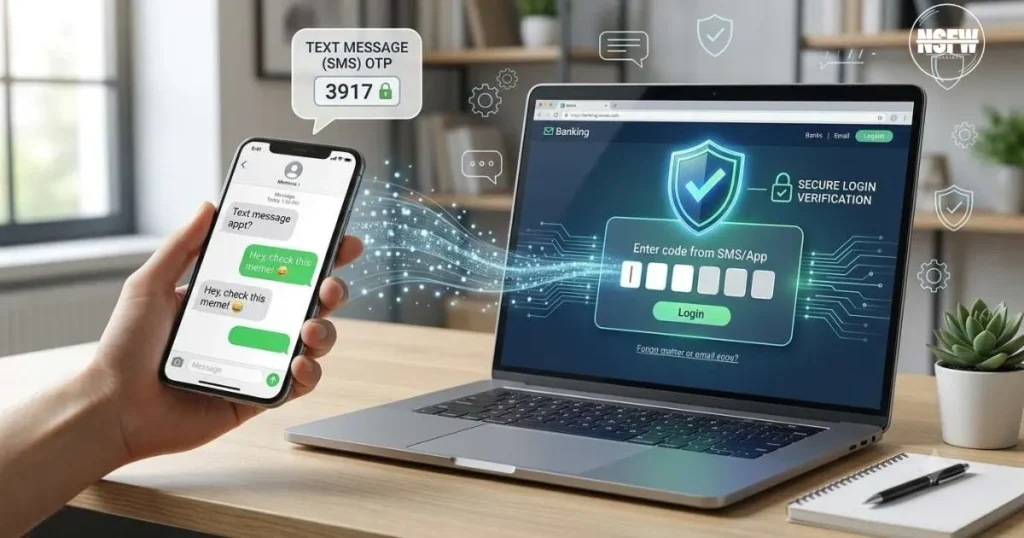
A One-Time Password is a short-lived security code usually four to eight digits sent to confirm you’re really the person trying to log in, pay, or recover an account. Unlike a regular password, it’s designed to be used once and expire quickly, often within minutes.
You’ll typically receive an OTP through:
- Text message (SMS)
- An authenticator app (Google Authenticator, Authy, etc.)
- An automated phone call
- A dedicated hardware token
Why services use them: a password alone can be guessed, reused across sites, or leaked in a data breach. An OTP adds a second, time-limited layer so even someone with your password can’t get in without also having your phone or authenticator app.
You’ll run into OTPs most often with banking apps, email providers, social media logins, e-commerce checkouts, and account recovery flows.
OTP Meaning #2: One True Pairing
In fandom spaces fans discussing TV shows, movies, anime, books, or games OTP stands for One True Pairing: the couple a fan supports above all others, real or fictional.
“They have the best chemistry, they’re my OTP” means the speaker is emotionally invested in that pairing, not talking about security at all.
This usage is especially common on social platforms, fan forums, and in comment sections under clips or fan art.
Two Less Common Meanings
“On the Phone.” In casual texting, some people shorten “I’m on the phone” to OTP e.g., “can’t talk, OTP with work.” This is informal and mostly generational; context (a mid-conversation excuse rather than a security or fandom topic) gives it away immediately.
“Off-Topic.” In forums, subreddits, and comment threads, OTP occasionally flags a reply that’s drifting from the main discussion functionally similar to “OT” in older internet slang.
Is an OTP the Same as a Password?
No they solve different problems.
| Regular Password | One-Time Password | |
| Lifespan | Permanent until changed | Expires in minutes, often seconds |
| Reuse | Used repeatedly | Single use |
| Set by | You | Generated automatically by the service |
| Purpose | Primary login credential | Extra verification step |
Think of an OTP as a second lock on top of your regular password, not a replacement for it.
OTP Scams Are Rising in 2026 — Here’s What to Watch For
This is the part most “OTP meaning” guides skip, and it’s arguably more useful than the definition itself.
OTP interception and social-engineering scams have grown into a significant fraud category. Cybersecurity researchers tracking 2026 fraud trends report that global telecom fraud losses reached over $41 billion in 2025, with SMS-based fraud attempts climbing sharply through the year — much of it tied to abuse of verification and OTP delivery systems rather than actual code-cracking (source: Prelude security research, 2026). Separately, fraud-tracking firms have flagged OTP-related scams as a leading cybercrime category in several regions, particularly schemes that trick victims into voluntarily reading a code back to a scammer posing as bank or delivery support (source: SQ Magazine fraud statistics, 2026).
Interestingly, not all the trend lines point the same way: some cities have reported year-over-year declines in classic OTP phishing as fraudsters shift toward more elaborate scams like fake investment schemes or impersonation calls suggesting OTP theft tactics are evolving rather than disappearing (source: Deccan Herald, citing Bengaluru cybercrime data, 2024–2025).
A quick self-check before you ever share a code:
- Did you initiate the action (login, payment, password reset) yourself? If not, don’t enter or share the code.
- Is someone on the phone or in a chat asking you to read the code back to them? Legitimate banks and services never ask for this.
- Did the request come through a link in an unexpected text? Don’t tap it go to the official app or website directly instead.
- Are you being rushed or pressured? Urgency is one of the most common manipulation tactics in these scams.
If you receive an OTP you didn’t request, don’t act on it contact the company directly through its official app or verified phone number.
Conclusion
OTP has two main lives: a security code (One-Time Password) and an internet slang term for a favorite couple (One True Pairing) with “On the Phone” and “Off-Topic” showing up occasionally. Context is the only reliable way to tell them apart. And if you’re ever asked toshare one out loud to a stranger, that’s the one time the “meaning” doesn’t matter the answer is no.
FAQs
Author

Ethan Carter is an SEO blogger specializing in internet slang, text abbreviations, and social media meanings. He creates clear, accurate, and reader-friendly content backed by thorough research. His goal is to help readers understand modern online language with reliable, easy-to-read guides.

One Comment