

Decoy Meaning: 15 Powerful Examples and the Surprising Truth Behind This Word
The decoy meaning is a person, object, or action used to attract attention, mislead someone, or draw a person or animal away from the real target. In everyday English, a decoy can be a fake target, a distracting plan, or an artificial bird used by hunters. The word is closely related to bait, lure, distraction, and diversion, although each has a slightly different emphasis. Understanding the definition of decoy helps readers recognize the word in conversations, news reports, sports commentary, mystery stories, and other everyday situations.
The word can describe something harmless, strategic, or deliberately deceptive, depending on the context. For example, a football player might make a decoy run to create space for a teammate, while a hunter might use a duck decoy to attract waterfowl. Dictionary references from Cambridge, Collins, and Oxford recognize these central meanings. This guide explains the pronunciation, grammatical forms, synonyms, word origin, and practical examples so you can understand exactly what someone means when they use the term.
Decoy Meaning and Definition
A decoy meaning is something or someone used to attract attention, influence another person’s actions, or divert attention from the real objective. It may resemble the thing someone expects to find, or it may simply create a distraction. The central idea is that the decoy draws attention away from what would otherwise be the main focus.
Imagine that a store manager notices someone watching the front entrance while another person approaches a different exit. If the first person is intentionally drawing attention away from the second, they may be described as a decoy. The term does not always mean something is fake; it describes the role that a person, object, or action plays in a plan.
In simple English, a decoy is something used to distract, attract, or mislead. Its purpose might be to create an opportunity, conceal a real intention, or encourage a target to move in a particular direction. The word can therefore apply to a physical object, a person, a movement, or a planned action.
The word often carries a suggestion of deception because the decoy may not be the real target or may not represent the true purpose of a situation. However, its tone depends on context. A decoy in a sports play is usually a tactical move, while a decoy used to lure someone into danger may have a negative meaning.

Decoy Meaning in American English
In American English, decoy commonly refers to a person or object that attracts attention or leads someone toward a particular place, sometimes to mislead them. Another familiar meaning is an artificial bird or animal used to attract wildlife. These senses appear in major American English dictionary entries.
For example, a news report might describe a vehicle as a decoy if it was used to divert attention from another vehicle. In hunting, a wooden or plastic duck placed near a pond may be called a duck decoy. Both uses share the same basic idea: something attracts the attention of a target.
The word is useful in ordinary conversation because it explains the purpose of an action without requiring a long description. Someone might say, “That meeting was a decoy,” meaning the meeting distracted people from the real activity. The surrounding sentence determines whether the speaker means a deliberate trick, a tactical distraction, or a harmless diversion.
American dictionaries also record specialized meanings in fields such as military strategy, aviation, and security. A decoy device can misdirect attention or confuse a detection system. In each case, the intended effect is more important than the particular form of the decoy.
Decoy Meaning as a Noun and Verb
The word decoy can function as both a noun and a verb. As a noun, it identifies the person, object, or action being used to attract or mislead a target. As a verb, to decoy means to lure or lead a person or animal somewhere, often through distraction or deception.
Consider the sentence, “The team used a decoy.” Here, decoy is a noun because it names the tactic or person. In “The team tried to decoy the defenders,” the word functions as a verb because it describes the action of drawing the defenders away from the intended play.
The verb can appear in several grammatical forms. The simple present is decoy; the third-person singular is decoys; the past tense and past participle are decoyed; and the present participle is decoying. These forms let writers describe the strategy across different time frames.
- Present: The player uses a decoy run.
- Past: The driver decoyed the pursuers.
- Continuous: The team is decoying the defenders.
- Past participle: The animals were decoyed toward the feeding area.
Using the right grammatical form makes a sentence more precise. When naming a distraction, use the noun. When describing the act of luring or redirecting attention, use the verb. This distinction is particularly helpful for English learners and writers who encounter the word in sports reporting or formal news writing.
Decoy Meaning in Sentences and Everyday Usage
Seeing the word in context makes its meaning easier to remember. A decoy usually has a purpose: attracting attention, creating confusion, encouraging movement, or drawing someone away from a more important target. The following examples show how the same word works in everyday communication, sports, security, and wildlife contexts.
- Everyday conversation: “The surprise announcement was a decoy to keep everyone focused on the wrong issue.” The announcement distracts people from the real subject.
- Sports: “The forward made a decoy run, allowing her teammate to move into open space.” The movement draws defenders away from the player who will receive the ball.
- Security: “Investigators used a decoy vehicle during the operation.” The vehicle helped redirect attention.
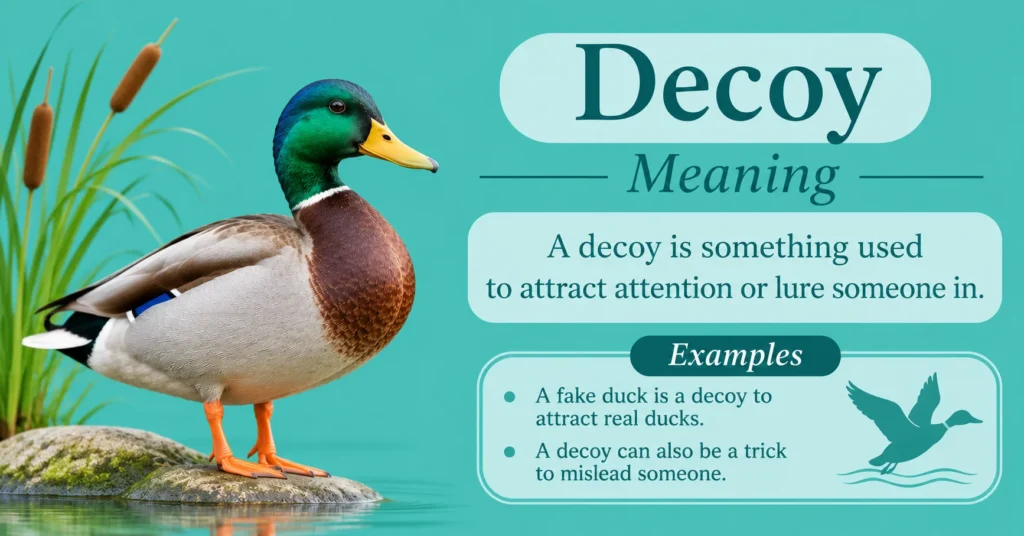
- Wildlife: “The hunter placed a duck decoy on the water.” The artificial bird was intended to attract real ducks.
- Mystery fiction: “The suspicious letter turned out to be a decoy.” The letter was designed to distract readers or investigators from the real clue.
- Business: “The flashy promotion was a decoy that distracted customers from the additional fees.” The promotion drew attention away from another detail.
In each example, the exact situation changes, but the central meaning remains consistent. Something is being used to draw attention or influence behavior. The word does not automatically establish whether the tactic is legal, ethical, successful, or harmful; those judgments require more information about the situation.
When interpreting decoy in a sentence, ask three questions: What is attracting attention? Who or what is being redirected? What is the real target or objective? Those questions usually reveal the intended meaning without needing a complicated definition.
Decoy Meaning, Synonyms, and Related Words
The closest synonyms for decoy include lure, bait, distraction, diversion, and enticement. These words overlap, but they are not interchangeable in every sentence. A decoy is often a person or thing used for a specific purpose, while its synonyms emphasize different parts of the process.
| Word | Main emphasis | Example |
| Decoy | A person or thing used to mislead or redirect attention | The vehicle was a decoy. |
| Bait | Something used to attract a target | The fisherman prepared bait. |
| Lure | Something that draws a person or animal toward something | The light acted as a lure. |
| Distraction | Something that takes attention away | The noise was a distraction. |
| Diversion | An action or event that redirects attention or activity | The announcement served as a diversion. |
| Trap | A device or situation designed to catch someone or something | The offer turned out to be a trap. |
| Enticement | Something attractive that encourages action | The discount was an enticement. |
The difference between bait and decoy is particularly useful. Bait attracts a target by offering something appealing, such as food. A decoy may attract attention by resembling something familiar or by serving as a distraction. A decoy can also be a person or a planned movement, whereas bait is more commonly something that tempts a target.
A distraction does not necessarily involve deception. A ringing phone may distract someone accidentally, while a decoy is generally employed for a particular purpose. Similarly, a trap is intended to catch or confine a target, whereas a decoy may only redirect attention or movement.
There is no single antonym that works in every context. Depending on the sentence, words such as truth, reality, original, or genuine target may express the opposite idea. For example, “The object was genuine, not a decoy” makes the contrast clear without forcing an unnatural one-word antonym.
Decoy Meaning in Hunting and Wildlife
In hunting and wildlife contexts, a decoy is a real animal, an artificial model, or another object used to attract birds or other animals. Duck decoys are a familiar example: hunters place realistic-looking models in or near water to encourage wild ducks to approach. Similar techniques may be used to observe wildlife or manage animal movement.
Decoys can vary in shape, material, movement, and realism. Some are carved from wood, while others are made from plastic or other materials. Their effectiveness depends on factors such as placement, the behavior of the target species, surrounding conditions, and whether the object looks convincing from the animal’s perspective.
The wildlife meaning is important because it shows that a decoy is not always a person pretending to be someone else. It can be an ordinary physical object whose appearance or placement attracts a target. In this sense, the decoy functions as a visual signal rather than as a spoken lie.
The same principle appears outside hunting. A realistic model can attract an animal, a dummy object can redirect attention, and a simulated target can be used in training. The common thread is the use of something to influence where a target looks or moves.
Decoy Meaning in Strategy and Deception
In strategy, a decoy is used to make an opponent focus on something other than the real objective. This can occur in military planning, security operations, sports, games, and storytelling. The decoy may be a person, a movement, a vehicle, a false target, or an event that creates an opportunity elsewhere.
In a team sport, for example, one player may run toward a defender to create space for a teammate. The first player is acting as a decoy even if the movement is part of a perfectly legitimate play. The tactic works because the opponent reacts to the apparent threat rather than anticipating the actual direction of the attack.
In a mystery story, a red herring and a decoy can serve similar purposes by drawing attention away from the true explanation. However, red herring often describes misleading information or a clue, while decoy can refer to the person or object used to create the distraction. The terms overlap without having precisely the same meaning.
Decoys can also appear in cybersecurity and electronic defense. A decoy system or resource may be deployed to draw malicious activity away from a real asset or help security teams observe suspicious behavior. These technical uses extend the everyday concept into digital environments, where the objective is to redirect or detect activity rather than attract a physical person.
The ethical meaning depends on how the strategy is used. A decoy in a game may be harmless, whereas a decoy used to lure a person into danger can be harmful or unlawful. Understanding the context is essential before deciding what the word implies about the person or action involved.
Decoy Meaning and Word Origin
The word decoy has a historical connection to Dutch de kooi, meaning “the cage.” English dictionaries trace its development to a term associated with enclosures used to lure wild birds. Over time, the word developed a broader meaning for people, objects, and actions used to attract or mislead a target.
Historical accounts associate the word’s English use with the early seventeenth century. Early uses referred to a person who enticed others into a trap, while later meanings included objects and strategies used to attract game or divert attention. The precise history is nuanced, so the Dutch connection is best presented as the commonly cited explanation rather than an oversimplified certainty.
The word’s evolution helps explain why its modern meanings span hunting, military strategy, sports, security, and ordinary conversation. In each setting, the idea of drawing a target toward a particular place or away from the true objective remains recognizable.
Learning a word’s origin can make it easier to remember, but the present-day context should guide interpretation. A modern reader does not need to know the full history to understand that a decoy is something used to attract or mislead. The historical background simply adds depth to the definition.
Conclusion
The decoy meaning centers on attracting attention, misleading a target, or drawing someone or something away from the real objective. A decoy might be an artificial duck used in hunting, a player making a distracting run, a vehicle used in an operation, or a misleading detail in a mystery story.
The most useful related words are lure, bait, distraction, and diversion. Remember that a decoy is not necessarily a physical object or a harmful trick; its purpose depends on the situation. Once you recognize what is attracting attention and what the real objective is, you can understand the word in almost any context.
FAQs
Author

Ethan Carter is an SEO blogger specializing in internet slang, text abbreviations, and social media meanings. He creates clear, accurate, and reader-friendly content backed by thorough research. His goal is to help readers understand modern online language with reliable, easy-to-read guides.






One Comment