Vex Meaning: Definition, Examples, Origin & How to Use It
If you’re wondering vex meaning, the word generally means to annoy, irritate, trouble, worry, or frustrate someone. As an experienced language-content writer, I’ve found that words like vex can be confusing because their tone changes with context: it can sound literary in American English, natural in some regional varieties, or playful in online conversation. You may encounter it alongside words such as annoyed, irritated, frustrated, bothered, upset, and vexed. This guide explains the definition, pronunciation, origin, word forms, examples, and modern usage so you can recognize exactly what someone means when they say they are vexed.
The simplest way to remember vex meaning is “to cause annoyance or trouble.” But the word can also describe worry, emotional distress, or something that leaves you puzzled. That broader range explains why learners sometimes struggle with it. Whether you found vex in a book, text, workplace message, or social-media post, this guide gives you the context needed to understand it without overcomplicating the vocabulary.
Vex Meaning Quick Definition
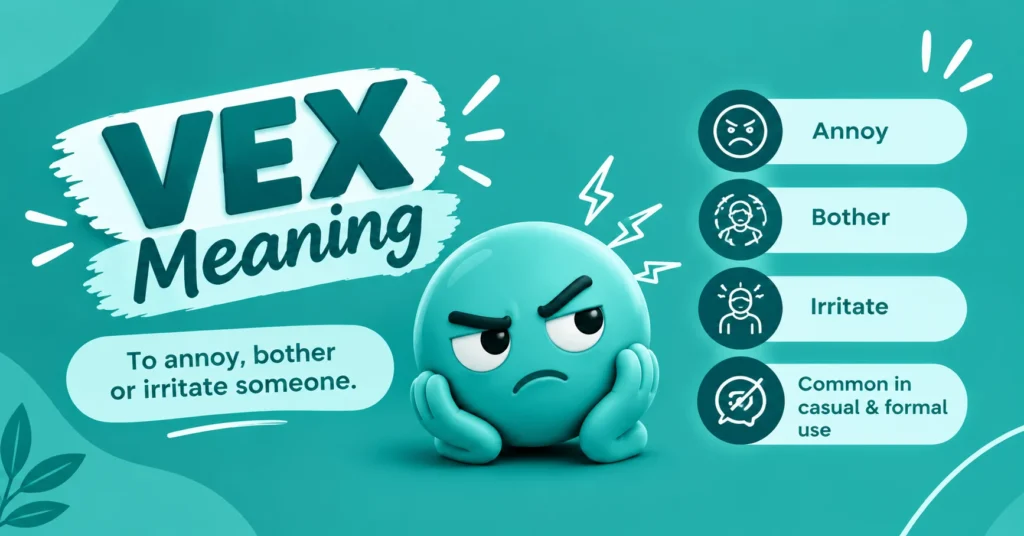
In simple English, vex meaning is to annoy, irritate, bother, trouble, or frustrate someone. If something vexes you, it gets under your skin or causes emotional discomfort. Related words include annoyance, irritation, frustration, worry, distress, and trouble. For example, repeated delays might vex a traveler, while an unusually difficult question might vex a student.
The word does not always indicate intense anger. Depending on context, being vexed can mean mildly irritated, seriously troubled, emotionally upset, or simply puzzled by something difficult. That flexibility is one reason the word appears in both formal writing and everyday expressions. In modern usage, vexed often communicates frustration without necessarily suggesting rage or hostility.
Vex Meaning: Definitions of Vex
Dictionary sources give vex several related meanings. It can mean to irritate or annoy, to trouble or distress, or to confuse or bewilder. Vocabulary.com also records senses involving prolonged discussion and agitation. These meanings connect through one central idea: something disrupts a person’s mental or emotional calm.
| Meaning | Simple explanation | Example |
| Annoy | Cause irritation | The constant noise vexed her. |
| Trouble | Cause difficulty or distress | The delay vexed the travelers. |
| Worry | Create concern | The uncertainty vexed him. |
| Confuse | Make something puzzling | The complicated question vexed the students. |
| Agitate | Disturb or stir | The disturbance vexed the situation. |
So, vex meaning depends partly on the sentence surrounding it. When the object is a person, it commonly means annoy or trouble them. When the object is a problem or question, it can suggest that the issue is difficult, confusing, or unresolved.
Vex Meaning: Origin & Background of the Word “Vex”
The history behind vex meaning is surprisingly old. Dictionary.com records the English word from late Middle English vexen, borrowed through Old French vexer from Latin vexāre. The Latin verb carried ideas including shaking, troubling, harassing, or disturbing. Over centuries, those physical and emotional ideas developed into the modern senses of annoyance and distress.
That history helps explain why vex can sound more formal than annoy or bother to many American English speakers. Older literature frequently used the word to describe emotional trouble or difficult circumstances. The word has never completely disappeared, however. Contemporary dictionary examples show vex, vexed, and vexing still appearing in modern journalism and general English.
Vex Meaning: Other Word Forms
Understanding the related forms makes vex meaning much easier to recognize. The main forms are vex, vexes, vexed, and vexing. The noun vexation refers to the state or experience of being annoyed or troubled, while vexatious describes something irritating or troublesome. Dictionary.com and Vocabulary.com both identify these related forms.
| Word form | Meaning | Example |
| Vex | To annoy or trouble | Don’t vex your brother. |
| Vexes | Present-tense third person | The delay vexes her. |
| Vexed | Past tense or emotionally annoyed | He was vexed by the decision. |
| Vexing | Causing annoyance or difficulty | It was a vexing problem. |
| Vexation | Annoyance or distress | The delay caused considerable vexation. |
| Vexatious | Irritating or troublesome | It became a vexatious issue. |
One especially useful expression is “a vexing problem.” Here, vexing does not simply mean annoying. It often means that the problem is difficult, puzzling, or frustrating to solve. That distinction is important when reading academic, professional, or journalistic English.
Vex Meaning: Pronunciation
The pronunciation of vex is straightforward: /vɛks/. It is one syllable and rhymes closely with words such as checks, decks, flex, and hex. Vocabulary.com and other dictionary references give the U.S. pronunciation as /vɛks/.
When speaking naturally, pronounce the vowel like the “e” in bed, followed by the /ks/ sound. Because vex is short and sharp, it can sound more forceful than longer synonyms such as irritate or frustrate. Learning the pronunciation is useful when you encounter the word in literature, classroom discussions, or formal conversation.
Vex Meaning: Example Sentences
Real examples make vex meaning easier to understand because context determines the emotional strength. Dictionary.com currently provides contemporary examples from publications such as the Wall Street Journal, Los Angeles Times, BBC, and other sources, demonstrating that vex remains an active English word rather than a purely historical term.
Here are some natural examples:
- The constant construction noise vexed the residents.
- The unanswered question continued to vex the researchers.
- Her repeated interruptions began to vex her coworkers.
- The confusing instructions vexed the students.
- The delay vexed travelers who had connecting flights.
- The unresolved mystery vexed the detective.
- That complicated problem is really vexing me.
- He looked vexed after hearing the unexpected news.
Notice that vex works especially well when the irritation lasts for some time or when a problem refuses to go away. It can therefore sound more nuanced than simply saying “I’m mad.” It often suggests that something has disturbed your peace of mind, patience, or ability to find an easy solution.
Vex Meaning: Usage of “Vex” in Different Contexts
The way people understand vex meaning changes according to context. In American English, the word can sound somewhat formal or literary, while dictionaries still recognize it as current usage. In casual digital communication, people may use vexed to describe ordinary frustration. Online examples can be playful, exaggerated, or emotionally expressive.
| Context | Likely meaning | Example |
| Everyday conversation | Annoyed or bothered | “That really vexed me.” |
| Workplace | Troubled or frustrated | “The repeated delays vexed the team.” |
| Academic | Puzzled or challenged | “The question vexed the students.” |
| Literature | Deeply troubled | “He was vexed by the news.” |
| Texting | Annoyed or frustrated | “I’m so vexed rn.” |
| Social media | Often playful frustration | “This app is vexing me today.” |
In a professional sentence, vex can sound polished: “The unresolved issue continues to vex the committee.” In a casual text, “I’m vexed” may simply mean “I’m annoyed.” The surrounding words, relationship between speakers, and communication platform help determine the intended tone.
Vex Meaning: Emotional & Psychological Meaning of “Vex”
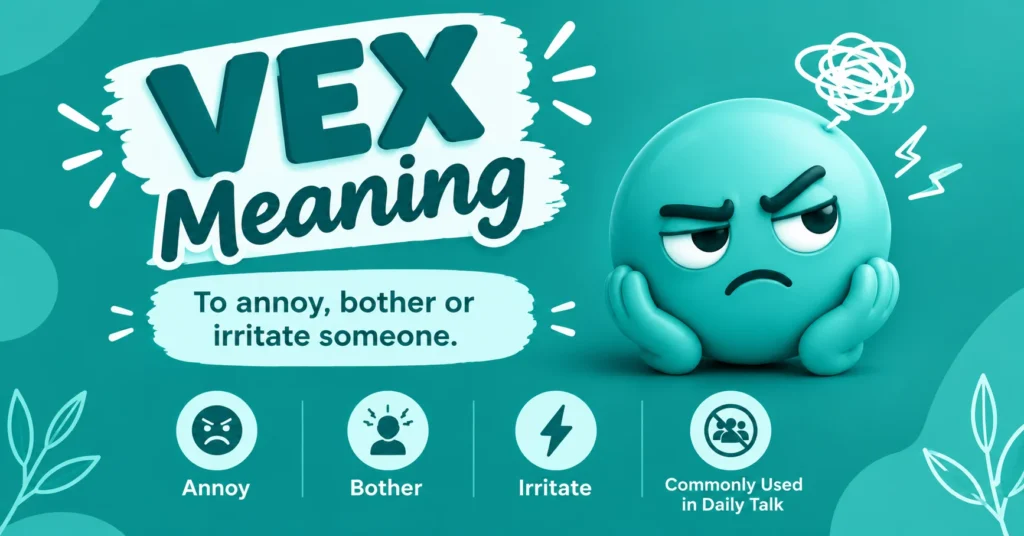
Emotionally, vex meaning often sits somewhere between simple annoyance and deeper frustration. A person who feels vexed may be irritated by repeated inconvenience, worried about an unresolved situation, or mentally tired from trying to solve a difficult problem. The word can therefore describe both an external annoyance and an internal emotional response.
Imagine someone repeatedly changing the deadline for an important project. The employee might not be furious, but the uncertainty could make them feel vexed, frustrated, worried, and mentally drained. Likewise, a student staring at a difficult equation might feel vexed because the answer remains just out of reach. In both situations, something has disturbed the person’s mental calm.
Vex Meaning: Regional & Cultural Usage of “Vex”
Regional usage adds an important layer to vex meaning. In contemporary American English, vex may sound formal, old-fashioned, or literary, although it remains in active use. Caribbean English is different: vex can be an ordinary everyday expression for being angry, annoyed, or irritated.
This difference matters when interpreting conversations. A Caribbean speaker saying “Don’t vex me” may be using completely natural everyday language rather than deliberately choosing an old-fashioned word. Lexistry describes vex as widespread across Caribbean English and links its continued use to older English vocabulary preserved in Caribbean varieties.
Conclusion
Understanding the meaning of “vex” can make the word much easier to recognize in everyday conversations, books, and formal writing. It generally describes a feeling of annoyance, irritation, or frustration, especially when something continues to bother you. Depending on the context, “vex” can sound more formal or old-fashioned than words like “annoy” or “bother.”
You may also come across the word in religious or biblical passages, where it can carry a deeper sense of distress or trouble. Knowing the context helps you understand the intended meaning. Whether you see “vex” in a message, conversation, or text, its core idea is usually about causing or experiencing irritation or distress.
FAQs
Author

Ethan Carter is an SEO blogger specializing in internet slang, text abbreviations, and social media meanings. He creates clear, accurate, and reader-friendly content backed by thorough research. His goal is to help readers understand modern online language with reliable, easy-to-read guides.