
7 Powerful Carom Meaning: Definition, Examples, Uses & Key Facts
Carom meaning is simple: it usually describes something striking a surface or another object and bouncing or rebounding, often at an angle. The word also has a specialized meaning in billiards and pool, where it can describe a particular shot. In researching modern dictionary usage, sports writing, cue sports, and everyday English, I’ve found that rebound, ricochet, bounce, deflect, and glance off capture its main semantic neighborhood.
The confusion usually comes from context. A sports announcer may say a ball caromed off the rim, while a billiards player may discuss a carom shot; someone else may write that a conversation “caromed” between subjects. This guide separates those meanings, explains carom pronunciation, billiards, pool, synonyms, carrom, cannon, and word origin, and gives practical examples so the word finally feels natural rather than mysterious.
Carom meaning at a glance
The simplest carom meaning is to strike something and rebound or bounce away, especially after changing direction. As a noun, it can describe the rebound itself or a billiards shot. As a verb, carom means to hit and rebound. Common nearby words include bounce, ricochet, rebound, deflect, and glance off.
Pronunciation varies slightly by dictionary and accent, but American English commonly gives a pronunciation close to KAR-um or KAIR-um. Grammatically, you may encounter carom, caroms, caromed, and caroming. The meaning becomes much clearer once you notice what is doing the hitting and what it rebounds from.
The word is especially useful when ordinary “bounce” feels too vague. If a puck strikes a post and shoots away, carom meaning highlights the impact and resulting change in direction. In sports writing, that compact meaning makes the word vivid without requiring a long explanation.
The simplest definition of carom
In everyday American English, carom meaning describes an impact followed by a rebound or deflection. A ball can carom off a wall, a puck can carom off a goalpost, or a vehicle can carom after hitting a barrier. Cambridge similarly defines the verb around hitting something and bouncing back, particularly at an angle.
The key idea is directional change after contact. A stationary object that is merely touched has not necessarily caromed. The word suggests movement, impact, and a subsequent change in trajectory. That’s why rebound, ricochet, bounce, deflection, and angle frequently appear near the term.
Simple examples
Consider these natural sentences: “The basketball caromed off the rim,” “The puck caromed off the post,” and “The ball caromed into the corner.” Each sentence describes contact followed by movement in another direction. Dictionary.com also provides contemporary examples involving balls, rebounds, walls, and sports plays.
You can also use the word beyond sports. A stone may carom across a hard surface, while an object may carom away after striking a barrier. In each case, the mental picture is similar: impact, rebound, and changed direction. That is the core sense to remember.
What does carom mean in billiards?
In billiards, the carom meaning becomes more technical. A carom can describe a shot in which the cue ball contacts two object balls in succession. Dictionary.com and Collins both identify this cue-sport meaning, while carom billiards uses the term within a broader family of pocketless-table games.
This differs from simply saying that a ball bounced. Here, cue ball, object balls, carom shot, billiards, cushion, and scoring form a specific semantic network. In traditional carom billiards, the successful contact sequence is part of how points are produced, making the word a technical term rather than ordinary sports vocabulary.
A beginner-friendly way to picture it
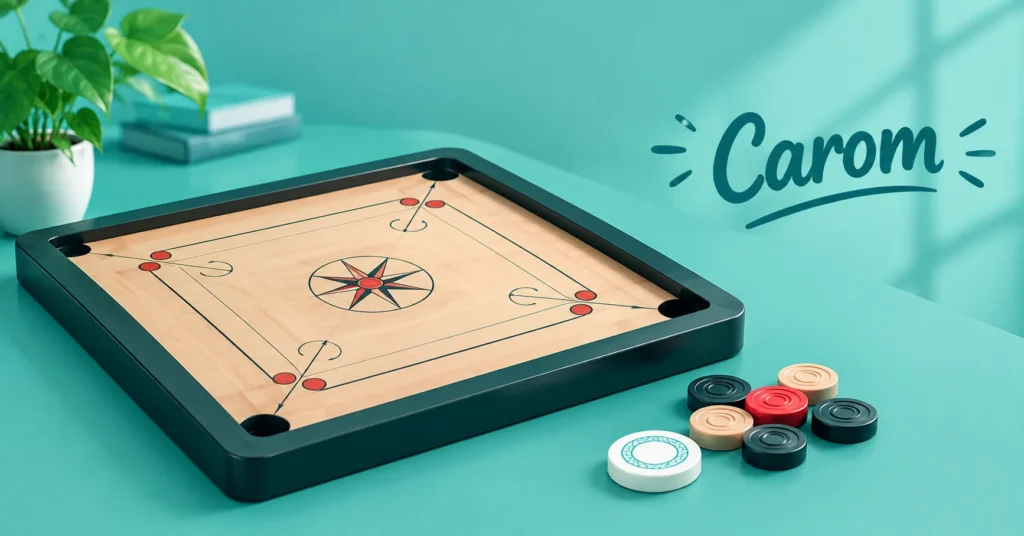
Imagine three balls on a billiards table. You strike the cue ball, it contacts one object ball, and then reaches the second object ball. That sequence illustrates the classic billiards sense of a carom. Collins describes the American usage as a shot where the cue ball successively hits two object balls.
The important distinction is that carom billiards is played on a table without pockets, unlike ordinary pocket billiards. Wikipedia identifies carom billiards as a family of cue sports and lists disciplines including straight rail, balkline, one-cushion, and three-cushion billiards.
What does carom mean in pool?
In pool, carom can be used more broadly than the specialized carom-billiards definition. Depending on the game and context, it may describe one ball contacting another before a pocket is reached. That makes pool, cue ball, object ball, combination shot, rebound, and contact relevant contextual terms.
The safest approach is to examine the sentence around the word. If the writer is describing ordinary movement, carom probably means bounce or rebound. If the sentence describes a cue-sport technique, it may refer to a particular shot or ball-to-ball contact. Context prevents a misleading one-definition-fits-all interpretation.
Carom can also be a verb
Yes, carom is commonly used as a verb. To carom means to strike something and rebound, often changing direction. Standard dictionary sources recognize forms such as caroms, caromed, and caroming.
For example, “The puck caromed off the post” means the puck hit the post and moved away. “The ball caromed off the backboard” describes a similar action. The verb is especially common in sports reporting, billiards writing, news descriptions, collision reports, and vivid narrative prose.
The verb can also be figurative. A conversation may “carom” from one subject to another, suggesting quick and somewhat unpredictable movement between topics. Cambridge specifically recognizes this broader sense of moving or changing between different places, things, or subjects.
Another meaning people often miss
A less obvious carom meaning involves figurative movement. Instead of describing a physical ball, writers can use carom to describe something moving rapidly between subjects, places, ideas, or situations. This extends the physical image of rebound, direction, movement, collision, and sudden change into abstract language.
For example, a story might “carom between comedy and tragedy,” or a conversation could “carom from sports to politics.” The meaning is not literal bouncing. Instead, the writer creates a picture of abrupt transitions. This usage is especially useful when ordinary words such as “switch” or “move” feel too flat.
Carom vs. carrom vs. cannon
These three terms can cause unnecessary confusion because they overlap historically or contextually but are not always used identically. Carom generally means rebound or a cue-sport shot; carrom is recognized as a variant spelling, while many people associate it specifically with the South Asian tabletop game; cannon is used for the billiards sense in British terminology.
| Term | Main meaning | Typical context |
| carom | Rebound, deflection, or cue-sport shot | American English, sports, billiards |
| carrom | Variant spelling; commonly associated with tabletop carrom | South Asian board-game context |
| cannon | Billiards term corresponding to a carom | British cue-sport usage |
| ricochet | Bounce or deflection after impact | General English |
| rebound | Move back after striking something | Sports and general English |
Carom
Carom is the spelling most relevant to the U.S. English focus of this article. It works as both a noun and a verb: a ball can make a carom, while another object can carom off a wall, rim, rail, or barrier. Dictionary.com and Collins both document these uses.
Carrom
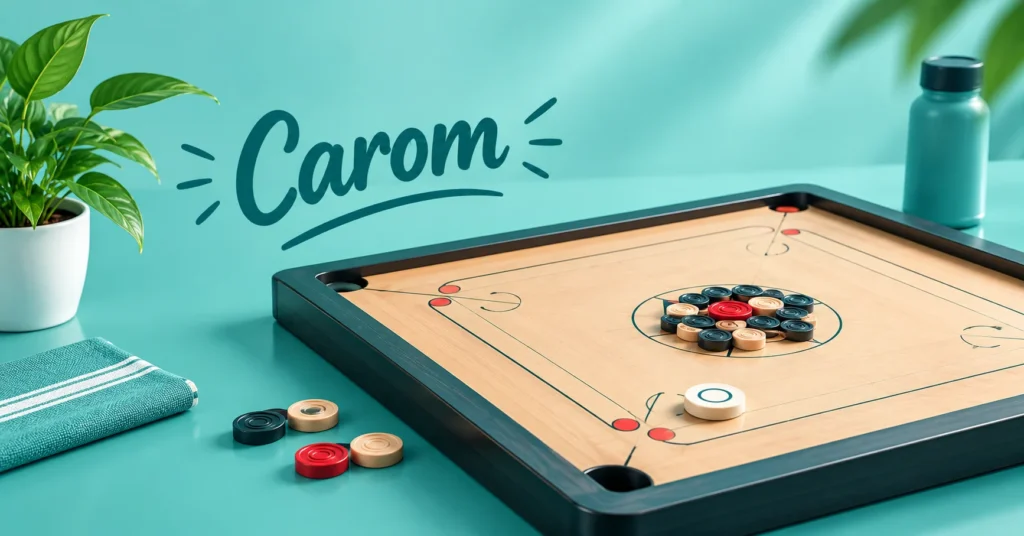
Carrom is a recognized variant spelling of carom, but modern everyday usage often uses the double-r spelling when discussing the tabletop game popular in South Asia. That game involves a board, striker, pieces, and corner pockets, making its context quite different from American billiards terminology.
This distinction matters for search intent. Someone typing “carom meaning” may be asking about the English word carom, while someone searching “carrom board” is probably looking for the tabletop game. The spellings overlap, but the surrounding entities usually reveal which meaning the person wants.
Cannon
Cannon is particularly important for British cue-sport terminology. Dictionary.com and Collins identify it as a term used in Britain and certain other countries for the billiards action represented by carom.
So an American reader may see carom, while a British cue-sports source may use cannon for a related technical meaning. This is a regional vocabulary difference rather than evidence that the two words are completely unrelated.
What does carom billiards mean?
Carom billiards refers to a family of cue sports played on tables without pockets. The basic objective involves using the cue ball to contact the object balls, with different disciplines adding different cushion or scoring requirements. Wikipedia lists straight rail, one-cushion, balkline, three-cushion, and artistic billiards among its disciplines.
Three-cushion billiards is particularly notable because the cue ball must contact cushions before reaching the required object ball. That gives the word carom a deeper technical context: it isn’t simply another word for pool. It belongs to a broader cue-sports vocabulary involving cue balls, object balls, cushions, scoring, tables, and angles.
For a beginner, the easiest distinction is this: pool normally involves pockets; carom billiards traditionally does not. That single difference helps explain why a page about carom meaning may lead into an entirely different branch of cue-sport terminology.
Word origin of carom
The word has a long history connected with billiards. Dictionary.com dates its origin to around 1770–80, describing it as arising through carambole, ultimately connected with Spanish carambola. Collins likewise traces the word through French carambole and Spanish carambola.
The exact deeper etymological story is more complicated than a simple one-line explanation. Wikipedia notes that sources differ on the proposed chain beyond carambole/carambola, and it cautions that some proposed connections to the tropical fruit may represent folk etymology rather than a proven historical pathway.
That uncertainty is worth preserving. A good word origin explanation should distinguish documented history from attractive theories. What is much more secure is the word’s long association with billiards and its later broader sense of striking and rebounding.
Common places people see the word carom
The word appears in several recognizable environments. Understanding those environments makes the carom meaning easier to identify without reaching for a dictionary every time.
1. Sports commentary
Sports broadcasters use carom when a ball or puck changes direction after contacting a rim, post, wall, defender, or another surface. Basketball, hockey, baseball, and soccer writing can all use the word when describing an unexpected rebound or deflection.
2. Billiards or pool
Cue-sport contexts use carom technically. Here, cue ball, object ball, shot, cushion, scoring, and billiards help establish that the word refers to a particular type of contact or shot rather than a random bounce.
3. General writing
Writers can use carom for vivid descriptions of sudden physical movement. A vehicle can carom off a barrier, while a ball can carom across a surface. The word creates a stronger sense of abrupt movement than the simpler verb “move.”
4. Searches for carrom board
People sometimes search for carom when they actually mean carrom, particularly when discussing the South Asian tabletop game. Dictionary sources recognize the spelling overlap, so the surrounding words are important when determining the intended meaning.
Common mistakes people make about carom meaning
One common mistake is assuming carom only means billiards. It does not. Dictionaries also define the word as a strike and rebound, and contemporary examples show it being used for sports and general movement.
Another mistake is assuming carom and carrom are always completely different words. Dictionaries recognize carrom as a variant spelling, although real-world usage often gives it a stronger association with the tabletop game. Context is therefore more reliable than spelling alone.
A third mistake is overlooking the figurative meaning. A sentence saying that a discussion “caromed from one subject to another” is not talking about a billiard ball. It uses the physical idea of sudden movement as a metaphor for rapid shifts, changing topics, and unpredictable transitions.
Finally, avoid assuming that every sport uses carom with precisely the same technical meaning. In ordinary sports writing it often means deflection or rebound, while billiards uses can be much more specialized.
Quick usage tips and synonyms for carom
Use carom when you want to communicate impact followed by a noticeable change in direction. Rebound is usually broader and more neutral; ricochet often emphasizes a sharp deflection; bounce is simpler and more conversational; and deflect focuses on the change in trajectory.
Natural examples include: “The puck caromed off the post,” “The ball caromed off the rim,” and “The conversation caromed from one topic to another.” In each case, the word creates an image of movement rather than merely saying that something changed position.
For formal or descriptive writing, carom can be especially effective because it is concise but visual. It is less common in everyday casual speech than bounce or rebound, yet it remains recognizable in American sports journalism, billiards terminology, and narrative writing. Dictionary examples show the word functioning naturally in contemporary sports contexts.
Conclusion
Understanding the carom meaning becomes easier when you look at how the word is used in different contexts. It can describe a billiards-style rebound, a shot in carom billiards, or the familiar tabletop game known as carrom, depending on the situation. Knowing these meanings helps you understand conversations, sports terminology, and references to the popular board game more clearly.
While the word may seem simple, its meaning can change based on context and region. Whether you came across it in a game, dictionary, or casual conversation, a little context usually makes the intended meaning clear. Keep that in mind, and you’ll be able to use and understand “carom” naturally.
FAQs
Author

Ethan Carter is an SEO blogger specializing in internet slang, text abbreviations, and social media meanings. He creates clear, accurate, and reader-friendly content backed by thorough research. His goal is to help readers understand modern online language with reliable, easy-to-read guides.




2 Comments