Slag Meaning: 15+ Surprising British Slang Uses You Should Know
The slag meaning depends on context: it can refer to waste left after metal processing or be an offensive British slang insult, usually directed at a woman. Understanding the difference helps you interpret the word accurately when reading messages, watching British television, or learning English. Major dictionaries recognize both meanings, but they belong to very different situations.
If you have encountered this word in a conversation and wondered whether someone was joking, criticizing another person, or discussing industrial materials, you are not alone. In this guide, we explain its British slang usage, American English meaning, pronunciation, word origin, related expressions, and practical examples. You will also learn why the expression can cause offense and how context helps you understand what the speaker actually means.
Slag Meaning in British Slang
In British English, slag is a derogatory slang term, commonly used to insult a woman by suggesting she has many sexual partners. It can also express general contempt. Dictionaries explicitly label this usage offensive, so it is not a neutral way to describe someone.
For example, if a character in a British drama calls another character a “slag,” the speaker is probably insulting or humiliating that person. The exact tone depends on the scene, but the term carries a sexualized, judgmental implication. It is safer to recognize the word when you hear it than to use it casually yourself.
Is slag a bad word?
Yes, when used as a personal insult, slag is generally considered offensive in British English. It can be especially hurtful when directed at women because it makes a derogatory judgment about their sexual behavior. Even if someone claims to be joking, the listener may not interpret it that way.
The word is not equally offensive in every context because it also has a legitimate industrial meaning. For example, discussing slag produced in a steel furnace is ordinary technical language. The distinction is straightforward: the subject and surrounding sentence determine which meaning applies.
What does slag mean when referring to a woman?
When used about a woman, the word usually implies that the speaker considers her sexually promiscuous or holds her in contempt. This is an insult, not a factual description of the person’s character or private life. Its use can reinforce unfair sexual stereotypes.
Suppose someone says, “He called her a slag after the party.” This sentence reports an insult; it does not prove anything about the woman. Recognizing that difference is important when interpreting gossip, arguments, online comments, and dialogue in British films.
Slag Meaning in American English and Metalworking
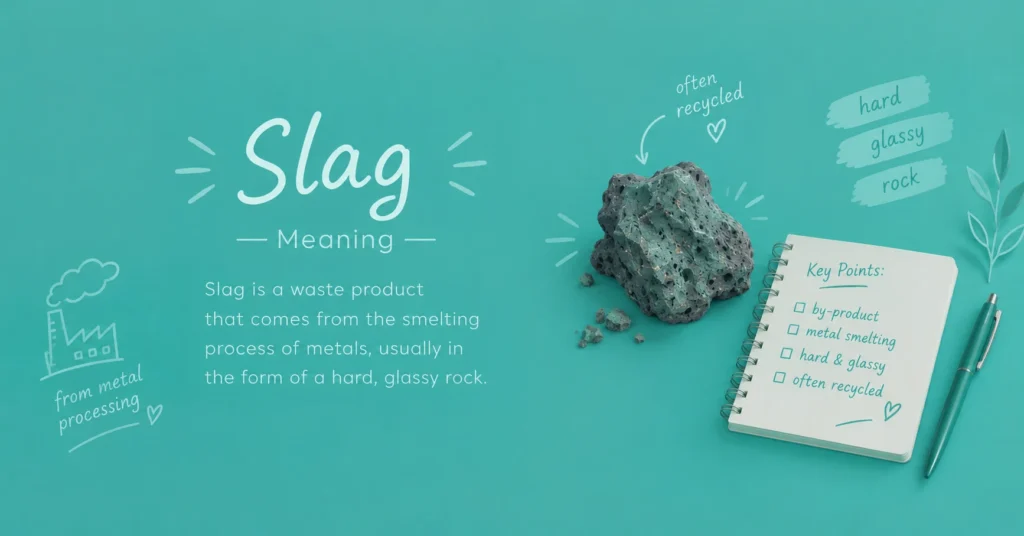
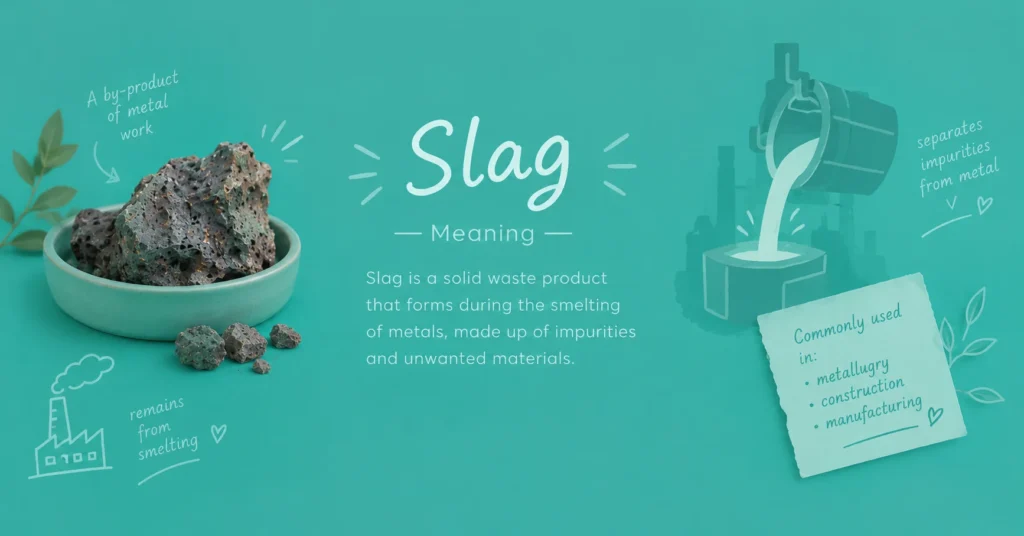
In American English, the established technical meaning of slag is waste material separated from metal during smelting or refining. It can also refer to certain volcanic materials and coal-processing waste. In metallurgy, slag forms when unwanted mineral components combine with a flux during processing.
Imagine a steel plant heating and processing metal ore. As the material is refined, unwanted components separate from the desired metal and form a molten or solid byproduct called slag. Although it is commonly described as waste, some types can be processed for useful applications, depending on their composition and safety characteristics.
What is slag in metalworking?
In metalworking, slag is a nonmetallic material produced during processes such as smelting. It may contain compounds formed from impurities in the ore, flux, and other components involved in refining. Its composition varies with the metals and processes used.
Slag can float above molten metal, helping separate unwanted materials during certain operations. After cooling, it may become a solid, glassy, or rock-like substance. Engineers and metallurgists study its properties because composition, temperature, and processing conditions affect how it behaves.
Is slag the same as waste or cinder?
Not exactly. Waste is a broad term for discarded material, while cinder usually refers to a residue associated with burning. Slag has a more specific meaning in metal processing, although dictionaries sometimes list cinder as a related or alternative term.
The words may overlap in some descriptions, but they are not always interchangeable. In a technical report about a furnace, slag identifies a particular byproduct. In everyday conversation, someone may use a broader word such as waste or residue instead.
Can slag have other meanings?
Yes. Dictionaries also record slag for volcanic scoria, a rough material associated with volcanic eruptions, and certain types of waste from coal mining. These meanings are less likely to be relevant when someone uses the word as an insult.
For example, a geology text might describe dark, porous volcanic material, while a mining report might discuss a pile of mineral waste. Neither use has the interpersonal meaning associated with British slang. Looking at the subject of the conversation usually makes the intended definition clear.
Slag Off Meaning and Related Word Forms
The expression “slag off” is informal British English meaning to criticize, insult, or speak negatively about someone or something. In this construction, slag functions as a verb. The expression is different from calling someone “a slag,” which uses the word as a noun.
For instance, “Stop slagging off my favorite team” means “Stop criticizing my favorite team.” Similarly, “They were slagging off the movie” means they were speaking negatively about it. These examples demonstrate why the word’s grammatical role matters as much as the context.
What does slagged off mean?
Slagged off is the past-tense form of slag off. It describes criticism or verbal disparagement that happened in the past. If someone says, “My coworkers slagged off the new policy,” they mean the coworkers criticized the policy, usually in an informal or negative way.
The phrase is particularly useful to recognize in British television, interviews, podcasts, and everyday conversation. It does not automatically mean that the criticism was false; it describes the act of speaking negatively. The severity depends on what was said and how it was delivered.
What do slagging and slagging off mean?
Slagging is the -ing form of the verb. It may appear in sentences such as “They are slagging off the referee” or “He keeps slagging off the new manager.” Both examples describe ongoing or repeated criticism.
The noun slagging can also refer to an episode of criticism or verbal abuse. Do not confuse these verb forms with the offensive noun used to insult a woman. Although the words share a spelling, their grammatical function and meaning differ.
Slag versus slag off
| Expression | Meaning | Example |
| A slag | An offensive British insult, often directed at a woman | “He used a derogatory word.” |
| Slag off | To criticize or insult someone or something | “They slag off the referee.” |
| Slagged off | Criticized or insulted in the past | “She slagged off the decision.” |
| Slagging off | Criticizing or insulting | “He is slagging off the film.” |
| Industrial slag | Material produced during metal processing | “The plant removed the slag.” |
The most useful distinction is between the noun used as an insult and the verb phrase describing criticism. If you remember that difference, you can interpret many sentences without confusing their meanings.
Slag Meaning, Pronunciation, and Word Origin
The word slag is pronounced /slæɡ/, with a short vowel similar to the vowel in flag or bag in many English accents. It is a single syllable, so the pronunciation is straightforward even though its meanings vary across regions and contexts.
Its technical history goes back to the sixteenth century. Oxford traces the word to Middle Low German slagge and notes a possible connection with a word meaning “strike.” The insulting noun was recorded later, while the verb meaning “criticize” dates to the twentieth century.
Where does the word slag come from?
The industrial word originally referred to residue produced during metalworking. Etymological sources connect it to Germanic vocabulary associated with fragments or material separated when metal is struck or processed. The exact historical relationship between the industrial term and later insulting slang should not be overstated.
Dictionary entries document the different senses and their historical development, but they do not establish that every modern slang use developed directly from the industrial process. For readers, the important point is that the word has a long history and acquired different meanings over time.
Is slag an American or British word?
Slag is used in both American and British English, but the meanings differ in prominence. In American English, the industrial definition is well established. The insulting noun and the expression slag off are chiefly associated with British slang.
An American viewer might encounter the slang meaning while watching a British television series or reading comments from UK users online. Conversely, a British reader might see the technical meaning in a science or engineering article. Neither use is necessarily incorrect; each reflects a different context.
Slag Meaning in Everyday Examples
Examples are one of the easiest ways to learn the difference between a word’s meanings. Compare a conversation about a person with a technical report about a factory. Although both contain slag, the subject and sentence structure tell you whether the word is being used as slang or as a technical noun.
Here are original examples illustrating the main uses. The slang examples are included to explain the language, not to endorse the insult.
| Example sentence | Meaning |
| “He called her a slag during the argument.” | An offensive British insult |
| “Please stop slagging off my favorite singer.” | Stop criticizing the singer |
| “The team was slagging off the new rules.” | The team was criticizing the rules |
| “The furnace produced slag during refining.” | A metal-processing byproduct |
| “The geology report described volcanic slag.” | A volcanic material or scoria |
| “The workers cleared the slag from the production area.” | Industrial residue |
What does slag mean in a text message?
In a text message, slag may be an insult, while slag off usually means to criticize or talk negatively about someone or something. A message such as “Why are you slagging me off?” means “Why are you criticizing or insulting me?”
However, a single word in a message may not reveal the speaker’s complete intention. The previous messages, relationship between the people, and tone of the conversation can provide important clues. If you are unsure, asking the sender what they meant is better than assuming the worst.
How should you respond if someone calls you a slag?
If someone directs the insult at you, you do not have to accept it as a joke. You can calmly say that the language is disrespectful and ask them to speak to you differently. If the conversation feels threatening, it is reasonable to disengage or seek support.
If you are simply reading a book, watching a show, or studying British English, recognizing the word is enough. Understanding an offensive expression does not mean you need to repeat it. In professional, academic, and respectful everyday communication, more neutral wording is usually preferable.
Conclusion
The slag meaning depends on how and where the word is used. It can refer to industrial residue produced during metal processing, but in British slang it is also an offensive insult. The related expression slag off means to criticize or speak negatively about someone or something.
If you encountered the word in a message or British television show, pay attention to the sentence and surrounding conversation. If it appears in a technical article, the industrial meaning is more likely. Understanding these distinctions helps you interpret English accurately without accidentally using an insulting expression.
FAQs
Author

Ethan Carter is an SEO blogger specializing in internet slang, text abbreviations, and social media meanings. He creates clear, accurate, and reader-friendly content backed by thorough research. His goal is to help readers understand modern online language with reliable, easy-to-read guides.